by Julia Felton | Aug 11, 2026
More than 95% of businesses turning less than $25 million in revenue run without a budget or a forecasting model. That figure comes from David Guttman, a three-times Inc. 500 entrepreneur who has worked across 45 different industries and delivered multiple eight- and nine-figure exits. He finds it breathtaking. So do I, because the gap it exposes has very little to do with spreadsheets. When nobody in your business can see where the business is heading, you cannot reasonably expect them to own the outcome.
That tension sits at the centre of this week’s episode of Impactful Teamwork, where David and I unpick why servant leadership consistently outperforms the command-and-control model that still dominates most C-suites.
Servant leadership starts where ambition runs out
At 24, three separate doctors misdiagnosed David with terminal cancer and gave him six months to live. He had just secured a place at Wharton. He had an Ivy League degree, a paper fortune, and a plan for every year of the decade ahead. Then he had nothing.
Ask him at 24 whether he was happy, and he would not have understood the question. The misdiagnosis did not make him softer. It made him externally focused. He decided to let success become the side effect rather than the goal, and it arrived faster than it would have done otherwise.
Leaders reach that realisation through very different doors. Mine came during the Enron collapse at Arthur Andersen, when I understood that the company was never going to look after me. The lesson lands the same way regardless of the route. You cannot build something durable while you are the only person it serves.
Put your coworkers first and everything else follows
Most executives assume their fiduciary duty runs to the company first and their people second. David argues the reverse, and I agree with him. Look after your coworkers, and they will look after your customers, your investors, and your valuation.
He refuses to use the word employees, which delighted me, because you employ somebody in order to use them. The language gives the game away.
Think about the two managers you have worked for: the one who genuinely cared about you, and the one who could not have cared less. Which one got your best work? Self-motivated people produce good work for a leader who ignores them. They produce their best work only for a leader who demonstrably cares, and nobody can fake that.
Hire for humility and curiosity, then act fast when you get it wrong
David has hired and fired well over a thousand people. He named humility and curiosity as the two qualities that matter most, by galaxies, and he will decline a highly capable candidate who lacks either one.
Both qualities are choices rather than accidents of birth, which makes this genuinely useful. Every three-year-old asks why relentlessly. Our education system tends to beat that out of us, yet anyone can reactivate it at any age.
Then came the line that stopped me. Across a 35-year career, David has never once regretted firing someone he suspected he should fire. Not 90%. Not 95%. One hundred per cent, with zero exceptions.
I know how expensive the alternative is. I once kept somebody whose CV was flawless and whose cultural fit my intuition flagged from the first interview. I ignored the signal, protected my ego, and kept trying. My team eventually told me they would all leave unless I acted. That is a humbling place to stand.
Intuition is not mysticism. As David put it, intuition is your nervous system’s pattern-matching ability doing its job. Leaders who disconnect from it pay for the privilege.
Share the numbers, share the equity, share the ownership
This is where servant leadership stops being a sentiment and becomes an operating system.
David insists that everyone in the business can read an income statement, which he can teach in roughly fifteen minutes. He runs quarterly board meetings even in small companies. The week after each board meeting, he delivers the identical presentation to the entire company, because he serves his coworkers exactly as he serves his shareholders.
He also gives equity to everyone whenever the decision sits with him. His argument disarms even the most reluctant founder. Set aside 10% of the equity for your people and that 10% will increase your exit value by more than 10%. Generosity happens to be the greedy choice as well as the right one.
The mechanism is simple. Once it stops being the company’s money and starts being their money, people make different decisions. They stop ordering the phone they do not need. They start bringing you ideas, and some of those ideas are better than yours.
Core values only work when the team writes them
David builds two sets of core values in every business he runs: four internal values that govern hiring, promotion and reward, and four external values that filter products, partners and suppliers. Four, because nobody remembers more than four.
Crucially, the team creates them together. He then awards a trophy for each internal value, and the recipient chooses who receives it next quarter. They cannot give it to their boss or to their own department. For three months, everybody watches for the behaviour they claim to value.
That is co-ownership made operational, and it is the difference between a team that cooperates and a team that co-owns.
Servant leadership is not softness
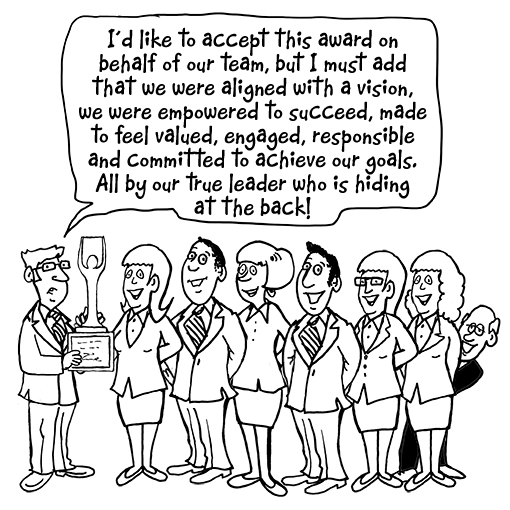
People assume the servant leader is a pushover. David holds everyone rigorously accountable, himself first. He deflects credit outwards and absorbs blame inwards, because every failure traces back to a decision he made about hiring, resourcing, training or strategy.
The alternative produces the bottleneck I see in almost every business I work with. Leaders who cannot delegate decisions hire and promote people who will not make them. Everything escalates upwards, the owner’s desk becomes the constraint, and growth quietly stalls.
Listen to the full episode
David and I covered considerably more than fits here, including his Anti-MBA course and why he tore up his Wharton diploma live on air. Listen to episode 123 of Impactful Teamwork on Spotify, Apple Podcasts, YouTube, or on the Business HorsePower website.
Show Notes
00:45 Meet Dave Guttman
01:57 Cancer Wake Up Call
03:24 Servant Leadership Basics
07:10 Relationships Build Loyalty
08:56 Hire Right Fire Fast
12:00 Humility Curiosity Gen Z
14:53 Assume Positive Intent
17:24 Radical Transparency Trust
19:37 Scaling to Exit Playbook
22:13 Equity Budgets Core Values
28:03 Decision Making Culture
32:13 Servant Leader Accountability
33:53 Anti MBA Offer
35:24 Final Challenge Outro
You can connect and learn more about Dave’s work here – https://www.linkedin.com/in/drguttman/

by Julia Felton | Aug 4, 2026
There is a moment in a horse’s canter when all four feet leave the ground and the animal hangs, for a fraction of a second, entirely unsupported. Riders call this a flying lead change, and it is what a horse does when the ground beneath it changes shape and the balance it has been relying on no longer serves. To turn, it must let go of the leg it has been leading with, commit to a moment of free fall, and land leading with something else entirely.
I cannot think of a better description of where most leadership teams find themselves at this moment in time.
That metaphor belongs to Kelly Wendorf, and she is my guest on the latest episode of Impactful Teamwork. Kelly is the founding partner of EQUUS, an equine-inspired leadership organisation based at Buffalo Spirit Ranch in Santa Fe, and the author of Flying Lead Change: 56 Million Years of Wisdom for Leading and Living. I have been reading her work for years, and it was a genuine pleasure to unpack it with her.
Disruption is not the problem — it is the mechanism
Kelly brings the adaptive cycle into this conversation, a framework biologists use to describe how living systems evolve. It runs through four stages — new beginnings, growth, consolidation, and endings or letting go — and every species moves through it repeatedly.
What is worth pausing on is that the thing which turns the cycle is disruption. Summer does not become autumn because the trees decide it is time; the light shifts, the temperature drops, and the leaves fall. Disruption is the catalyst rather than the catastrophe. As Kelly puts it, the species that respond differently evolve, and those that carry on exactly as before do not survive.
Which raises an uncomfortable question for those of us leading through climate volatility, artificial intelligence and a workforce that is quietly exhausted. The topography has changed, so are we willing to leave the ground for a moment in order to land differently, or will we keep cantering on the same lead and hope the corner never arrives?
Why the horse is worth studying
Kelly makes a case for horses as a leadership model grounded in longevity rather than sentiment. The horse has existed for around fifty-six million years, surviving tectonic shifts, climate spikes and the arrival of humanity. Of all the species that have ever lived, roughly one per cent remain, and the horse is one of them.
So if you are asking how to build an organisation that lasts five hundred years rather than twenty, the sensible thing is to study something that already knows how. Kelly’s work points towards horse culture resting on five core premises: safety, connection, peace, freedom and joy. The lead mare earns her position not through dominance or force, but through her ability to keep those five conditions intact for the herd, and she does it through care and presence.
Hold that list against your own leadership team for a moment. Are your people genuinely connected to one another, or merely engaged with the same set of tasks? Do they have real choice? Is there any joy in it at all? Those five things are precisely what every team member is quietly asking for, whether or not they have the language to say so.
Care and presence are not soft skills
Both Kelly and I get rather animated on this point, and I make no apology for it. Care, as she describes it, is robust; it has strong boundaries, and it has teeth and hooves when the situation requires them. What it does not have is the performance of authority that so many organisations mistake for leadership.
Her argument is that the power-over model is comparatively recent, emerging perhaps six thousand years ago, and that it is a distortion rather than an inevitability. She also points out that the word appearing most often in Darwin’s research was not competition but love.
The messy middle, and why leaders lose their nerve
The part I suspect will land hardest is what happens when a leader actually commits to changing direction. First comes tribal shaming, a phrase coined by Dr Mario Martinez, which is the predictable reaction of a group whose primitive wiring feels threatened by someone doing things differently. Then, after the letting go and before the new beginning, comes what Kelly calls the messy middle.
This is the snake shedding its skin, and it is not pretty. Things get tumultuous, people get frightened, and the leader who initiated the change is suddenly answering for the mess. What separates those who make it through from those who quietly revert is whether one person understands the cycle well enough to say, with conviction, that this is exactly where we are meant to be.
Rewilding is not reinvention
We close on rewilding, a word we both use and which is rapidly being flattened into a meme. Kelly’s definition is the clearest I have heard: rewilding is not about becoming wild, because we already are. It is about dismantling the fences and inherited constraints that keep us from our intuitive, creative and adaptive selves. A returning, rather than a building.
You can find out more about Kelly’s retreats and online courses at equusinspired.com, read her monthly essays at equusinspired.com/essays, and pick up her book Flying Lead Change at equusinspired.com/flc.
There is far more in the episode than I can do justice to here, including Kelly’s account of how the horses effectively refused to let her ignore this work. My invitation to you this week is simple: choose one of the five principles — safety, connection, peace, freedom or joy — and ask yourself honestly whether it is intact for your team right now. Then tell me which one you chose, because I would very much like to know.
Show Notes
00:50 Meet Kelly Wendorf
01:58 Calling And Origins
05:01 Coaching With Horses
06:47 Service And Adaptability
10:08 Presence Over Engagement
11:58 Adaptive Cycle Explained
14:34 Flying Lead Change Metaphor
19:22 Horse Culture Principles
22:20 Care Over Dominance
23:14 Darwin and Power With
24:49 Trauma Shifted Leadership
26:30 Care Is Not Soft
27:36 Regenerative Business Model
29:57 Courage to Change
31:26 Messy Middle Cycle
35:26 Rewilding Leaders Defined
38:25 Book and Next Steps
You can connect to kelly on LinkedIn here and on her website here.

by Julia Felton | Jul 28, 2026
Global employee engagement has fallen to twenty per cent. Gallup has never recorded a lower figure, it has now declined for three straight years, and not one region of the world went up. That statistic circulates so widely it has lost its power to alarm anyone. So let me give you the one underneath it. Manager engagement dropped from thirty per cent to twenty-two per cent in two years. The people holding your organisation together in the middle have quietly stopped holding it, and Gallup attributes seventy per cent of a team’s engagement variance to its direct manager. This is not a wellbeing statistic. It is a performance forecast.
Into this environment, almost every organisation I speak to is introducing artificial intelligence on the assumption that it will help. It will, though not in the way most leadership teams expect. AI does not fix culture. AI amplifies culture. Whatever your organisation already organises itself around, you are about to get more of it, and faster. I make that argument in full in the latest episode of Impactful Teamwork.
The Four Levels Of Culture
I recently spent an hour in a session run by Peter Matthies of the Conscious Business Institute. It gave me a cleaner language for something I have watched in leadership teams for years. After fifteen years of building culture inside organisations, his team could not find a systematic approach to it anywhere, in the consultancies or in the literature. So they built one. The result is four levels, and each describes what an organisation fundamentally organises itself around.
Level One: The Output Culture
The overwhelming majority of organisations sit here. An output culture chases results, measures everything externally and answers only to financial return. It operates as a machine rather than an organism. Processes matter, and people become replaceable components.
Which is precisely why an output culture and current AI make such a perfect match. Machine learning excels at producing more, so drop it into a culture whose organising principle is already volume and you do not get transformation. You get acceleration towards exhaustion. If burnout rises at the same time as output, those are not two lines on the chart. They are the same line.
Level Two: The Intention Culture
Here, purpose and judgement lead rather than volume. AI becomes a collaborator, because a human intelligence now sits above it deciding what to amplify. IKEA offers the cleanest example I know. They replaced around eight and a half thousand customer service representatives with AI, then retrained those people as interior design advisors rather than letting them go. Most leadership teams reading their own strategy documents believe they already operate here. Very few actually do.
Level Three: The Human-Centric Culture
This is where the real shift happens, and it is a shift in belief rather than strategy. The human moves into the centre, not alongside the numbers but in place of them. The leadership team must genuinely hold the conviction that results follow when they do this. Most attempts at culture change collapse right here, because the leader announces that people come first and then reverts to output language the moment the quarter looks difficult. Staff receive two contradictory messages. They conclude, correctly, that the first one was decorative.
Level Four: The Higher Purpose Culture
This level connects to something larger than the organisation, and it leaves space for what nobody has created yet. The commercial argument has nothing to do with idealism. AI can only draw on what already exists. Every competitor now holds the same models, and those models only know the past. One durable advantage remains. That advantage is the capacity to originate. It is human, it is fragile, and it needs precisely the conditions an output culture destroys.
Where The Horses Come In
This is the territory my horses work in. A horse has no interest in your title, your track record or your executive presence, and reads only what stands in front of it. So the gap between who a leader performs to be and who they are becomes visible within seconds.
I worked with a chief executive who spent a long stretch of time trying to catch a horse. The horse had no intention of cooperating. His leadership team watched the whole thing. Months later, when he still pushes too hard for an outcome that will not move, they have a shorthand for it. Someone says lightly: Steve, you are having a Cafe moment. That is honest upward feedback to a chief executive, and it carries no threat, needs no process and costs nothing. Psychological safety starts in a field and travels back into the business. That is not a wellbeing initiative. It is a commercial asset.
The Job Is Not To Live At Level Four
Most people miss one point when they meet a four-level model of anything. The leader’s job is not to relocate to level four. It is to hold the balance across all four. Work still needs delivering, and judgement still needs applying.
The centre of gravity in nearly every organisation sits at level one, and it will not correct itself while everyone stays busy. Nor does culture descend from the org chart. Seventy per cent of engagement variance sits with the direct manager. Every manager in your business runs a culture right now, and most of those cultures bear no resemblance to the one on your wall.
Which Culture Are You About To Amplify?
So here is the question I would leave you with. If AI amplifies whichever culture you already run, what exactly are you about to make more of? And would your people give the same answer you just gave?
The full conversation sits in the latest episode of Impactful Teamwork, where I take each of the four levels apart and set out three things to do about it on Monday morning. That includes why modelling the values you want falls short, and what to do instead. Listen to the episode here.
If you want to know which culture zone your leadership team genuinely occupies, take the Turbo Charge Your Team audit. You will find it at businesshorsepower.com/quiz. It is considerably more useful than another engagement survey.
If you want to know which culture zone your leadership team genuinely occupies, take the Turbo Charge Your Team audit. You will find it at businesshorsepower.com/quiz. It is considerably more useful than another engagement survey.
Show Notes
00:46 Engagement Crisis
02:27 AI Amplifies Culture
03:44 Four Culture Levels
06:19 Level One Output
10:29 Level Two Intention
13:37 Level Three Human Centric
16:19 Horses Reveal Truth
19:32 Level Four Higher Purpose
23:06 Leading Across Levels
25:47 Three Culture Shifts
29:22 Purpose Driven Turnaround
31:29 Final Questions Next Steps
32:46 Closing Thanks

by Julia Felton | Jul 21, 2026
Business energetics is the reason two leaders can say and do almost the same things, yet get completely different results from their teams. I explored this exact idea this week with Jean Walters, a personal growth consultant and seven-times Amazon best-selling author. Energy and metaphysics can sound, to a lot of leaders, like subjects for a wellness retreat rather than a boardroom. I used to think so too. Nearly fifteen years ago, when I was building a business unit inside the corporate world, nobody talked about energy. If you had raised it in a leadership meeting, you would have been quietly filed under “hippie” and never invited back. However, the more I have worked with teams, and the more time I have spent around horses, the more convinced I have become. Energy is not a soft add-on to leadership. It is the thing leadership is actually made of.
Why Business Energetics Is Not the Soft Stuff
Jean put it more plainly than I ever have. You cannot get away from the universal laws, so you may as well know how to use them. Whether you believe in metaphysics or not, everyone in your business is walking around radiating a mood. That mood is either building your people up or wearing them down.
For example, Jean told me a story about a woman who was warned by her doctor that she would need a second liver transplant within the year. The reason was simple: she had been carrying anger and negativity for years. Sitting in the same waiting room was another woman on her fourth transplant, someone who complained constantly and saw the worst in everything. The first woman took note. She decided to change how she showed up, and returned twelve months later needing no transplant at all. I found that story genuinely startling. Not because it proves some mystical point, but because it illustrates something we already sense intuitively: what we carry inside us does not stay inside us. It leaks out, into our bodies, our teams, and our households.
The Mission Statement Nobody Can Recite
This is where the conversation moved somewhere I think every leader needs to sit with. Jean asks every business owner she works with the same opening question: tell me your mission statement. Almost without fail, the answer is some version of, “it’s on the wall, but that’s about it.” We have all seen it: values printed on the breakroom poster that nobody could recite if you stopped them in the corridor.
Importantly, the trouble is not that the words are wrong. Instead, the trouble is that a mission statement said once and then laminated is not the same as one that is lived, repeated, and felt. Your team needs to hear it, see it enacted, and experience it in more than one form before it becomes real to them. Otherwise, you are the leader standing at the front convinced everyone is aligned, while your team is quietly doing something else entirely.
Attention Is the Real Currency of Leadership
What struck me most, and what ties so closely to the work I do with horses, was Jean’s insight about attention. She talked about walking into someone’s office, noticing the baseball memorabilia on the shelves, and using that as the way into a working relationship with him. Rather than trying to make him relate to her interests, she met him in his. It sounds almost too simple to matter. And yet, how many leaders actually slow down enough to notice what their people care about, let alone use it?
What My Horse Knew Before My Team Told Me
I shared with Jean my own version of this lesson, learned the hard way. There was an entire summer when I could not catch my own horse. My energy was so focused on what I wanted from him that I had built no relationship at all. Months later, I discovered my team felt exactly the same way about me: scary, intimidating, too focused on the task to be approachable. My horse had been telling me the truth the whole time. I simply did not have the language yet to hear it.
The Ripple Effect You Take Home With You
That is really the heart of what Jean and I explored together: the idea that we are all creating a ripple effect, whether we mean to or not. That ripple travels further than we think. It moves from the leader to the team, from the team member’s day at work into their evening at home, and from there into how they treat the people they love.
Jean’s point about responsibility was the one I keep returning to. We live in a culture that is quick to blame, and quick to decide someone else is the difficult one. We are much slower to ask what we ourselves are bringing into the room. For instance, Jean shared an example of an employee who chose forgiveness toward a difficult boss, rather than resentment. As a result, the entire dynamic shifted. It is a reminder that we are rarely as powerless in these situations as we feel.
Listen to the Full Conversation
There is a great deal more in this business energetics conversation than I can fit into a single blog post. Jean shared an exercise for sceptics who cannot get their head around energy at all, her thoughts on why rejection is almost never personal, and a generous offer of three free chapters from her book, The Journey from Anxiety to Peace, available on her website.
If any of this has struck a chord, whether it is the mission statement gathering dust on your wall or the ripple effect you might be sending home with you tonight, I would love for you to listen to the full episode. Settle in with a cup of tea, take note of what lands for you, and then tell me on LinkedIn which part challenged you most. If you would like to explore how business energetics shows up inside your own leadership team, take a look at our Unbridled Teamship Roadmap or get in touch directly. Your team, and quite possibly your horse, will thank you for it.
Show Notes
00:45 Meet Jean Walters
01:46 Business Energy Basics
03:54 Mindset And Health Story
06:01 Proving Energy To Skeptics
08:29 Grounded Leadership In Chaos
09:27 Mission And Employee Strengths
13:49 Ego Free Hiring And Appreciation
17:47 Avoiding Negativity And News
19:16 More Engagement Strategies
20:05 Rejection Proof Selling
21:29 Know Your Audience
22:29 Leaders Build Relationships
23:22 Forgiveness Changes Dynamics
25:32 Responsibility Over Blame
26:35 Ripple Effect Leadership
27:41 Horses Reveal Energy
31:22 Growth Through Polarity
33:36 Connect and Free Chapters
35:24 Final Takeaway Reflection
You can connect to Jean on LinkedIn here and on her website here.
by Julia Felton | Jul 14, 2026
Sixty-five per cent of leaders would rather appear decisive and get it wrong than admit uncertainty and get it right. Read that number twice. It means two out of every three leaders you work with — maybe including you — will choose to look good over being right.
I didn’t invent that statistic. New research from Sam Conniff and Katherine Templar Lewis at Uncertainty Experts found it, studying over a thousand leaders across every sector and seniority level. The ratio holds regardless of gender. This isn’t a story about one bad boss. It’s a story about a system that has trained good leaders to fear the wrong thing.
At the same time, a separate piece of research landed in Forbes this month, arguing that visibility has become the new credibility for senior leaders. Doug Melville pointed to conversations at Cannes about C-suite leaders needing to show up more like influencers. Not for vanity — because clients, employees, and investors no longer want to hear only from brand voices. They want to know what the people running the business actually think.
Sixty-five per cent of leaders would rather appear decisive and get it wrong than admit uncertainty and get it right. Read that number twice. It means two out of every three leaders you work with — maybe including you — will choose to look good over being right.
Put these two findings side by side and you’ll spot the contradiction immediately. We’re asking leaders to be more visible than ever, at the exact moment most of them dread letting anyone watch them get something wrong.
That isn’t a communications problem. It’s a credibility problem, and it sits at the heart of this week’s episode of Impactful Teamwork.
Invisibility never reads as neutral
For decades, senior leaders learned to communicate only after polishing, approving, and perfectly timing every message. The CEO spoke through the annual report. Layers of review handled everything else.
That era is ending, and it’s ending because silence no longer buys leaders safety. When you go quiet, your people don’t assume you’re being careful. They fill the gap with assumptions, and they read your absence as avoidance.
Rob Schwartz, former CEO of TBWA Chiat Day, makes the sharpest point in the Forbes piece: the best CEOs are the best storytellers in the company. Not because storytelling is decoration. Because a story differs from a speech — a speech sounds rehearsed, a story sounds human, and your team can tell the difference in seconds.
Why your brain treats “I don’t know” as a threat
Here’s where it gets interesting. If honest, imperfect visibility builds more trust than polished distance, why do 65% of leaders still choose the performance of certainty over the substance of being right?
Because your brain doesn’t treat uncertainty as neutral information. It treats uncertainty as danger. Leadership writer Marlene Chism draws a distinction I find genuinely useful here. Uncertainty says “I don’t know.” Shame says “it’s wrong that I don’t know.” The moment shame enters the room, you stop operating from curiosity and start operating from protection. You delay decisions to avoid exposure. You shut down input before it can surface the gap you’re already afraid of.
This pattern isn’t just something I’ve read about. I’ve lived it. During the collapse of Arthur Andersen in the Enron scandal, I led a team in real time while every instinct told me to project total composure. I remember standing in front of a room knowing the honest answer was “I don’t fully know what happens next.” Instead, I reached for something more polished, because polished felt safer.
It wasn’t safer. It was just quieter. And everyone else fills that quiet with their own assumptions, same as they always do.
The horse herd never performs certainty it doesn’t have
I watch this same dynamic play out constantly in the work I do with horses, because a horse herd cannot fake confidence. It has navigated uncertainty for millions of years without one animal issuing instructions from the front. Instead, it relies on shared leadership and constant, collective awareness. Attention rotates to whichever horse is best placed to read what the moment actually demands.
Try performing certainty you don’t feel in front of a horse. It won’t work. The herd reads your body, not your job title, and it responds to what’s actually true rather than what you’re projecting. Leadership teams work exactly the same way. They’re just better at hiding it, for a while.
This is a teamship problem, not a personality problem
Here’s the reframe I want to leave you with, because I don’t think this is fundamentally about courage or communication skills. I think it’s about teamship.
When you perform certainty you don’t have, you’re not just managing your own reputation. You’re training your entire leadership team on what’s allowed in the room. If you can’t say “I’m not sure,” nobody beneath you will say it either. Individuals quietly absorb every unresolved question in the business instead of surfacing and sharing it. That’s cooperation, not co-ownership — everyone nods in the meeting, and nothing moves between meetings.
Teamwork is something people do. Teamship is something a group becomes, and a leadership team cannot become anything together while only its leader has permission to look uncertain.
Where to start this week
Find one live decision right now where you genuinely don’t have the full picture, and say so out loud, before you’ve resolved it. Not as a confession — as an invitation. “Here’s what we don’t know yet. Let’s think this through together.”
Then watch what happens to the room.
This week’s episode of Impactful Teamwork goes deeper into both pieces of research. It covers the 74% of transformation programmes that fail because of uncertainty-driven resistance, plus what the data reveals about the 35% of leaders who resist certainty theatre altogether. Listen wherever you get your podcasts, or catch it on the website.
So here’s the question worth sitting with before you listen. The next time someone on your leadership team says “I don’t know” — does the room go quiet in a bad way, or does it lean in?
Show Notes
03:14 Visibility Is Credibility
07:03 Imperfect Presence Builds Trust
10:57 The Decisiveness Crisis
13:46 Shame And Certainty Theater
16:56 Where Research Meets Reality
19:02 Teamship And The Horse Herd
20:39 Make Uncertainty Safe
21:58 Weekly Challenge And Close
23:51 Final Takeaways And Next Steps
by Julia Felton | Jul 7, 2026
Leaders today are not struggling to make bad decisions. They are struggling to make any decision at all. I have spent years working with senior leadership teams, watching the same pattern emerge across organisations of every size and sector. What I see with increasing frequency is not recklessness or poor judgement at the top. It is paralysis. Decision fatigue is quietly dismantling the effectiveness of leadership teams, and the cost is far greater than most organisations will acknowledge.
In this latest episode of the Impactful Teamwork podcast, I joined forces with Carrie Gallant, host of The Tall Poppy Revolution Radio Show. Together we explored decision fatigue, emotional intelligence, energy, intuition, and the culture conditions that either enable or destroy a team’s capacity to decide. What emerged was a candid, commercially grounded dialogue about one of the most pressing and least-discussed challenges facing leadership teams right now.
When the Leader Stops Deciding, Everyone Pays
The most expensive decision in any organisation is often not the wrong one — it is the one nobody ever made. When the sheer volume and velocity of decisions presses down on leaders, many do not prioritise or delegate. They simply stop. And when the person at the top stops deciding, the entire organisation stalls with them: suppliers wait, customers grow impatient, and team members — already aware that something is wrong — disengage further.
The Gallup data tells us that only around 20% of employees are fully engaged at work. The majority show up in body only, moving through their days without genuine investment in outcomes. And the leaders who abdicate their decision-making authority — however unwittingly — drive that disengagement significantly. When people cannot see the rationale behind a decision, feel no ownership of the direction, and watch their leader defer and delay, they stop bringing their full intelligence to the table. They become, as I described in our conversation, a bit like someone walking through the day with a blindfold on.
No Decision Is Still a Decision
One of the sharpest insights from this conversation with Carrie was the reminder that inaction is not neutral. Not making a decision is itself a decision — the decision to abdicate power, to hand agency over to circumstances, to let the situation resolve itself by default rather than by design. I have seen this play out in teams where a leader avoided a difficult people decision for months. Tensions built beneath the surface. What began as a manageable conversation became a structural rupture that consumed months of leadership time and energy to repair.
The instinct to avoid a decision usually comes from fear — fear of getting it wrong, fear of conflict, fear of being visible and accountable when economic conditions already feel precarious. Yet avoidance does not eliminate the fear. It compounds it. And it sends a clear signal to the team: if the leader does not trust their own judgement, why would anyone else trust theirs?
Decisions Are Emotional. That Is Not a Weakness.
For decades, the dominant assumption in business was that good decision-making was rational. That logic provided the correct filter and emotion was interference to manage and suppress. Neuroscience has now comprehensively dismantled this view. We now know that emotion shapes virtually every decision we make, with logic arriving later to provide the rationale. This is not a design flaw — it is how human cognition actually works. The question is not whether emotions influence your decisions, but whether you notice them and factor them in deliberately.
This matters enormously for leaders. A team member who carries mixed feelings about a direction but has never voiced them will not bring full commitment to its implementation. Carrie’s work confirmed what I observe in the field consistently. When people feel heard in the process — when the decision feels fair and considered rather than imposed — they will often support an outcome they never personally argued for. The process itself builds the trust. The 2010 Vancouver Olympics illustrates this precisely: a divisive, high-stakes decision that became a city-wide rallying point because the consultation process gave people genuine voice.
Intuition Is Not Soft. It Is Inner Tuition.
During our conversation, I shared something that a Canadian equine teacher once passed on to me, and that has stayed with me ever since. If you break the word intuition into its two component parts, you get in and tuition — inner teaching. Your intuition is not a vague feeling or a mystical sense. It is your inner knowing: the accumulated intelligence of everything you have observed, learned, and processed, operating below the threshold of conscious thought.
Most leaders live almost entirely in their heads. Embedded in analysis, in the next meeting, in managing their own anxiety, they effectively sever the connection to that inner intelligence. I have made that mistake myself. I once hired someone who met every logical criterion for the role. My gut told me clearly it was wrong. The hire was a disaster — and it cost my team significant time and emotional energy. The data from the competency framework was right. The somatic intelligence I ignored was righter.
What the Horses Know About Undecided Energy
The horses I work with at Business HorsePower are not training props. They are diagnostic instruments, and they detect the energy of indecision with a precision no coaching tool can replicate. A horse whose leader carries an uncertain internal state will simply stop. It does not experience confusion — it accurately reads the signal it receives and responds honestly. During our conversation, Carrie described exactly this dynamic. She was leading a horse at liberty — no rope, no halter — when someone asked her a question mid-exercise. Her internal state became unclear for a moment. The horse stepped directly in front of her and refused to move.
This is not a quirk of equine psychology. It is a precise mirror of what happens in organisations. Team members read the energy of their leaders constantly. A leader whose internal state broadcasts uncertainty — even when the words say otherwise — will find that the team slows, second-guesses, and waits. The horses show this dynamic with an immediacy and an honesty that no 360 feedback process can match. And once a leader has experienced it in the field, they cannot unsee it at the board table.
The Culture That Makes Decisions Possible
The structural solution to decision fatigue is not for leaders to become faster or bolder individually. It is to build culture conditions that distribute decision-making appropriately across the organisation. Leaders make the decisions only they can make. Teams take the decisions they are closest to. When JFK walked through NASA and asked the janitor what his job was, the answer stopped him cold. “To put a man on the moon.” That was not just inspirational. It was evidence of a culture where every person understood their role and the authority they carried within it.
The concept I call “reward the try” is central to this: create an environment where team members know their leader will back a thoughtful decision that does not go to plan, not punish it. When people know their leader has their back, they decide. When they do not, everything escalates upward. The leader becomes the bottleneck — overwhelmed, isolated, and unable to focus on the strategic work that only they can do. This is the pattern I see most consistently in teams operating in what I call the Turbulent or Tolerable culture zones. The gap between their potential and their actual output is significant — and it is growing.
Listen to the Episode
This conversation covers far more than any blog post can contain. Carrie and I explore Human Design as a framework for understanding your own decision-making style, the role of stillness in accessing intuition, and the neuroscience of flow state — which arrives only after we step away from the very problem we are trying to solve.
If your leadership team is experiencing decision drag, if decisions pile at the top and slow the organisation, or if you suspect the culture conditions for genuine teamship are not yet in place — this episode is worth your time.
Show Notes
02:10 Decision Fatigue Today
03:50 Doubt and Agency
05:48 Engagement and Ownership
10:50 Consultative Decisions
16:09 Context and Buy In
17:14 Emotions Drive Choices
20:14 Gut Instinct Hiring
23:07 Energy and Culture Fit
25:11 Horses Sense Energy
25:45 Firefighting Leadership
26:37 Laser Focus Purpose
27:23 Undecided Energy Lesson
28:25 Human Design Blueprint
30:41 Intuition Inner Teacher
31:29 Stillness And Flow
34:22 Decision Speed Myth
39:51 Psychological Safety Culture
42:48 Adapting In Change
44:04 Closing And Resources
Take tthe Turbo-Charge Your Team assessment at www.businesshorsepower.com/quiz

by Julia Felton | Jun 30, 2026
A single observation posted on LinkedIn last week reached over 12,500 people and generated 48 comments from senior leaders, advisors, and organisational thinkers across the UK and beyond. Not because it was provocative for sport. Because it named something that most organisations are experiencing and almost none are saying out loud.
Here it is: the UK has a leadership problem. And it is not the one dominating every conference agenda right now.
The conversation in most boardrooms is dominated by artificial intelligence — its potential, its disruption, the urgency of adoption. That conversation is not wrong. But it is functioning, in many organisations, as a distraction from something quieter and considerably more expensive. What is actually damaging performance in most organisations right now is leadership fatigue. And leadership fatigue is not a personal failing. It is a structural outcome — the predictable result of promoting intelligent, capable people into environments that demand constant decision-making, constant visibility, and constant pressure with no resolution point in sight.
When leadership teams are fatigued, they stop taking risks. They default to control. They protect rather than innovate. They agree in meetings and dissent in corridors. And no AI implementation, however sophisticated, fixes that — because the problem is not informational. It is relational, cultural, and embodied.
Why AI Is Not the Answer to This Particular Problem
Gallup’s research shows that fewer than 13% of employees globally are fully engaged at work. Separate research consistently attributes 86% of business failures to silo mentality and poor collaboration rather than technical or market failure. These numbers predate the current wave of AI acceleration, and they are not trending in the right direction.
You can give a fragmented, trust-deficient leadership team access to the most powerful decision-support tools available, and what you will get is a fragmented, trust-deficient leadership team making faster decisions. Speed is not the same as quality. Efficiency is not the same as coherence. And the gap between those two things — between a team that looks high-performing on paper and one that genuinely operates with shared accountability and collective intelligence — is precisely what AI cannot close.
That gap is a human problem. It requires a human solution.
What 48 Senior Leaders Actually Said
The comments on that LinkedIn post were more instructive than I anticipated.
Richard Perry, an Advisory Board Member, wrote simply: “At last. Someone who gets it. We need to understand our biology as the basis of high performance.” That response — arriving within hours — captured something I hear regularly in rooms of senior leaders: a recognition that the body matters, that regulation matters, that the nervous system is not a soft-skills consideration but a hard commercial one, followed immediately by the admission that almost no leadership development programme addresses it directly.
Andy Nisevic, a bestselling author and speaker on team performance, offered a more nuanced challenge. He argued that the problem is not the nervous system itself but the fact that organisations actively suppress its natural responses. Policies, performance norms, and professional expectations make it increasingly difficult for people to express the signals that something is wrong. The result is not resilience. It is a kind of managed numbness that looks like composure from the outside and costs a great deal underneath.
Dan Shakespeare pushed back more directly. He argued that pressure is part of leadership, that the best leaders he has worked with have not avoided pressure but learned to perform within it, and that this is a capability which can be developed. He is right. And the episode explores exactly where his argument is correct and where it stops being sufficient — because the individual leader who has developed their own capacity for regulation is valuable, but a team with shared capacity for regulation is categorically different, and considerably rarer.
These are not abstract debates. Each of them points to a specific, commercial consequence that shows up in how teams make decisions, how accountability is distributed, and how fast an organisation can actually move when it matters.
What the Horses Reveal That Nothing Else Does
One of the questions the post generated — and one that comes up whenever I speak about this work — is why horses. It is a reasonable question, and it deserves a precise answer.
Horses do not respond to job title, track record, or polished professional behaviour. They respond to what is actually present: coherence between intention and action, clarity of direction, the quality of relational trust in the moment. They provide immediate, honest, unedited feedback on the gap between the leader people believe themselves to be and the leader they actually are under pressure. Anthony Silver, one of the commenters, described it well: a horse reads the person, not the performance. It responds to something the person cannot edit, cannot rehearse, and probably cannot see in themselves.
That is not a metaphor. It is a diagnostic. And the episode includes a specific example — a client, a horse, a refusal to move — that illustrates what that diagnostic looks like in practice and what it surfaces that months of conventional development had not.
The Question Worth Sitting With
The latest episode of Impactful Teamwork is built around the conversation that post started. It covers the neuroscience of leadership fatigue, the limits of AI as an organisational solution, the specific diagnostic value of the horses, and the structural shift required to move from a leadership model built for the industrial age to one that actually works in this one.
But the question I want to leave you with before you listen is this: the leaders I work with are, almost without exception, capable of handling significant pressure. They have proved it repeatedly. The question is not whether they can handle it. The question is whether their team can — and whether the way they are currently leading is building that collective capacity, or quietly doing the team’s thinking for them.
If you recognise that pattern — a capable team not quite stepping up, a leader carrying more than they should, a culture where the most important conversations are not quite happening — that is not a personality problem. It is a systems problem. And systems problems have solutions.
Listen to this weeks episode and if what you hear resonates, take the Turbo Charge Your Team audit here. It takes less than ten minutes and it will give you a clear, honest picture of where your team currently sits and what is specifically holding you back. From there, you can book a complimentary review call to explore what is actually possible.
The leadership problem nobody wants to admit is rarely one that cannot be solved. It is simply one that has not yet been named clearly enough to work with.
Show Notes
00:46 LinkedIn Leadership Storm
03:08 Chronic Pressure Biology
04:43 Suppressed Emotions Culture
06:03 Why AI Falls Short
09:09 Horses As Mirrors
11:08 Arena Breakthrough Story
13:06 Rethinking Leadership Models
14:55 Distributed Leadership Lessons
16:45 Building Team Resilience
18:51 Team Audit Invitation
Take tthe Turbo-Charge Your Team assessment at www.businesshorsepower.com/quiz

by Julia Felton | Jun 23, 2026
When sales numbers start to slip, most leaders reach for the same lever without thinking twice about it. They commission more training. They tighten the script. Then they raise the target and hope pressure does the rest. It rarely does. The real reason took my guest this week the better part of a decade to understand. Sales team culture is usually the variable that matters. Training is usually just the symptom everyone treats instead.
The Real Constraint Behind Inconsistent Sales Performance
This week on Impactful Teamwork, I sat down with Luke Jorgenson. He spent ten years leading door-to-door solar sales teams across the United States. Door-to-door is about as unforgiving an environment as sales gets. There is no warm lead and no inbound interest. There is only a cold doorstep, a stranger, and the real chance of rejection within seconds of opening your mouth.
Luke told me the average tenure in that industry runs to roughly six or seven months. Most people who try it do not last the year. Interestingly, the ones who do tend to share surprisingly little in common with each other in terms of personality. What they share, instead, is the environment they were placed into.
That distinction sits at the heart of this episode. It translates directly to any leadership team trying to work out why performance is inconsistent. Luke built what he calls his Proven Five Sales Systems framework, covering compensation, incentives, training, team culture, and leadership mentoring. His point is a simple one with significant implications. Most organisations only ever pull the training lever and assume the problem is solved. As a result, they quietly wonder why results have barely moved. Training was never the constraint. The system around the person was.
The Dinner That Changed Everything
The story Luke told me to illustrate this is worth repeating. The mechanism behind it is more universal than the sales floor it happened on. His team used to run weekly incentives on the standard model. They would offer a gift card or small bonus for hitting a metric. At some point, they changed the prize from a gift card to a dinner together as a team, spending exactly the same money in the process.
The shift in behaviour was immediate and lasting. People stopped treating their targets as solely their own. Instead, they started pushing each other to qualify for the shared experience. Genuine friendship formed inside what had previously been a transactional working relationship. With it came a willingness to go further for one another than any compensation plan could buy. Luke’s own summary of this captures it precisely: pay gets them in the door, and culture gets them to stay.
Teamwork vs Teamship
This is not a soft observation dressed up as a hard one. It is a structural finding about where performance actually originates, and it sits at the heart of what I mean when I talk about the difference between teamwork and teamship. A group of people cooperating on shared targets is teamwork. A group who have genuinely come to co-own the outcome is teamship. In a teamship culture, even an underperformer would rather stay for the relationships than leave for the money elsewhere.
Luke had a salesperson who was let go for poor results. He immediately asked whether he could still attend the team’s monthly social events. That is not a story about a weak performer. It is a story about a leader who had built something people did not want to lose, even after the commercial relationship had ended.
Reading the Room Is a Leadership Skill, Not Just a Sales One
The second idea worth sitting with is the concept of the ambivert. This is a term coined by the author Daniel Pink to describe people who move comfortably between extroversion and introversion, depending on what a moment requires. Luke’s experience training hundreds of sales reps backs this up directly. The strongest performers were rarely the loudest people in the room. Instead, they were the ones who could read what a conversation needed and adjust accordingly. Sometimes they talked. More often, they listened, and they asked considerably more questions than they ever thought to answer.
Luke’s advice to anyone who believes they are simply not a salesperson by temperament was refreshingly direct. Stop trying to perform a personality that was never yours. Instead, get better at asking questions. The path the customer needs to walk reveals itself once you stop talking long enough to hear it. That same discipline, in turn, is exactly what is missing in most leadership teams I work with. Leaders who are used to having the answer rarely build the habit of asking the better question first. The cost, consequently, shows up not in a missed sale but in a team that has quietly stopped thinking for itself.
Why the Best Performers Still Have Coaches
The final thread worth pulling on is Luke’s own relationship with coaching. He was blunt about a pattern he sees constantly. Some people treat receiving coaching as evidence that something is wrong with them. In reality, it is the very thing that separates good performers from exceptional ones. Every elite athlete he could name has a coach. Most business leaders, by contrast, would rather absorb a year of underperformance than spend a fraction of that cost on genuinely good support. The irony writes itself, and it is one I have lived through personally in my own corporate career.
This conversation runs far deeper than sales tactics. It has direct implications for how any leadership team thinks about culture, retention, and the system it has unintentionally built around its people. I would encourage you to listen to the full episode with Luke Jorgenson. It is available now on Spotify, Apple Podcasts, and YouTube, or via the Impactful Teamwork page at businesshorsepower.com.
Before you do, it is worth asking yourself one question honestly. If your sales numbers dipped tomorrow, would your first instinct be to fix the training? Or would you look instead at the system you have built around the people delivering it?
Show Notes
00:00 Teamwork Advantage
00:45 Meet Luke Jorgenson
01:48 Door To Door Sales
03:30 Rejection Resilience
04:41 Training New Reps
08:35 Why Coaching Matters
12:18 Proven Five Systems
15:30 Building Winning Culture
18:07 Culture Keeps People
19:37 Working for Free Culture
19:57 Coaching Lessons for Sales
21:04 Culture Is Who Leads Daily
23:11 Sales Is a Universal Skill
25:23 Authentic Selling Mindset
27:39 Ambiverts and Adaptability
29:11 Questions Over Pitching
32:37 Energy and Belief in Product
34:29 Reputation and Long Game
35:21 Where to Find Luke
36:19 Final Wrap and Subscribe
You can connect with Luke on:
LinkedIn – https://www.linkedin.com/in/lukejorgenson/
Instagram – https://www.instagram.com/coach_lukej/

by Julia Felton | Jun 16, 2026
A horse herd has never had an HR department. It’s never run a finance function or an IT team. And nobody in it has ever had “Head of Procurement” on a name badge. Yet a herd coordinates — navigating predators, terrain, and the competing needs of every member of the group. It does so with a precision most businesses would kill for.
I want to start there, because Impactful Teamwork’s latest episode makes an argument some leaders find genuinely uncomfortable. The departments running your business right now might not fit what’s coming next. Not restructured. Not rebadged. Quite possibly gone — and replaced with something far more fluid.
A fifty-nine-point gap
Deloitte’s 2026 Global Human Capital Trends survey put a number on this. Sixty-six per cent of C-suite leaders say it’s very or extremely important to move beyond traditional functions — HR, finance, IT, legal and procurement. Yet only seven per cent say they’re making real progress.
That’s a fifty-nine-point gap. And gaps that size aren’t usually about ability. They’re about appetite. Leaders know, in principle, what needs to happen. Far fewer are willing to be the ones who actually do it. After all, doing it means dismantling the very structure that gave many of them their title in the first place.
Running the business is not growing the business
Deloitte offers a distinction worth borrowing. Split your organisation’s work into two categories: running the business, and growing the business.
Running the business is the repeatable stuff — payroll, compliance, vendor management, routine reporting. This work looks remarkably similar whether it sits in HR, finance, IT or supply chain. And increasingly, it suits shared services and automation, regardless of which department’s name happens to be on the door.
Growing the business is different. A new market entry. A merger. A product launch. This kind of work doesn’t respect departmental lines at all. Instead, it needs finance, HR, IT and supply chain pulling together — often through the same people, at the same time.
Here’s the uncomfortable bit. Most organisations build themselves — beautifully, efficiently — around the first category. Then they ask that same structure to handle the second. Almost half the leaders Deloitte surveyed admit that their own organisational structure is the primary barrier to fixing this. Read that again. The structure is the barrier to fixing the structure.
Why breaking down departments is so controversial
None of this is simply a logistics problem, which is partly why it provokes such resistance. Deloitte is candid about the real obstacle here: turf. As they put it, leaders hoping to reimagine functions need to face the human tendency to protect territory and political power. And that’s true no matter how agile or cost-effective a new structure might look on paper.
That’s worth sitting with for a moment. If your function disappears, does your role disappear with it? For a great many senior people, the honest answer feels like yes. And that, more than anything technical, is why so few organisations move past the seven per cent making real progress. Even when sixty-six per cent agree, on the record, that it matters.
The Diamond Model: a shared-leadership alternative to fixed departments
So what does “fluid” actually look like in practice? In Business HorsePower, I talk about the Diamond Model of Shared Leadership — drawn directly from how horse herds operate. Leadership rotates depending on what the moment requires. Different members lead from the front, the side, or behind, always moving in alignment behind a shared direction. Nobody holds a permanent title of “leader.” Leadership simply moves to wherever the herd needs it.
One of the most important positions in that diamond isn’t “leader” at all. It’s attention — the capacity to read the environment, sense the energy of the group, and notice what nobody’s saying. When a predator appears, the herd doesn’t convene a meeting to agree whose responsibility it is. The horse with the clearest read of the threat moves. The others follow.
Translate that into a business, and the first question changes. It stops being “whose department is this?” and becomes “who’s best placed to lead this, right now?”
Decoupling expertise from the org chart
Deloitte calls this decoupling domain expertise from organisational structure. In practice, that means letting people apply what they know wherever the business needs it — rather than locking it inside a single function.
We’re already seeing it happen. Moderna merged HR and IT under a single leader. Unilever recently gave its CFO responsibility for supply chain, procurement, digital and business services. At Cisco, leaders describe the rise of “dynamic teaming.” These are cross-functional squads that form around a problem, not a department. And the static team, they say, is becoming a thing of the past.
A lead mare in a herd isn’t “the logistics horse.” She leads because, right now, she has the clearest read of the ground ahead. Tomorrow, leadership might shift to someone else entirely — and nothing about her standing changes when it does. That’s the part most organisations haven’t worked out yet. How do you let leadership move without anyone losing status when it moves on?
Where you sit on the fifty-nine points
I’ll be honest — this episode isn’t a comfortable listen if your function defines who you are. It isn’t meant to be. But the discomfort is worth examining. Staying exactly as you are, while the gap between intention and progress widens, carries its own cost too. It just arrives more quietly.
Have a listen to the full episode of Impactful Teamwork. Then notice where your own leadership team would nod along — and where they’d bristle. Both reactions are useful.
Show Notes
00:46 Work Stuck Between Teams
01:34 Deloitte Gap Revealed
03:30 Why Functions Strain
07:09 Running Versus Growing
09:44 Horse Herd Leadership
12:28 Tension And Delays
16:36 Decouple Expertise
20:35 Turf And Clarity
23:16 Unbridled Adaptability
26:56 Key Takeaways
28:14 Teamship Invitation

by Julia Felton | Jun 9, 2026
Most leaders reading this have a mindfulness app they have not opened in three months. They have a gym membership they intend to use. They have half-finished books on sleep, nutrition, and recovery stacked on the bedside table. And yet the single most powerful performance lever available to them — the one thing that is on, twenty-four hours a day, that costs nothing and requires no subscription — is almost entirely ignored.
You are breathing right now. The question is whether you are breathing in a way that is helping you lead, or in a way that is quietly undermining everything you are trying to build.
In the most recent episode of Impactful Teamwork, I sat down with Lucas Kulbis — a high-performance coach and breathwork expert — and what he shared fundamentally reframed something I thought I already understood. I have been working with horses for years, and one of the first things you learn in that field is that breath is everything. A rider holding their breath communicates one thing to a horse: threat. The moment they exhale, the horse exhales with them. The conversation between nervous systems happens in milliseconds, and it is entirely non-verbal. What Lucas helped me articulate is that the same dynamic is happening in every boardroom, every leadership team meeting, and every conversation between a leader and the people who report to them — whether anyone in the room is aware of it or not.
The Feedback Loop Nobody Talks About
Here is the physiological reality. Most high-performing leaders breathe in the top 20% of their lung capacity — shallow, rapid, chest-driven breaths. Research has established that the average American adult takes 18 breaths per minute, and at that rate the nervous system receives a constant signal that reads as low-level threat. The amygdala — the brain’s fear centre — stays activated. Decision-making narrows. Peripheral vision, both literal and strategic, contracts. And because the nervous system communicates directly to those around you, your team’s biology follows yours. You are not just managing your own state when you walk into a room. You are managing theirs.
The irony, as Lucas points out, is that this is not a stress problem. It is a pattern problem. The shallow breathing came first. The anxiety came second. Most leaders are trying to fix the symptom while the cause runs silently in the background, breath after breath, all day long.
The Counterintuitive Case for Slowing Down
Lucas trained in breathwork after burning out following the launch of a successful startup. The product landed. The revenue followed. And the emptiness was still there, because he had been neglecting everything that actually sustained performance in pursuit of a goal that kept moving. It is a story that will be familiar to many of the leaders I work with — not because they have failed, but precisely because they have succeeded, and discovered that the engine running beneath that success was running on fumes.
What he found, and what the emerging neuroscience supports, is that the exhale — not the inhale — is where the real shift happens. When you breathe out fully, you activate the parasympathetic nervous system, the body’s rest-and-digest mode. The prefrontal cortex — the part of the brain responsible for strategic thinking, emotional regulation, and complex decision-making — comes back online. You can see the bigger picture again. You can read the room again. You can lead, rather than react.
This is not soft science. Lucas describes what researchers call coherence breathing — breathing in for 5.5 seconds and out for 5.5 seconds — as the point at which the heart, the brainwaves, and the breath come into measurable alignment. Studies show that people who breathe at this rate perform better, connect more deeply with the people around them, and recover from stress faster. Yet in a world where we have optimised almost every other performance variable, most leaders have never consciously regulated their breath for five minutes in their professional lives.
What This Means for the People You Lead
The concept Lucas returns to throughout our conversation is co-regulation — the phenomenon by which nervous systems synchronise with one another. It is ancient and pre-verbal. We first experienced it as infants, co-regulating with our mothers and caregivers before we had language for anything. It never switched off. Every time you walk into a room as a leader carrying unprocessed cortisol from the morning’s fire-fighting, your team’s bodies register it before your mouth opens. The inverse is also true. A leader who has genuinely regulated their state — not performed calm, but actually arrived in it — changes the neurological conditions in the room for everyone present.
This is the part of the conversation that landed most precisely for me. In my work with horses, I have watched this happen in real time, in ways that are impossible to dismiss as coincidence. I will never forget watching a client on horseback, breath held, shoulders braced, and the horse moving with exactly the same anxious energy beneath her. The moment she exhaled — a proper, full exhale, shoulders dropping — the horse settled instantaneously. Her nervous system spoke to his. His body answered. There was no intermediary. And your team is doing the same thing in your Monday morning meeting, with slightly less visibility.
The Three-Minute Practice That Changes Your State
Lucas shares two exercises in the episode that are worth taking seriously, precisely because they ask nothing of you beyond what you are already doing. The first is the physiological sigh: a full breath into the diaphragm, followed by a small second sip of air at the top, and then a long, extended exhale through the mouth. Three repetitions of this will measurably down-regulate your nervous system and shift you out of tunnel-vision reactivity into the wider-field thinking that leadership actually requires. It takes less time than checking your messages.
The second is simpler still — something you can do tonight, as you lie in bed before sleep: place your hands on your chest and your belly and breathe into your diaphragm, feeling your stomach rise rather than your chest. This single habit, practised consistently, rewires the feedback loop that keeps shallow breathing and anxious states cycling together. It is not a mindfulness practice. It is re-establishing a biological baseline that most high performers have inadvertently degraded.
The Question Worth Sitting With
Lucas shared something in our conversation that I have been thinking about since we recorded it. He described research suggesting that each person has a unique breath print — that the pattern of their breathing is as individual as a fingerprint, and that the part of the brain governing breathing overlaps with the region rooted in identity. When you change how you breathe, you change how you think. You change, in some measurable neurological sense, who you are in the room.
For leaders who have built their professional identity on being the person who drives hardest, decides fastest, and absorbs the most pressure — that is a genuinely confronting idea. The question it raises is not whether you can handle more. It is whether the way you are currently functioning is actually the best version of what you are capable of. Not more. Different. More present, more grounded, more genuinely in contact with the people and information around you.
That is a performance question, not a wellbeing question. And it deserves a serious answer.
Listen to the full conversation with Lucas Kulbis on Impactful Teamwork — including the live breathwork demonstration and his explanation of the neuroscience behind coherence breathing — wherever you get your podcasts. If this episode prompts you to explore what a different quality of leadership presence could unlock in your organisation, I would love to have that conversation. Book a complimentary review call at businesshorsepower.com and let us explore what is genuinely possible.
Show Notes
00:46 Meet Lucas Kulbis
01:55 From Startup to Burnout
02:45 Why Breath Matters
04:03 Breathwork for Leaders
05:02 Stress Reset Framework
08:54 Safety and Co Regulation
12:06 Neuroscience of Breathing
15:52 Crisis Breath Exercise
20:02 Sleep and Daily Habits
21:21 Client Results and Revenue
25:19 Coherence Breathing Basics
28:43 Resources and Closing
Connect to Lucas here.