by Julia Felton | Jul 29, 2016
A few years ago the guru’s at Google set out to determine what makes a high performing team. Now we all know how great Google is at finding patterns in data series but the reality is that after years of research and analyzing 150 teams they came to the conclusion that simply there was no pattern. Initially they had believed that putting the best people on a project would get the best results but this simply was not true.
So what ensures that a team is high performing?
The Google executives frustrated with the lack of patterns in the data they collected, the researchers delved further into reviewing past academic studies on how teams work. In the literature, they discovered that psychological and sociological research kept using the term “group norms” when describing successful groups. Norms are the traditions, behavioral standards and unwritten rules that govern how we function when we gather. It was becoming clear that the most effective teams had ‘group norms’ that added to their success.
The challenge that the Google researchers now had was figuring out which ‘group norms’ were the most valuable. With further research, the group norm that emerged as one of the most powerful was ‘psychological safety’.
‘Psychological safety’ has been described by Harvard Business School professor Amy Edmondson as a ‘‘shared belief held by members of a team that the team is safe for interpersonal risk-taking.’’ “A sense of confidence that the team will not embarrass, reject or punish someone for speaking up,’’ Edmondson wrote in a study published in 1999
How to create Psychological Safety
Creating a psychologically safe environment for a team needs to be spearheaded by the leadership in the developing stages of a team. This is the reason that leaders play a more significant role in creating effective teams than the people who make up the team. I certainly know this to be true from my own experience. Some of the best teams I have been part of have been led by inspiring and compelling leaders. People who have been really inclusive and have led by example. People who have created an environment in which we have all felt valued, included and safe to share. A place where we can be authentic and be ourselves. A place were we don’t have to worry about putting on a our game face but rather can show up as our true self, devoid of any masks.
Leaders need to allow for the creation of an emotional safety net to develop within their teams. One way to create this environment is to carve out time for people to actually share their feelings and not just updates on the latest reports or budget numbers.
Leaders can take the time at weekly meetings to start by asking how people are feeling and why. The first few times these conversations happen, it will be beneficial if the leader shares first to set an example of the level and type of information to be shared. In one example from Google at an offsite retreat with a newer team, the leader started off the conversation telling his team that he had cancer and the effects it was having on his life. This opened the doors for in-depth sharing from the rest of the team.
As a leader showing up as authentic and vulnerable can really set the tone for the group and encourage others to open up and so have courageous conversations without fear of reprisals. (You can learn about the 6 C’s to Courageous Communication here). Being vulnerable goes a long way in developing strong trust bonds and trust is the basic building block of teams.
by Julia Felton | Apr 24, 2016
This week I have been reflecting on the fact that great leaders are masters at reading non-verbal communication and knowing exactly what their team members need, and what is going on for them, before they even ask for it. This is because great leaders are really grounded and present and tuned into their surroundings.
At this time of year my horses coats are molting and that makes them really itchy. The best solution for them is to roll around on the floor so they can give themselves a good scratch. Now two of my horses have been wearing rugs all winter so it is more difficult for them to get to scratch and roll. So it is no surprise that on a sunny day at the weekend, when I took their rugs off, they would want to roll. Knowing this I created a great experience for them where they could roll in a deep sandy area. They just loved it. A great example of knowing what your team need even before they ask for it.
As masters of being to read non-verbal communication clues, great leaders also recognise when team members are not “quite right” and functioning at their best. Great leaders read the energy of their team members to know something is amiss. We all have this ability. Just think about a time you went into a room and when you asked how everyone how they were, they replied fine. And yet you intuitively knew that something was up. You could do this as you were tuned into the energy in the room and intuitively something just didn’t feel right.
Just imagine the impact you can make on a team member when you acknowledge this fact and then take steps to help them. It really shows you care, and this simple act can go a long way to foster team engagement and motivation.
So today, please pay attention to what is happening with those around and seek to acknowledge what others need before they have to articulate it. This will bring untold benefits.
Have a great week and please share on the facebook group what happened for you.
by Julia Felton | Apr 10, 2016
‘Before you are a leader success is all about growing yourself. When you become a leader, success is all about growing others.’ Jack Welch
A recent survey conducted by Emergentics International revealed that Leadership development is the number one priority of HR and organizational development leaders, with 25% of respondents putting it at the top of their priority list. With organizations needing to meet ever-higher financial goals and growth targets, the emphasis on people development provides a window into the way companies are seeing their ability to rise to the top.
The emphasis on talent development and management over competencies like innovation and tactical elements like metrics points to a realization that positive advancements in organizations must start with people. The second highest response for organizational priority was employee engagement, at 22%.
So what is leadership? The Oxford Paperback Dictionary defines a leader as ‘one whose example is followed’. Leadership is that elusive quality that companies are looking for and yet, in my opinion, is so often lacking in organisations. Given the multitude of companies offering leadership training and the circa £3billion spent on external training annually in the UK, how come our companies are not some of the best performing in the world? To my mind, leadership and management are too often confused. We expect managers to lead and yet leadership and management involve completely different skill sets. Indeed, the Peter Principal invariably plays out in organisations. The Peter Principal states that ‘people are promoted to the level of their incompetency’. This is why all too often people get promoted only to fail in their managerial role because what they really need are leadership skills.
Complete leadership starts with the vision and builds relationships with the people that share the vision and who will take on the task of achieving the vision. This differs from management which uses structures, rules and processes in order to control and predict results in a more stable situation. Frank S. Greene notes that ‘the success of management is seen in the industrial empires where people can be used interchangeably and as replaceable parts.’
In order for any business to be successful it needs strong leaders and particularly so in this age of globalisation because whilst an individual might be able to mask their lack of leadership skills in a small organisation, in my experience once they have to manage across multiple locations they will be found out. Great leadership involves developing a blend of vision, relationships and execution and as an organisation expands, the need for the leader to communicate that shared vision to a diverse set of people becomes paramount because unless the vision is shared, the organisation will never meet its goals. It will become like a ship bobbing up and down on the ocean with no clear direction of where it is heading and wonder why the business fails to move forwards.
Horses Always Ask – Who is Leading?
So how can Horse Assisted Coaching help people develop leadership skills? The answer lies in the fact that horses are always looking for a leader. As a prey animal, the horse always has to be aware of imminent danger or else he could end up as someone else’s lunch. This means that a horse always has to be alert to any danger in his surroundings and also be in a position to run away should that danger present itself. To ensure that the horse can survive being a prey animal it has evolved so that its natural behaviour and physiology can keep it as protected as possible. This is why horses have eyes on the side of their head, as it gives them nearly 360 degree vision to see any approaching danger. They are also acutely aware of any changes in their environment, as this could herald the onset of approaching danger. The sense of community and camaraderie they gain from living in herds also helps keep horses safe. I’m sure you’ve heard of the idiom ‘Safety in numbers’ – well, this is the premise that horses work from. The more of them that are together, the more eyes they have looking out for danger and so the safer they feel.
It is because of this desire to stay safe that a horse is always looking for a leader. Can you imagine living by yourself, never being able to rest and relax for fear of being attacked and eaten? This is a tiring place to be and the reason why a horse is willing to let us take up the leadership role with them. However, and this is a really big thing, we must prove to be a leader who can be trusted and who knows what they are doing. If we have no clarity or certainty and don’t evoke a sense of trust from the horse then he will not let us lead him and he will take over the leadership position. You see, unlike people who might be quite polite when their boss is not being a clear, decisive leader, a horse has no option but to act, his life depends on it, whereas in a business we continue to tolerate poor leadership until such time that the leader is removed from that position – ironically often promoted to another position.
Different from humans, horses don’t follow blindly, yet they are looking to be led. They cannot be coerced or influenced, they choose to follow. Horses have survived for thousands of years due to their ability to get along with, and depend upon, one another. They test each other to establish their position within the herd, deferring only to other horses they feel will keep them safe. In a world in which money, control and status are non-existent, horse leaders respond immediately to the thoughts, feelings and sometimes hidden agendas of those around them, and communicate with authority, purpose, authenticity and confidence – all without ‘saying’ a single word. Like some employees, horses can either be willing participants or resentful ‘herd members’, making them ideal partners for teaching self-leadership and teamwork.
Want to learn more about how horses can help you make systemic leadership changes in your organisation, then give us a call or connect with us at co*****@****************er.com

by Julia Felton | Nov 27, 2015
Just because you have the title of leader doesn’t make you are a leader. And just because you don’t have the title of leader doesn’t mean you aren’t a leader. To my mind everyone in the organisation is a leader which is why in my new book The Alchemy Of Change: The Key To the Future Lies In The Past I explore the concept of Shared Leadership.
So what is Shared Leadership?
Shared Leadership is the concept that, given the rapidity of change, there is no way one person can know about everything in the business. For a business to be successful, leadership and decision making needs to be shared.
The old paradigm of command and control leadership simply won’t serve us in this The Big data era, where collaboration is a necessity. There is simply too much going on for one leader to be able to manage it all. This in itself creates blind spots for businesses, which is why a more flatter, more collaborative style of leadership, which is more responsive is required.
When Shared Leadership is adopted within the organisation then everyone looks out for the needs of the businesses, not in a self-serving ego way, but from a place of contribution to the community. Everyone is focused on the goal and works as a team to achieve this. It always surprises me that business has not taken a leaf from the world of sport. In a sports team there is no place for individual performance. Success only comes from the collective performance of the team.
The famous basketball player Michael Jordan knew this when he said: “Talent wins games but teamwork and intelligence wins championships”. Michael understood the power of collaboration and how only by all team members working together could the team win the game.
Interestingly, herds of wild horses also understand the power of Shared Leadership. The herd is structured with two leaders – the lead mare and the stallion – and they work in collaboration to keep the herd safe. They seek out food, water and shelter for the herd but the herd members do not solely rely on the leaders to keep them safe. Every herd member has a responsibility to maintain the safety of the herd and so contribute to its survival.
The herd has a shared purpose and focus, which quite simply is to stay alive. As a prey animal the horses main challenge is how to avoid being someone else’s dinner! It is this shared purpose and vision which enables the herd to become self regulating. There is no space in the herd for self-serving members and in fact they are driven out of the herd. This is the worst punishment ever because being evicted from the herd means that you are all alone, and this is not a safe place to be because its challenging to protect yourself when you are isolated from others.
So when is business going to wake up to the need for Shared Leadership? I wonder how much more productive and profitable an organisation could be if everyone was working from the same page towards the same goals and where the result of the team was more important than that of the individual.
The 2010 Burston-Marsteller?IMD Corporate Purpose Study revealed that organisations that focused on having a strong well communicated corporate purpose that everyone in the business got behind delivered a 17% improvement in financial performance compared to those organisations that didn’t. Wow, what a load of resources are being wasted in business simply because of the self serving stance that many people are taking.
Imagine the possibilities if everyone in business worked more effectively together as a high performing team. I wonder what we all could achieve.
If you’d like to learn more about the principles of creating a high performance business with Shared Leadership then please connect with me for a complimentary consultation.
by Julia Felton | Nov 12, 2015
At a time when training budgets continue to be under pressure I am always amazed by the fact that few organisations are prepared to look out of the box for more innovative solutions to developing their talent. In the 2015 Deloitte Human Capital Survey 78% of companies cited leadership development as their biggest challenge. And yet we continue to teach leadership in the same way and wonder why we keep getting the same results. How mad is that!
Einstein summed it up well when he said : “The definition of insanity is doing the same things over and over again and expecting a different result” and yet this is what many companies continue to do when it comes to training.
I would like to propose a different approach, one that is making a profound impact and generating significant ROI for its attendees. It involves getting out the classroom and learning in a different way. Experiential learning is so effective because it’s a process of learning by doing. What makes it unique is the opportunity to learn from your own experience, and no one else’s.
Let’s take a quick look at some of the most important reasons why experiential learning is effective:
- Sense of equality – All participants in an experiential learning program are equal in terms of their knowledge and skills with regard to the tasks at hand. This creates a sense of equality among the participants, which is favourable for effective learning.
- Collaborative environment – Experiential learning programs help you learn how to quickly build a relationship. When resolving unfamiliar challenges collaboratively with a group of unfamiliar people, you quickly find ways to build relationships. This strengthens your communication, collaboration and interpersonal skills.
- Unfamiliar situations – In experiential learning, you are taken out of your comfort zone. When handling unfamiliar challenges, you learn how to focus on task and process related themes, and how to organize yourself around a challenge. Learning becomes more effective because most of your prior experiences are irrelevant in the present context.
- Meta learning – The ability to review your process of learning is referred to as Meta learning. When you participate in experiential learning programs, you get an opportunity to improve your Meta learning skills. With improved focus on your process of learning, you get the space and flexibility to review your leadership skills, problem solving skills, communication skills and so on.
- Crisis management in safe environment – You learn how to manage crises in an environment that is safe and supportive. This enhances your crisis management skills in real life situations.
- Whole body learning – Rather than only listening and viewing, whole body learning method requires a learner to perform physical movements. Experiential learning incorporates kinaesthetic learning methodology, thus ensuring holistic improvement of your mental, behavioural and physical strengths.
I think Confucius summed up the benefit of experiential learning when he said: “I hear and I forget. I see and I remember. I do and I understand.”
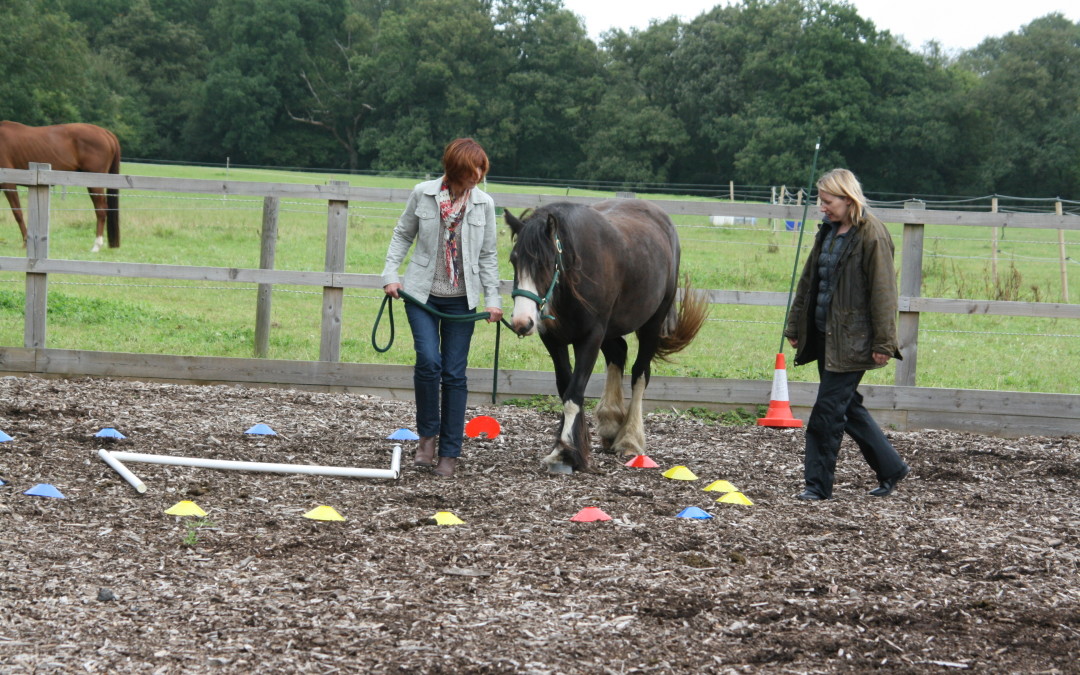
There are many types of experiential learning programmes but to my mind the most cost effective and impactful leadership programmes are those with horses. The horses provide unbiased feedback on how the delegates show up. Are they inspiring, compelling and energetic leaders who the horse (and other team members) would want to follow, or do they lack focus, direction and are generally unsure of themselves.
Since horses are masters at reading body language they challenge the delegates on how congruent and authentic they are. Are their words and deeds aligned so that trust can be built? Do they feel empowered and listed to? Through a series of exercises the horses show delegates how to BE a leader rather than DO leadership and thats something that can’t be learnt in the classroom.
So if you are looking to develop your leadership skills, why not give us a call, and we can explore what is possible.

by Julia Felton | Oct 14, 2015
Almost a century after horses were the almost only source of transportation on our streets it is surprising that in this digital age, we still measure the power of a car engine in ‘horsepower’. Even today, when probably the only time most people will see a horse in on a Saturday afternoon at the races, horses still hold a fascination for everyone. For author and business consultant, Julia Felton she believes we can learn so much from them that every business should have one on its payroll.
Julia is the Herd Leader of Business Horsepower Ltd, a company that grew out of her realisation that the horses she keeps on her land in Yorkshire had become her best coaches in teaching her business and life lessons.
According to Julia ” I realised that my herd of horses live in a state of harmony. They act as a single unit and there is collaboration and shared leadership. A wild horse simply cannot afford to live alone, it is simply too dangerous and so the herd band together with a shared purpose of survival. To act in silo groups would be detrimental to the overall success of the herd, and yet, in the corporate world, that is what I witness in business day in day out.”
Drawing from this, and her extensive corporate experience growing effective teams at Andersen and Deloitte, she has just published a new book ‘The Alchemy of Change in which she reinvents ancient wisdom, and the forces of nature, to unlock the potential of leaders and teams.
in the same way that nothing happens in nature on its own, she has created the concept of the Joined-up business. Using an impressive array of tools, strategies and processes Julia helps the reader to unleash their powerful potential and “grab the reins” of their business and inspired everyone in it to work together with a singular purpose.
By each individual focusing on their unique natural strengths individuals, teams and organisations are able to become more engaged and motivated. Collaboration reigns and competition is banished. The result is increased productivity and profitability as twice as much is achieved with significantly less effort.
Her innovative coaching and development programmes, for individuals, teams and organisations, are inspired by nature and her herd of horses. She is committed to creating positive transformation and getting outstanding results through streamlining and systemising businesses so that all the aspects of the business are aligned and no resources are wasted.
During her 12 year career at Andersen and Deloitte she was responsible for developing a business from an idea on a piece of paper to creating and then building a million pound business unit, that became firmly established as the global market leader, providing business intelligence solutions to the hospitality industry. Her unique ability to work at both a strategic and tactical level means that she is sought after as a high performance consultant, mentor and coach.
Julia holds a degree in Hospitality Management and is a member of the Chartered Institute of Marketing and the Institute of Leadership. She is also a Fellow of the British Association of Hospitality Accountants. As a Master Coach and qualified NLP practitioner and trainer she enjoys mentoring young entrepreneurs and recently became a Young Enterprise Coach. She is also a Talent Dynamics Performance Consultant, a Trusted Sales Dynamics Coach and a Certified Money and Marketing Business Coach.
Julia’s passion is horses and as a natural horsemanship coach and a Licensed HorseDream Partner she often incorporates sessions working with the horses into her Business HorsePower leadership and team working programmes and Unbridled Success Retreats.
Julia is an accomplished international speaker and in addition to The Alchemy of Change: Ancient Wisdom Re-invented To Unleash The Potential of Leaders and Teams she is the author of Unbridled Success – How the Secret Lives of Horses Can Impact Your Leadership, Teamwork and Communication Skills. Her keynote speech Straight From The Horses Mouth: Leadership Lessons From The Barn To The Boardroom is provocative and thought-provoking, making her a sought after speaker.
Julia will be holding a book launch and masterclass event tonight – Wednesday 14th October – from 7-9pm at Waterstone’s Leeds.
For press, media and general enquiries please connect with Julia via co*****@****************er.com. We can’t wait to hear from you.

by Julia Felton | Jun 24, 2015
As a fellow entrepreneur I understand that you went into business because you just love what you do. I bet you are super creative and loved the excitement and buzz of starting your own company. With loads of ideas and energy you were just what the business needed at that time. But, assuming your business has been a success, are you still the right person to be running the business. Maybe it is time to fire yourself?
So why do I say that? Well time and time again I come across successful entrepreneurs still trying to run their business as a start up when in fact it is an established business and leading it requires a very different skill set.
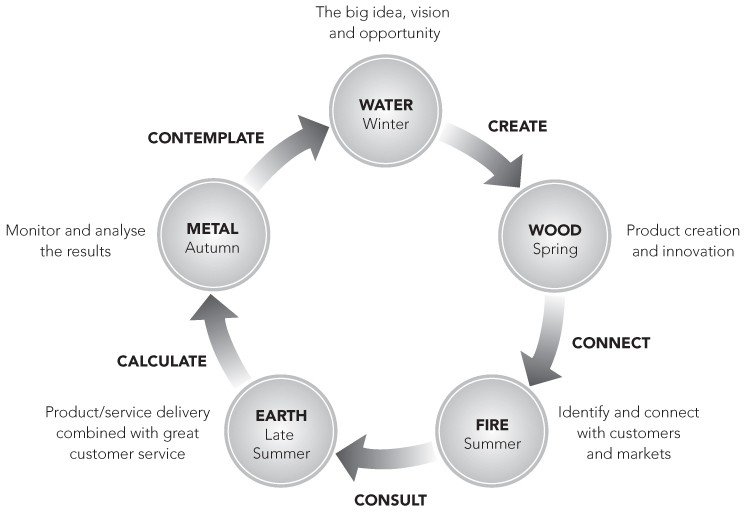
Just as each year goes through the five seasons and has a natural rhythm to it so does your business. Businesses follow cycles as illustrated in the Five Energy Dynamic below, which is why it is rare to find the same companies being the best performers, year on year.
When a business is just starting out it needs lots of Wood Energy for creating the vision and coming up with the strategy. Wood energy is Spring type energy, it gets things moving. Then the business moves into a phase of growth, represented by Summer and Fire energy. Here you find companies acquiring market share and presence by connecting and collaborating with others.
Then business moves into the late summer phase represented by Earth energy and consultation. This is a time ,when a business established in their niche, needs to focus on looking after customers. Then the business moves into autumn (Metal energy) which is all about consolidation and calculation – getting more from the business by closely monitoring the numbers. Then the business moves into Winter and Water energy. At this point the business typically reflects back on what has and hasn’t worked. It begins to look for ways to expand its product offering with product extensions and so the business moves back into creation mode and the Spring energy. It’s a virtuous circle
So what season is your business in? The best way to figure this out is to examine which season you have just passed through. If you have a great product that has proven itself in the market, you are out of Spring and into Summer, where you will be focusing on building your market.
If you have many new customers and sales are coming in easily, you are out of Summer and into late Summer focusing on serving your customers well. If your customers are happy and your team members are settled, you are out of late Summer and into Autumn, where your focus will be on analyzing and measuring how the business performed and then you move into Winter where you will reflect on what occurred and seek ways to enhance performance before moving back into Spring
The big error that many business owners make is that because they fail to realize when they have moved from one season to the next, they keep adopting the same old strategies when a new approach is needed. Oftentimes the wrong type of leader is running the business in the wrong season and when this occurs the results can be disastrous.
So, I urge you to honestly look at your business and consider whether you are the right person to be leading the business through this phase of its development. And if not, be brave, swallow your pride, and fire yourself from the CEO role because the consequences could be dire for your business if you don’t.

by Julia Felton | Apr 15, 2015
This week as I’ve been preparing for the Building Relationships To Build Your Business Workshop which I am hosting this weekend, I got to thinking about the relationship between trust and respect. Trust and respect are foundations of building great relationships whether in life or business, but how do these apply to leaders?.
Can you trust someone you don’t respect? Can you respect without trust? In all my years of being in business I can’t recall anyone that I really respected and who I didn’t trust. Although recently I did come across a stallion horse that I certainly respected for his power and presence, but to be honest I didn’t really trust him. In fact he intimidated me, and I was a little afraid, however I did trust myself that I knew enough to keep me safe by keeping him out of my personal space.
So whilst trust and respect can exist independently, it’s when they co-exist together that something magical happens. It is definitely a case of 1+1=3.
So let’s be clear on what are trust and respect. Trust is defined as reliance on the integrity, strength, ability, surety, etc., of a person or thing whilst respect is defined as a deep admiration for someone’s abilities, qualities or achievements.
So how do you build trust and respect with others? Here are six practices you can engage with:
1. Model The Way
“What you do speaks so loudly I cannot hear what you say. “ ~ Ralph Waldo Emerson
Both trust and respect are earned. The fastest way to earn them is to give them: Show others trust, give others respect.
2. Keep Your Commitments
Do what you say you will do. So if you agree to follow up with someone then make sure you do it. This builds credibility and shows you are reliable. And if for some reason circumstances change make sure you circle back and explain why you can no longer keep this commitment and ask to be released from your original promise.
3. Listen To Communicate
Being a great communicator means listening with your mind as well as your heart. What is being communicated by what isn’t being said? Listen to people and consider what they have to say with an open mind. Great communicators address both the “why” and the “how” of the situation. Trust your gut and learn to ask great questions.
4. Prepare for Confidence
Respect is born through the competence you show, one of the 5 pillars of trust. (The 5 pillars are Caring, Commitment, Consistency, Competence and Communication) Have the confidence born of knowledge and experience. When you speak, know what you are talking about. Remember, though: confidence is not arrogance; a confident leader is willing to admit his mistakes; hiding them is a sign of duplicity.
5. Make People Feel Safe
Create an environment where everyone feels that they can express their viewpoint. Respected leaders acknowledge they don’t know everything and they can learn a lot from other people. Keep an open mind and appreciate that everyone has something to teach you.
6. Lead From The Front
Do you want trust and respect from others? Start by trusting and respecting yourself. It means not putting yourself down when you make a mistake; own up to it and move on. Let yourself take risks based on your own values and strengths. Listen to that “inner voice” guiding your decisions.
What else are you doing to build trust and respect? I’d love to hear as the same principles apply whether you are building trust and respect with prospects, clients, suppliers or even your horse.
by Julia Felton | Mar 17, 2015
Thomas J. Watson, the founder and first president of IBM said: “Failure is a teacher – a harsh one, perhaps, but the best… That’s what I have to do when an idea backfires or a sales program fails. You’ve got to put failure to work for you … you can be discouraged by failure or you can learn from it. So go ahead and make mistakes. Make all you can. Because that’s where you will find success. On the far side of failure.”
I know when I was starting out in business I used to dread getting things wrong and having projects fail. I used to think that failure was something bad, to be avoided, but along the way I have begun to realise that my best lessons are learnt when I try something and it doesn’t turn out as planned. In effect I’ve failed but the feedback I get is priceless and it helps me calibrate my offering and do something different.
Recently I read an article about the African impala. They can jump to a height of over 10 feet and cover a distance of greater than 30 feet and yet these magnificent creatures can be kept in an enclosure in any zoo with a 3 foot wall. The reason is that these animals will not jump if they cannot see where their feet will land.
This is a lot like humans. Many of us will not live up to our full potential and achieve all we want to as we are afraid to take a risk. We are afraid to fail as society has conditioned us that failure is bad. That was certainly the messaging that I got as a chlld, however failure can be one more step on your road to success – you just have to turn it around in a positive direction. Failure can push you harder to succeed. Failure can strengthen your determination to overcome obstacles. Failure can make you braver in the face of opposition. Failure can help you learn what you need to do in order to succeed. Failure can teach you what your limitations are – and your strengths. Failure can encourage you to change your strategy.
“Failure is not an option” became a popular catchphrase after the release of the movie Apollo 13. Failure happens, but when you’re responsible for the people working for you, you have to do everything you can to guard against it.
As a leader, devote yourself to avoiding these crucial failures in leadership.
- Disconnecting from people. Don’t get so caught up in strategy and planning that you forget to talk to the people who work for you. Most of the time, they know more than you about how things work from the ground level, and their insights can be invaluable.
- Doing too much. Delegate appropriately so you don’t get overwhelmed and lose sight of the big picture. When you hire, look for people who can perform aspects of your job as well as or better than you can. Your role is complicated enough without adding tasks that your team should be able to handle.
- Avoiding risk. Play it safe, and your organization will never grow. That doesn’t mean being foolhardy with your organization’s assets. Seek opportunities everywhere, and be willing to commit resources wherever you’ve got a reasonable chance of success.
- Exhaustion. Take care of yourself, physically and mentally. Eat well, exercise, and take time off so you can stay fresh as you confront the day’s challenges. Pushing yourself to the brink will only increase everyone’s anxiety.
- Falling in love with authority. You’re the boss, not a monarch ruling by birthright. Don’t rely on your title, and the volume of your voice, to get employees to do what you want. Base your decisions on your experience and judgment, and be willing to listen to other points of view instead of assuming that only you know what’s right.
When J. K. Rowling, author of the phenomenally successful Harry Potter series, had been out of college for seven years, she found herself at a dark juncture in her life. At that time, she says, she had failed in life on an epic scale. “An exceptionally short-lived marriage had imploded. I was jobless, a lone parent, and as poor as it is possible to be in modern Britain without being homeless.”
In short, Rowling says she was the biggest failure she knew. And while she says there is nothing ennobling about being poor, she believes she reaped benefits from her failures. Failure, she says, stripped away all the inessential aspects of her life. She stopped pretending to be anything other than herself, and it was then that she began to earnestly pursue the only work that mattered to her. It was not, she says, the fairy-tale transformation to success so often written about her in the media.
And one thing I have learnt is that becoming successful – whatever that means for you – is never something that happens overnight. Despite all the media hype success takes hard work because it takes 10,000 hours to perfect your craft. So imagine the opportunity for failure along the way and embrace this and learn from the experience because this will help accelerate your success.
So what leaps of faith will you take today to move your business to the next level?
by Julia Felton | Feb 24, 2015
In a recent article the Harvard Business Review cited the following as traits of innovative leaders. I’m curious what you think about these traits and are there any you would add.
Many organisations would like their leaders to create more innovative teams. But how exactly should they do this? Most highly innovative leaders can often find it difficult to pinpoint what accounts for their skill. Research carried out by US –based leadership development consultants Jack Zenger and Joseph Folkman identified 10 distinctive behaviours that set innovative leaders apart.
These leaders:
- Display excellent strategic vision. The most effective innovation leaders could vividly describe their vision of the future
- Have a strong customer focus. They networked with clients and asked incessant questions about their needs and wants.
- Create a climate of reciprocal trust. They initiated warm, collaborative relationships with the innovators who worked for them.
- Display fearless loyalty to doing what’s right for the organisation and customer. Pleasing the boss took a back seat to doing the right thing for the project.
- Put their faith in a culture that magnifies upward communication. These leaders were often described as projecting optimism, full of energy, and always receptive to new ideas.
- Are persuasive. They presented ideas with enthusiasm and conviction, and the team willingly followed.
- Excel at setting stretch goals. They set goals that required people to go far beyond just working harder but required that they find new ways to achieve a high goal.
- Emphasize speed. These leaders believed that experiments and rapid prototypes were preferred to lengthy studies by large committees.
- Are candid in their communication. These leaders were described as providing honest, and at times blunt, feedback.
- Inspire and motivate through action. This comes from a clear sense of purpose and meaning in the work.
So do you have the skills and mindset as a leader to create innovative teams? I’d love to hear if you’d focus on anything different.