If you’ve ever led a team in hospitality, you know the truth: teamwork isn’t “nice to have”, it’s survival. From the first guest smile to the last swipe of a room key, the pressure is relentless. In this week’s episode of Impactful Teamwork, I sat down with Karen Borain – 43 years in hospitality, 35 with Southern Sun, and a career leading training and development right up at CEO level. We went deep on what actually works when the clock is ticking and the lobby is full. Here’s your fast, practical download.
From “Hotel Manager” to Leader: Get Out of the Weeds
Hospitality is famously hierarchical. Titles scream “manager,” but the work screams for leadership. Karen’s blunt truth: too many leaders drag their first job up the ladder with them. F&B stars still doing ordering. Former reception legends still “just jumping in” at the desk. That loyalty to yesterday’s skillset strangles today’s team.
Try this: run a one-week diary audit.
Manage & Lead: Time spent getting work done through others.
Technical Only You Can Do: Budgets, sensitive HR, keep these.
Work Someone Else Is Paid To Do: Stop it. Today. Let them shine.
You don’t prove your value by rescuing tasks; you prove it by creating clarity, momentum and results through others.
Communication Isn’t “A Nice Chat”—It’s Your Operating System
Hospitality teams fail in the gaps – handoffs, assumptions, unspoken expectations. When front office is smooth but the room isn’t guest-ready, the blame game ignites and the guest feels it.
Make clarity your habit:
Common purpose at every level (team, peer team, property): “We create guest-ready experiences, every time.”
Role clarity: Who owns what, how success is measured, and when to escalate.
Team norms: “How we work together under pressure” agreed before the weekend crush.
Fix the Silos: Coach the Peer Team, Not Just the Vertical
Your heads of department will happily introduce themselves by the teams they manage. Then they forget the team they’re in, the peer team around the GM’s table. Karen’s team-coaching move is brilliant: reset that group’s identity, define their shared purpose, and codify how they collaborate across the operation. When the HODs work horizontally, the kitchen and floor follow suit. Momentum flows.
Workshop prompt for your next HOD meeting:
What do you bring to this peer team?
What do you need from this peer team?
What’s our one-line shared purpose?
What are three non-negotiable norms we all commit to?
Lead a Multi-Generational, Multi-Reality Workforce
Today’s teams blend seasoned pros with students on weekend shifts. Assumptions break fast: some recruits genuinely haven’t made tea at home; some veterans struggle with new D&I language. That’s not a problem, that’s a design brief.
Leader moves:
Meet people where they are. Train what’s actually missing, not what “should be known.”
Leverage difference. Invite newer team members to rethink “how we’ve always done it.” Tap experienced staff for craft, standards, and judgment under pressure.
Make learning continuous. Gen Z walks when growth stalls. Offer pathways, micro-modules, and cross-exposure between departments.
Onboarding That Sticks: Buddy Up, Don’t Drown
In a high-turnover environment, you’re always in forming mode. Throwing people into the deep end costs you guests, morale, and money.
Use a Buddy System:
Pair new hires with role-model operators who live the team’s purpose and standards.
Give buddies a clear checklist: purpose, safety, standards, escalation, “one shift to mastery” essentials.
Recognise your buddies publicly—they’re multiplying your leadership.
SOPs + Humanity: Automate Smart, But Don’t Lose the Soul
Automation is brilliant… until it breaks. We’ve all witnessed the lobby meltdown when self-check-in goes down. SOPs matter; connection matters more. Train both: the standard and the stance – presence, care, ownership.
Teach the stance:
If it touches the guest, we own it (even when another department “caused” it).
We solve here and now, then we tidy the process later.
We escalate with facts, not friction.
Purpose Powers Performance (And Cuts Through Drudgery)
Cleaning 18 rooms can feel soulless. Making every room guest-ready is a purpose. One lands like a chore; the other lands like a promise. Purpose turns grind into craft.
Implement today:
Rewrite every role’s purpose line.
Room attendant: “Make each room guest-ready, first time.”
Front desk: “Set the tone for a seamless, welcoming stay.”
Night manager: “Guard the quiet and safety of our sleeping guests.”
Start huddles with a purpose reminder + one micro-win.
Delegate the Doing, Own the Energy
Hospitality is a marathon disguised as a sprint. Leaders don’t need to be everywhere, they need to steward energy:
Plan peaks. Time the hardest tasks to your team’s natural highs.
Build recovery. Micro-breaks, water, stretch, rotate roles on long shifts.
Celebrate small wins. Shout-outs in real time fuel stamina and pride.
When Things Go Off the Rails, Look for These Signals
Blame spikes at handoffs (front office vs housekeeping). Fix: reset the peer team’s norms: shared ownership, clear escalation.
New starters drift, veterans grumble. Fix: buddy system + role purpose + daily clarity.
Try This in the Next 7 Days (Practical & Implementable)
Run the 3-bucket time audit (Lead/Manage, Only-You Technical, Someone-Else’s Job). Create a Stop-Doing List and honour it.
Write purpose lines for every role in your team and share them at the next huddle. Ask: “What would ‘guest-ready’ look like for your role today?”
Host a 30-minute HOD reset: agree a one-line peer-team purpose and three norms for handoffs and escalations. Put them on the wall.
Launch a buddy system for onboarding with a simple checklist. Recognise two standout buddies publicly this week.
Energy check-ins twice per shift: quick pulse (1–5) + one action to lift the average by one point (water, rotate, three-minute reset outside).
No-blame escalations: “I own the guest; I loop in the fix.” Track time-to-resolution, not “who caused it.”
The Edgy Truth
If you’re still proving your value by doing other people’s jobs, you’re not leading, you’re blocking. If your HODs don’t see themselves as a team, your guests will feel the cracks before you do. If your onboarding is a shrug, your turnover is a self-inflicted wound. This isn’t about being nice; it’s about being unbeatable under pressure.
Listen In + Next Step
This blog is the companion to my latest Impactful Teamwork episode with Karen Borain—packed with real-world tactics from the front line of hotels. Listen now for the full conversation and steal the scripts, the questions, and the coaching moves we unpacked.
Ready to turn these ideas into momentum across your whole operation? Book a Turbo-Charge Your Team Audit and we’ll map where energy, clarity, and collaboration are leaking, then fix it fast.
Start with the obvious: nothing moves without your people
Here’s the uncomfortable truth many leaders forget: if nobody shows up, or they show up disengaged there is no business. In service-led companies especially, your people are the product. Their energy, attention, and care are what clients feel and what your bottom line measures. That’s why Ulli Hildebrand, the Strategic Talent Architect at PinPoint Solutions and I meet in the middle: I say teamwork is the competitive advantage; she says talent is the competitive advantage. We’re both pointing to the same north star that results flow through humans.
Action: Ask yourself, “What would stop if my team didn’t show up tomorrow?” Whatever you list is the real engine of your business. Protect and fuel it.
Leadership is motivation and mindset before mechanics
Too many people stumble into leadership because it’s the next rung on the ladder, not because they’re motivated to help others succeed. Competence in an individual role doesn’t equal readiness to lead. Leadership is the daily choice to make your people’s progress your priority. That means asking more than telling and listening more than fixing. If it isn’t your natural pattern, you can still lead, just install prompts to nudge the behaviour.
Action: Add one daily cue on your screen: “Who needs my support today?” Then check in with one person to remove a blocker.
The always-on culture blurs work and life until both feel foggy. Stress rises, focus drops, and productivity gets replaced by presenteeism. Ulli’s take: boundaries are a leadership responsibility. If you send emails late at night, your team will mirror you, no matter what you say. Schedule messages, make response windows explicit, and model switching off.
Action: Choose a visible boundary this week (no weekend replies, scheduled sends, or shared “focus hours”). Tell the team what you’re doing and why, then keep the promise.
Remote work needs real rituals, not wishful thinking
Flexibility is fantastic, but without structure it becomes a stress loop, lots of microbursts of activity that feel like constant work yet don’t add up to focused output. One simple fix we both love: the “fake commute.” Step outside before you start and after you finish to mark transitions. It separates the roles and clears the head.
Action: Experiment with a start/stop ritual for five consecutive workdays (walk round the block, journal for three minutes, or tidy the desk). Notice the difference in your attention and mood.
Culture is behaviour at scale and it either accelerates or suffocates strategy
Most companies are clear on what they want (revenue, margin, market share) and vague on how they’ll behave to get there. That gap is where trust leaks and performance stalls. If you claim to value innovation but punish mistakes, creativity dies. If you promise bonuses for last year’s results and withhold them because this month looks weak, trust dies. Culture lives in what leaders do, not what they say.
Action: Name the three non-negotiable behaviours that would make your strategy inevitable. Publicly reward them when you see them, even in small ways.
Scaling exposes the cracks you’ve been tolerating
At 20 people, you can hustle and “shoot from the hip.” At 100, the same habits become bottlenecks, usually at the CEO’s desk. Growth needs systems, not heroics. As Ulli put it, there’s only so much any one person can carry. If everything routes through you, you’ve designed a queue, not a company. The fix is smarter structure and shared ownership, not a bigger to-do list.
Action: List the last five decisions only you could make. For each, write a simple threshold or rule that would let a capable team member decide next time.
Empowerment beats permission: decisions belong where the information lives
If your team must ask before they act, they aren’t empowered; they’re permissioned. That’s slow and exhausting. Teach decision-making, define guardrails, and then celebrate “not calling the boss.” When you’re away, tell the team, “Make the call; I’ve got your back.” Nothing builds confidence and speed like being trusted with real responsibility.
Action: Pick one decision category (discounts under £X, service recovery up to £Y, content approvals within Z standards) and hand it over with clear examples. Review outcomes, refine the rule, repeat.
The less you’re the expert, the better you can lead
When you’re the deepest expert, it’s tempting to grab the wheel. That smothers initiative. If you aren’t the expert, you must lead through clarity, coordination, and trust. Your job becomes designing the game so your experts can win—setting outcomes, aligning interfaces, and removing friction. It’s liberating for everyone.
Action: In your next meeting, resist solving the hard problem. Instead, frame the outcome and constraints, then ask, “What’s your best way forward?”
Reward the try if you want innovation to survive
Every leader says they want creativity; few protect the conditions it needs: psychological safety, time to think, and the freedom to make small mistakes without blame. Trial and error is how new value is found. If the first failed attempt equals punishment, the smartest people will stop trying—or leave.
Action: Add a five-minute “What did we learn this week?” slot to your team meeting. Celebrate a thoughtful experiment—even if the result was “not that way.”
Horses don’t read job titles, they read energy
In the arena, horses mirror us. Ulli shared how her horse would wriggle in the cross-ties until she calmed and focused. The message is universal: your presence sets the tone. Scattered energy confuses teams; grounded attention settles them. The fastest way to shift performance is to shift the energy you bring into the room.
Action: Before your next tough conversation, take two slow breaths and choose one intention (clarify, encourage, or decide). Enter with that single focus and notice how the dynamic changes.
The quiet courage of keeping promises
Perhaps the most under-rated leadership move we discussed is simply doing what you said you would do. Pay what you promised. Give the time off you endorsed. Hold the boundary you modelled. When leaders keep commitments, trust compounds; when they don’t, cynicism spreads fast.
Action: Scan your open promises (big and small). Close one today and communicate it clearly.
What this all adds up to
Talent truly is your unfair advantage but only when leadership is a service, boundaries are honoured, and culture aligns with strategy. Scaling then becomes the art of distributing capability, not hoarding control. Empowered teams move faster. Clear behaviours make decisions cleaner. Focused leaders create calmer, more effective rooms. And yes, your clients feel all of it. If you want a practical boost, tune into this week’s episode with Ulli Hildebrand on Impactful Teamwork. We unpack these ideas with real stories you can apply immediately—and we keep it human, because performance without people isn’t sustainable, and people without performance isn’t a business.
Show Notes
00:00 Introduction to Impactful Teamwork
00:53 Guest Introduction: Ly Hillebrand
01:36 The Importance of Talent in the Workplace
03:37 Challenges in Leadership Roles
05:33 Setting Healthy Boundaries in the Workplace
07:51 The Impact of Remote Work on Productivity
14:40 Scaling Companies: Challenges and Solutions
19:06 Creating a High-Performance Culture
19:52 Understanding Business Goals and Culture
20:29 The Importance of Tolerating Mistakes
21:50 Contradictions in Viewing Personnel as Costs
Every leader knows the cost of toxic team dynamics. Whether it’s a snide remark in a meeting, a defensive comeback, or the dreaded silent treatment, these behaviours don’t just create tension, they erode trust and crush performance. Teams are living systems, like spider webs, where one tug affects the whole structure. That’s why a single negative behaviour can ripple across departments and derail momentum. But here’s the opportunity: eliminate the toxic waste, and you free up the energy your team needs to perform at its best.
The Four Team Toxins Killing Performance
Relationship researcher John Gottman identified four destructive behaviours so lethal he called them the Four Horsemen of the Apocalypse. In organisations, I call them the Four Team Toxins. They are:
Blaming/Criticism – attacking the person rather than their behaviour.
Defensiveness – refusing to take ownership and shifting blame.
Contempt – sarcasm, cynicism, belittling, or hostile humour.
Stonewalling – shutting down, withdrawing, or refusing to engage.
These behaviours may seem small in the moment, but repeated over time they destroy collaboration and stall performance. And let’s be real: you’ve used them, and you’ve felt them. The key is learning how to stop them before they poison your culture.
Why Toxic Behaviours Show Up
Here’s the uncomfortable truth: toxic behaviours usually stem from one thing — powerlessness. When people feel unheard, stuck, or frustrated, they default to criticism, contempt, defensiveness, or withdrawal. It’s rarely about being a “bad” team member. It’s about lacking the tools to handle conflict in healthier ways.
Four Antidotes to Team Toxins
If you want your team to thrive, you need to replace toxic behaviours with powerful alternatives. Here’s how:
Name it – when toxins appear, call them out and commit to moving forward without them.
Educate – show your team the impact of toxins, and even make spotting them part of the culture.
Plan ahead – agree on how you’ll respond when these behaviours creep in.
Provide alternatives – teach people to express frustration in constructive ways.
This isn’t about policing behaviour, it’s about building resilience and creating a culture of trust.
Tackling Each Team Toxin
Blaming or Criticism Criticism attacks the person, not the action. “You missed the deadline” is feedback. “What’s wrong with you?” is criticism. The antidote is to focus on behaviour, soften your approach, and uncover the real request beneath the criticism. Use “I feel… I want…” statements to shift from blame to collaboration.
Defensiveness Defensiveness is blame in disguise — “It’s not me, it’s you.” Instead, use active listening: reflect back what you’ve heard before responding. Or try the 2% rule: assume at least 2% of what’s being said is true, and respond to that. This lowers the temperature and invites dialogue.
Contempt Contempt is the deadliest toxin. Sarcasm, sneers, and eye-rolls may feel small, but they corrode trust faster than anything else. The antidote is to pause, cool down, and speak honestly without contempt. Again, “I feel… I want…” statements build clarity without poison.
Stonewalling Stonewalling feels like self-protection, but in reality, it suffocates communication. Silence only fuels the other toxins. The antidote is to check for overwhelm, create safety, and take small steps back into dialogue. Naming the fear behind the silence can open the door again.
Your Toxic Waste Disposal Plan
High-performing teams don’t avoid conflict — they prepare for it. They create shared agreements, practise antidotes, and learn to spot toxins before they spread. Without a plan, toxins pile up and pollute the culture. With a plan, you reclaim energy, restore trust, and fuel momentum.
So ask yourself: Which toxin is showing up in your team right now, and what antidote will you commit to today?
In this week’s episode of Impactful Teamwork, I had the absolute pleasure of being joined by the brilliant Judith Germain, founder of The Maverick Paradox and one of Brains’ 500 Global Honourees. Jude is a strategic leadership consultant, author, and speaker who brings a fresh, dynamic lens to leadership through her Maverick methodology. We unpacked the often misunderstood concept of influence—and why it’s so much more than charisma or presence.
If you’ve ever thought, I need to be more influential, but had no idea where to start—this conversation is for you.
Influence Isn’t a Trait—It’s a System
Jude challenged the traditional view of influence being about personality or status. Instead, she presented her Influence Blueprint, which sees influence as a dynamic system powered by four core drivers:
Capability – The foundation: your skills, credibility, emotional intelligence, and clarity of vision.
Decisiveness – How you make decisions, demonstrate intent, and build your reputation.
Power – Not positional power, but internal authority—your ability to act, innovate and lead without coercion.
Impact – The ripple effect of your actions—how your influence spreads through people and systems.
“Influence isn’t about pushing people. It’s about aligning what you want with what others want—and what society needs,” Jude shared.
This holistic approach helps shift the narrative away from manipulation and into alignment, connection, and flow. Something that deeply resonates with my own experience partnering with horses.
Influence Exists at All Levels—If You Choose to Use It
A huge myth Jude busted is that only senior leaders have influence. Influence can come from any level in an organisation—from the CEO to the janitor. What matters is not your job title, but your ability to create movement and connection.
She used a lovely example: “When you’re out with friends and someone asks, ‘Where should we go?’—do they turn to you?” That, right there, is influence in action.
🟢 Action Step: Ask yourself: Where do people naturally seek my opinion or guidance? That’s the start of your influence zone.
What Stops Influence? Blocked Systems and Leadership Presence
One of the biggest barriers to influence is when it gets stuck in the system. This could be due to rigid hierarchies, poor communication flows, or ineffective leadership styles.
Jude and I both agreed—too often we see people say, “You just need more presence,” and then leave it at that. But what does that actually mean?
Her answer: Presence is built through your capability, reputation, and how well you use your power to make an impact. Influence can be amplified by others (like my former boss did for me), but you have to have it in the first place.
🟢 Action Step: Reflect on your reputation. Are you seen as competent, emotionally aware, and trustworthy? If not, where could you grow?
Let’s Talk About Power (Without the Eye Rolls)
Power gets a bad rap—but only if you think of it as control. Jude reframed power as something internal—what she calls Maverick Power. It’s the self-assurance, resilience, and innovation to act without needing permission.
She gave a great example: when there’s no hammer to hang a picture, a Maverick doesn’t say, “Oh well.” They pick up a screwdriver and get the job done.
🟢 Action Step: Where in your life or leadership are you waiting for the right tool or permission? How could you create a solution right now with what you have?
Leadership Is Influence in Action
In high-performing teams, influence is distributed. There’s an unspoken flow of leadership—people step up when needed, and decisions are made based on capability, not just hierarchy.
I loved how Jude described this as calibrated influence—where tools like the GC Index and her Influence Blueprint come together to reveal where people naturally lead and contribute.
This is something I see all the time with horses. If you don’t have the right energy, intention, and trust, the horse simply won’t follow. It’s not about domination—it’s about relational influence.
🟢 Action Step: Consider how leadership shows up across your team. Who’s actually influencing the direction of work, decisions, and morale?
Culture, Complexity, and the Need for Flow
As our conversation evolved, we delved into culture. Jude emphasised that real culture isn’t just “what we do around here”—it’s “who we are when we’re here.”
In today’s complex business environment, culture fit can be dangerous if it creates sameness. Influence thrives when there’s diversity of thought and energetic contribution—when people are hired for their potential impact, not just their similarity.
“Flow is what happens when presence meets trust meets clarity,” I added. And Jude agreed—businesses must now navigate energetics as much as strategy.
🟢 Action Step: Run a mini influence audit. Where is influence flowing in your organisation—and where is it getting blocked?
Influence Gone Wrong: The Trust Tax
We closed the episode reflecting on what happens when influence is missing. Jude shared examples of leaders who relied on control, but couldn’t motivate their teams. Change slowed, people left, and performance dipped. That’s what Stephen Covey calls the “trust tax.”
Conversely, when influence is present—when there’s alignment, trust, and shared goals—teams fly. Jude shared a story from early in her career when, despite holding others accountable, her team rallied to support her under pressure. That’s the power of relational influence at work.
Final Reflections
This conversation with Jude reminded me how crucial it is that we expand our definition of leadership beyond presence or performance—and see it as systemic influence.
Influence is the heartbeat of high-performing, agile teams. It’s what allows Teamship—not just leadership—to thrive. It’s what moves us from ego to eco, from chaos to coherence, from compliance to candour.
Your Next Steps: Build Your Influence Ecosystem
If you’re ready to deepen your own influence or diagnose what’s blocking it across your team, here’s what I recommend:
Take the GC Index with your team – and map where your team’s energy for influence lies.
Book a Turbo-Charge Your Team Audit – and I’ll help you identify the key friction points in your team and how to unlock momentum using the Unbridled Teamship Roadmap.
Let’s stop talking about influence as a “soft skill” and start treating it as the strategic advantage that it really is.
It turns out you don’t need to be in the boardroom to sharpen your leadership skills. Sometimes, the best leadership lessons emerge when you least expect them—like on a sailing holiday in Greece. After a week under the Mediterranean sun, navigating the open waters with my partner and nine other boats in a flotilla, I came back feeling more connected, more grounded—and full of reflections about leadership, teamwork and business.
Here are some of the leadership lessons I brought back with me, straight from the deck of a Beneteau 323.
1. The Power of Shared Leadership
This trip marked our third sailing holiday, but when I rewind the clock to our first adventure, I’m reminded how essential shared leadership really is. I hadn’t planned to do any training—I thought I’d spend the week relaxing by the pool while my partner completed his Day Skipper practical. What actually happened was quite different: I joined the crew, learned the ropes (literally!), and earned my Competent Crew certificate.
And thank goodness I did.
Because when we set sail on that first flotilla trip six months later, having a shared understanding of how the boat operated—and my partner not having to shoulder all the responsibility—meant we worked together as a team. I brought a different perspective, focusing more on safety and systems, while he focused on navigation. Together, we made a more effective, resilient crew.
Action: Ask yourself—how are you enabling shared leadership in your team? Who else can hold the reins with you?
Reflection: True leadership isn’t about knowing everything—it’s about knowing how to empower others to lead with you.
2. The Power of Beliefs: Old Experiences Shape New Realities
Before these flotilla adventures, my only sailing experience was in dinghies—and let’s just say that included three capsizes and a few dunkings, thanks to my partner’s enthusiastic steering! That experience left a deep impression. I developed a belief that sailing with him meant getting wet—and potentially being in danger.
So when we first took out a larger keelboat, even though it was far more stable, my nervous system was on high alert. I was terrified we’d capsize.
It wasn’t until I learned more about the stability of these boats, spoke to others, and built new experiences that I was able to let go of that limiting belief. And that’s when I started to actually enjoy sailing.
Action: What limiting beliefs are you carrying into your leadership or team interactions? What outdated ‘truths’ need to be re-evaluated?
Reflection: Beliefs formed in one context don’t always serve us in another. It’s time to let go of the stories that are no longer true.
3. Roles, Responsibilities, and Accountability Create Flow
Sailing taught me—yet again—the importance of clearly defined roles. When it was time to depart a port, there were multiple tasks that had to be done efficiently and safely. Naturally, we divided them: I was in charge below deck, securing items and closing hatches, while my partner handled the sails and navigation.
Each of us knew what to do. No confusion. No duplication. Just flow.
And the reason it worked? Systems. During my training, I’d been given a checklist to ensure the boat was ready to sail. That simple structure gave me confidence. It also freed up mental space because I didn’t have to remember everything—I just had to follow the process.
Action: Have you clarified who is doing what in your business? Do your people have clear systems and checklists to follow?
Reflection: When everyone knows their role and what’s expected of them, it creates empowerment, efficiency and trust.
4. The Value of Supportive Teams
One of the main reasons we continue to sail as part of a flotilla is the incredible support structure it provides. There’s a lead boat with a captain, an engineer and a social host—all of whom are available to assist if anything goes wrong.
And trust me, things do go wrong.
Like the time our anchor jammed mid-drop and we had 50 feet of chain dangling from the front of our boat. We couldn’t dock, we couldn’t move, and we definitely couldn’t fix it alone. But thanks to the flotilla team, help arrived—and after two hours and some serious manpower, the problem was solved.
Action: Who are your “flotilla captains”? Do your team members have people they can call on when something goes wrong?
Reflection: Psychological safety at work is just like sailing safety on the water. People perform better when they know help is at hand.
5. Proper Planning Prevents Poor Performance
There’s a reason that phrase is a cliché—it’s true. When we didn’t plan our manoeuvres properly, everything got a bit chaotic. My partner would suddenly say, “Let’s tack now!” and I’d freeze—unsure of what to do, feeling flustered.
But when we planned together—”Step one: bring in the mainsail; step two: adjust the jib”—the manoeuvre was seamless.
And this is so true in business too. When things are moving fast, it can feel like you don’t have time to plan. But pausing to clarify the steps means fewer mistakes, less chaos, and better outcomes.
Action: Where can you slow down to plan more effectively this week?
Reflection: Clarity breeds confidence. A calm, prepared team is a high-performing team.
6. Emotional Energy Sets the Tone
During one of our more rushed manoeuvres, my partner became visibly anxious. His energy shifted—he became erratic, issuing conflicting commands—and I froze. It reminded me how much a leader’s energy sets the tone for everyone else.
I had a fascinating conversation with a Navy captain on the trip who echoed this. He said that in high-pressure situations, the leader’s calmness anchors the entire crew. Whether you’re navigating a yacht or leading a team through a business storm, the principle is the same.
Action: How are you managing your emotional energy in moments of stress?
Reflection: Your energy is contagious. Staying grounded helps your team stay steady in uncertain times.
7. Don’t Lose Sight of the Bigger Picture
While helming the boat, I often picked a point on the horizon to steer towards. It gave me focus—but it also narrowed my field of vision. One day, I was so fixated on that point that I failed to notice a massive ferry bearing down on us from the side!
In business, this happens all too often. We’re so focused on the goal that we miss what’s happening around us—market shifts, team fatigue, or emerging risks.
Action: Take a moment to look up from your to-do list. What are you not seeing?
Reflection: Peripheral awareness is just as important as focus. Great leaders take in the full horizon.
Final Thought: From Busy to Brilliant
One of the biggest lessons from this trip was about attention—where we place it, how we manage it, and the impact it has on our performance.
That’s why I’m running a 20-minute webinar on August 12th called “From Busy to Brilliant: How Strategic Attention Fuels High-Performance Teams.” If you want to learn how to leverage attention to drive business results, I’d love for you to join me. Simply register at here
Whether you’re on a sailboat in Greece or in the thick of your next big project, the lessons are there—if you’re willing to pause, observe, and learn. I came back from holiday not just refreshed, but re-inspired.
Here’s to navigating your own leadership journey with more clarity, calm, and connection.
As leaders, we often seek a singular leadership style that defines our approach—firm but fair, visionary, collaborative, or strategic. But in reality, great leadership is far more dynamic. The best leaders don’t wear a crown; they wear many different hats—switching styles depending on what their team needs at any given moment.
In this week’s episode of Impactful Teamwork, I shared lessons fresh from the field—literally. After a week of hands-on leadership at the Paris Air Show, managing a hospitality chalet for an aerospace giant, I was reminded how leadership in action demands agility, presence, and emotional intelligence. It’s not about power or prestige—it’s about being who your team needs, when they need it.
So what does this look like in practice? Let me walk you through the 10 leadership hats that I believe every leader must learn to wear to truly make an impact.
1. The Mentor: Share Wisdom Without Preaching
The Mentor guides rather than instructs. They empower others to think for themselves by asking thoughtful questions and holding space for learning.
💡 Try this: Instead of giving all the answers, ask your team members, “What do you think is the next best step?”
2. The Coach: See the Potential Before They Do
Coaches spot hidden strengths and push their people to grow. They believe in potential—even when the person doesn’t believe in themselves.
💡 Action step: Identify one team member who’s playing it safe. What stretch goal could you challenge them with this week?
3. The Defender: Protect Without Hovering
The Defender shields their team from distractions and unnecessary politics. They fight battles behind the scenes so others can focus on their work.
💡 Try this: Review current team frustrations. Are there obstacles you can quietly remove without fanfare?
4. The Translator: Bridge the Communication Gaps
The Translator adapts their language to suit their audience. This leader doesn’t expect others to speak their language—they learn how to speak others’.
💡 Leadership prompt: Is your message landing? Try explaining your vision in the simplest terms possible—and tailor it to different generational or personality styles in your team.
5. The Cheerleader: Celebrate Effort and Energy
Everyone needs a cheerleader. This leader is generous with praise, celebrates the small wins, and energizes the team through appreciation.
💡 Quick win: Recognize someone’s effort publicly today. Bonus points if it’s something small that often goes unnoticed.
6. The Therapist: Hold Space for the Human Stuff
Let’s face it—life happens. The Therapist leader knows when to stop solving and start listening. They make it okay to be human.
💡 Reflection: Are you always jumping in with solutions? Next time someone vents, try just saying: “That sounds tough. Tell me more.”
7. The Janitor: Clean Up the Mess Without Blame
Sometimes things go wrong. The Janitor rolls up their sleeves and fixes what’s broken—without pointing fingers. They’re about solutions, not shame.
💡 Leadership move: Next time something fails, lead with curiosity: “What can we learn from this?” before assigning responsibility.
8. The Student: Stay Curious and Humble
Even seasoned leaders need to keep learning. The Student hat means staying open to ideas from anywhere—junior team members, peers, or even customers.
💡 Experiment: In your next team meeting, ask: “What can we do better?” And really listen.
9. The Mirror: Reflect Back Their Best Self
The Mirror helps others see their own brilliance. They reflect back strengths and hold up a vision of who someone is becoming—not just who they are now.
💡 Practice this: When giving feedback, balance it with what’s going right. Say, “I see how much you’ve grown in…”
10. The Compass: Provide Direction in Chaos
When everything feels uncertain, the Compass holds steady. They remind the team of the vision, the purpose, and what truly matters.
💡 Anchor your team: Revisit your team’s ‘why’ at the start of a busy week. Purpose is the fuel that sustains performance.
Why Wearing Multiple Hats Matters
Leadership is not a fixed identity—it’s an ever-shifting dance. Different situations call for different energies. Some team members need encouragement; others need clarity or protection. As leaders, our role is to sense what’s required and step into it—not from ego, but from service.
This doesn’t mean you have to master every hat immediately. Most of us have natural preferences. For example, I naturally love mentoring and cheerleading. But last week, leading a diverse team in Paris, I was constantly shifting between therapist, janitor, and compass roles, depending on what the situation called for.
Leadership is less about having the answers and more about showing up with the right energy at the right moment.
How to Discover Which Leadership Hats Fit You Best
If you’re curious about which leadership hats come naturally to you—and which ones you may need to cultivate—then I invite you to join me on **3rd July for a free 4-hour interactive masterclass: “Unleash the Game-Changing Potential in Your Team.”
In this session, we’ll use the GC Index®, a revolutionary tool that reveals your natural energy for impact, helping you understand:
✅ Where you add the most value in a team ✅ What activities energize or drain you ✅ How to play to your strengths (and those of your team) ✅ What hats you should wear more—and which to delegate or develop
Everyone will complete their own GC Index profile ahead of time, and during the workshop we’ll explore anonymized group data, breakout exercises, and practical applications to turbo-charge your leadership effectiveness.
In today’s fast-paced, unpredictable business world, reinvention is no longer a luxury — it’s a leadership imperative. At the recent Reinvention Summit in Dublin, I was struck by the urgency and magnitude of change leaders are facing. The statistics were mind-blowing: 85% of business models will be obsolete within five years. This isn’t a distant future scenario. It’s happening now.
In this blog, I’ll explore why reinvention must become the core of modern leadership, and how you can evolve your leadership approach to stay relevant, responsive, and resilient in today’s volatile environment.
Why Reinvention Can’t Wait
We’re not just living in an era of change — we’re living in an era of continuous transformation. Here’s why:
Innovation timelines are shrinking: 63% of leaders say their organizations can’t innovate fast enough to keep up with customer demands and technological advancements.
AI is redefining value: Over 50% of professional services tasks will be automated by 2027 (McKinsey).
Old strategy models don’t work: 70% of leaders are stuck in outdated planning cycles that can’t anticipate or respond to change.
In short, disruption is no longer a threat — it’s your daily operating system.
Reinvention Isn’t Starting Over — It’s Evolving Forward
Many leaders resist reinvention because they assume it means throwing everything out and starting again. That’s not true. Effective reinvention honors the best of the past while letting go of what no longer serves. It’s about building adaptive systems that evolve without burning out your people or losing your edge.
So how do we reinvent leadership for this new world? Let’s explore five key strategies.
This rhythm keeps your leadership agile and aligned with the natural cycles of growth.
2. Lead Continuous Change — Don’t Just Manage Stability
The traditional leadership model was designed for a stable world. Today’s reality demands a shift from control and predictability to experimentation and flexibility.
Old Leadership
Reinvented Leadership
One-time change projects
Ongoing change systems
Top-down decisions
Empowered teams
Fixed long-term plans
Adaptive strategies
Risk avoidance
Calculated experimentation
Control and efficiency
Innovation and agility
💡 Action: Reframe your role from managing stability to leading reinvention. Develop a culture where change is expected, welcomed, and integrated into everyday work.
3. Become Your Organization’s Chief Reinvention Officer
Reinvention isn’t just a business strategy — it’s a leadership identity. The Academy of Reinventors (of which I’m a member) outlines six pillars of reinvention every leader should embrace:
Anticipation – Scan the horizon for trends before they become disruptions.
Experimentation – Test ideas quickly. Fail fast, learn faster.
Collaboration – Break down silos and learn across teams and industries.
Sustainability – Design with long-term adaptability in mind, not short-term wins.
Resilience – Build a culture that embraces uncertainty as opportunity.
People Empowerment – Equip teams with skills, autonomy, and a growth mindset.
💡 Action: Use these six pillars as a checklist. Where are you strong? Where do you need to focus?
4. Reinvent Team Structures: From Hierarchies to Networks
Traditional teams operated in silos with rigid roles. Reinvented teams are fluid, networked, and purpose-driven.
Traditional Teams
Reinvented Teams
Rigid hierarchy
Flat, cross-functional collaboration
Fixed roles
Roles based on strengths and projects
Top-down decisions
Empowered, self-directed teams
Departmental silos
Cross-functional, agile networks
💡 Action: Set up a “Reinvention Lab” — a small team that pilots new ways of working and leadership styles. Treat business as an experiment, and test before scaling.
5. Bake Reinvention Into Your Daily Operations
If you want reinvention to stick, it must become part of your organization’s DNA — not just a one-off initiative. Here’s how to do that:
Allocate a reinvention budget for testing and innovation.
Measure what matters: Go beyond financial KPIs. Track adaptability, agility, and engagement.
Celebrate learning from failure — not just results.
Make learning non-negotiable: Invest in ongoing development and create space for curiosity.
💡 Action: Implement a Reinvention Scorecard. Track how often your team is experimenting, learning, and adapting. Use it in team check-ins or leadership reviews.
Avoiding Titanic Syndrome: Don’t Cling to Past Success
One of the biggest risks facing leaders today is Titanic Syndrome — the refusal to let go of past success in the face of a changing future. Kodak invented digital photography but didn’t embrace it. Nokia ignored smartphones. Blockbuster laughed at Netflix.
💡 Action: Use a Titanic Syndrome Diagnostic:
What past successes are we clinging to?
What emerging trends are we ignoring?
Where are we assuming “what worked before will work again”?
Final Thoughts: The Future Belongs to Reinventors
Reinvention is not a trend — it’s the defining leadership skill of the 21st century. The leaders who thrive will be those who:
✅ Anticipate rather than react ✅ Empower teams rather than control them ✅ Design for adaptability rather than stability ✅ Embrace curiosity rather than certainty
So the question isn’t “Do I need to reinvent?” — it’s “How fast can I start?”
Let this be your invitation to lead boldly into the future, to try, test, evolve, and adapt — just like nature does. Reinvention isn’t risky. Clinging to the past is.
Your Reinvention Starter Checklist:
☐ Schedule quarterly leadership “season” reviews
☐ Establish a Reinvention Lab
☐ Track progress with a Reinvention Scorecard
☐ Empower teams with autonomy and upskilling
☐ Celebrate experimentation and learning
Let’s not wait for disruption to force our hand. Reinvent now — and lead the change
of leadership that the world so desperately needs.
In this week’s edition of Impactful Teamwork, my guest Simon Bowen, founder of the Models Method shared a brilliant insight: Words alone often fail. Relying purely on language is risky because:
It depends on each person’s vocabulary and interpretation.
People “hear” but don’t always “understand.”
Action Point: Whenever you communicate complex ideas with your team, pair your words with a simple visual or structure. This could be a basic two-by-two matrix, a diagram, or even a simple flowchart.
Remember:
Visuals = “I see.”
Structure = “I get it.”
When people both “see” and “get it,” they feel engaged and aligned.
The “Green Zone” of Communication
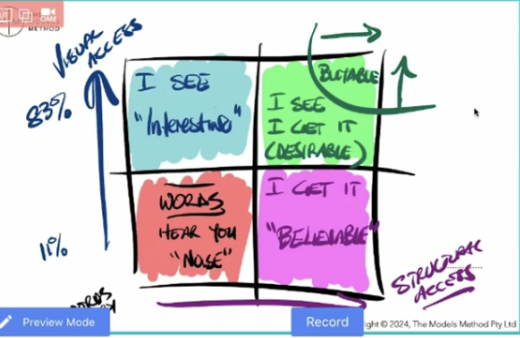
Simon introduced the concept of a two-by-two matrix where effective communication sits in the “green zone” — the top right quadrant where information is both visually engaging and structurally clear.
Visual access makes communication interesting.
Structural access makes communication believable.
When you combine both, your ideas become desirable and even viable.
Action Point: Next time you’re preparing for a meeting or presentation, think about:
What can I show visually?
How can I organize it structurally?
Even a rough sketch can make a huge difference!
Leadership Is a Performance Art: The Power of Choreography
Simon emphasized that every leadership communication is a performance. It’s not about being extroverted — it’s about choreographing your communication for maximum impact.
Drawing on lessons from stage magic and comedy, he explained:
Great leaders set up clear “pathways”.
They deliver “punchlines” that reveal new perspectives.
They trigger curiosity — keeping their teams engaged and wanting more.
Action Point: Think about the “story arc” of your next team conversation.
What “setup” are you creating?
What “aha moment” or “reveal” can you deliver?
Curiosity is one of the most powerful levers you can pull as a leader.
The Four “C’s” of Leadership
Simon beautifully framed leadership around four key elements:
Character — Your character enters the room before you do.
Communication — Clear communication builds believability.
Commitment — Your commitment inspires accountability.
Courage — Your courage fuels your team’s confidence.
Action Point: Reflect on these four areas.
Where are you strongest?
Where could you improve?
Leadership isn’t about having all the answers — it’s about how you show up every day.
Purpose and Values: The Foundation for Shared Leadership
In today’s complex and chaotic world, leadership can (and should) be shared within teams. But for shared leadership to work, the organization must:
Have a clear, compelling, self-evident purpose.
Define values that truly matter — not just baseline values like “trust” or “respect,” but the ones that make your team uniquely you.
Action Point:
Ask yourself (and your team): If our company disappeared for six months, who would suffer and why?
Clarify not just “what” you do, but why it matters to the world.
And when defining values, go beyond generic statements. Identify values that demand real behavior and actions every day.
The Superpower of Pause and Deep Thinking
One of the most profound reminders from Simon was that we’ve engineered pause out of the modern world.
To be great leaders, we must create intentional space for deep thinking, reflection, and model-building.
Action Point:
Block regular “thinking time” into your calendar.
If you catch yourself staring into space, grab a notepad and start sketching your thoughts — create a model!
Bonus Tip: When someone asks what you’re doing, say “I’m building a model to unpack a concept.” It instantly shifts perceptions: you’re seen as a deep, strategic thinker.
Final Reflections
Leadership isn’t a right — it’s a responsibility. It demands character, communication, commitment, and courage. It’s about guiding your team through chaos safely, anchoring them to purpose, values, and a shared vision.
As Simon so beautifully put it: “Business should be a noble enterprise.”
Let’s step up to create the kind of leadership that the world so desperately needs.
S
Show Notes
00:00 Introduction and Guest Welcome
02:01 The Importance of Models in Communication
04:13 Visual and Structural Access in Communication
12:16 The Role of Leadership in Effective Communication
14:34 Character and Communication in Leadership
20:19 Shared Leadership and Organizational Purpose
24:03 Balancing Commercial and Cause in Organizations
In today’s fast-changing, unpredictable world, the leaders who thrive are not those who rely on past successes, rigid structures, or outdated management playbooks. Instead, the 21st century demands adaptive, forward-thinking, and continuously evolving leadership—a model built on reinvention.
Why Leadership Must Be Reinvented Now
The traditional models of leadership were built for a more stable and predictable world. Hierarchical structures, top-down decision-making, and long-term strategic plans worked in an era of slow-moving change. However, today’s world operates at an accelerated pace, driven by technology, globalization, economic uncertainty, environmental shifts, and societal expectations.
The Data Speaks: Change Is No Longer an Event—It’s Continuous
60% of businesses report that they need to reinvent themselves every three years or less just to survive
One out of three public companies will cease to exist in their current form over the next five years—a failure rate six times higher than forty years ago
The average lifespan of an S&P 500 company has dropped from 33 years in 1964 to just 12 years projected by 2027
A Harvard Business Review study found that 75% of business transformations fail, largely because they approach change as a one-time initiative instead of an ongoing process.
Titanic Syndrome: The Danger of Holding on to the Past
One of the biggest threats to leadership today is what’s called Titanic Syndrome—when leaders and organisations, faced with disruption, create their own downfall by clinging to past successes, refusing to adapt, or ignoring emerging realities
Nokia ignored the shift to smartphones.
Kodak invented digital photography but failed to capitalize on it.
Blockbuster laughed at Netflix’s online streaming model.
Each of these companies had the opportunity to reinvent, yet they chose stability over evolution—and paid the price.
The same applies to leadership. If leaders today fail to adapt, evolve, and reinvent their leadership approach, they risk becoming obsolete—just like the organizations they lead.
How To Reinvent Leadership for the 21st Century
Reinvention isn’t just a business strategy—it’s a leadership mindset and a system. And with 45% of CEO’s believing their business will not be viable in 10 years if it stays on the same path, it is now a leadership imperative.
Here’s a practical, action-oriented framework for leaders who want to future-proof their leadership and create organisations that thrive in disruption.
1. Build a Reinvention Mindset: Adopt Nature’s Approach To Leadership
Nature is the greatest teacher of reinvention. The seasons change, ecosystems adapt, and animals evolve to new environments. Leaders should take inspiration from nature’s cycles of reinvention:
Winter (Reflection & Renewal) → Step back, assess, and let go of outdated methods.
Spring (Growth & Experimentation) → Test new strategies, encourage creativity, and allow fresh ideas to emerge.
Summer (Execution & Scaling) → Double down on what’s working and build momentum.
Autumn (Harvest & Preparation) → Celebrate wins, document lessons, and prepare for the next reinvention cycle.
👉 ACTION: Schedule quarterly “Seasons of Leadership” reviews where you assess what needs to be let go, nurtured, tested, scaled, and celebrated.
2. Shift From Managing Stability To Leading Continuous Improvement
Leaders can no longer afford to react to change; they must anticipate, design, and implement it continuously.
Key Shifts in Leadership Thinking
Old Leadership Model
New Reinvention Model
Change is a one-time project
Change is a continuous system
Top-down decision-making
Decentralised, empowered teams
Rigid long-term plans
Agile, adaptable strategies
Risk avoidance
Experimentation & calculated risks
Control and efficiency
Innovation and flexibility
👉 ACTION: Use the Titanic Syndrome Diagnostic to evaluate where your leadership style may be clinging to outdated success patterns.
3. Reimagine Your Leadership Role: Become a Chief Reinvention Officer
To succeed in the 21st century, leaders must go beyond traditional leadership models. You need to become a Chief Reinvention Officer—someone who anticipates change, designs new strategies, and implements transformation continuously.
The Reinvention Leadership Model
A reinvention-ready leader must master these six pillars:
Anticipation → Actively scan for emerging trends before they become disruptions.
Experimentation → Test new ideas rapidly with a “fail fast, learn fast” mindset.
Collaboration → Break silos and encourage cross-functional, cross-industry learning.
Sustainability → Lead with long-term adaptability, not just short-term gains.
Resilience → Create a culture that embraces uncertainty and sees change as an opportunity.
People Empowerment → Equip teams with the skills, autonomy, and mindset to adapt.
👉 ACTION: Shift your leadership approach from command and control to inspire and empower—let your team lead reinvention at all levels.
4. Reinvent Team Collaboration: From Hierarchies To Networks
Traditional hierarchical leadership no longer works. Teams today thrive in decentralized, agile, and purpose-driven environments.
How to Reinvent Your Team Structure
Traditional Teams
Reinvented, Agile Teams
Rigid hierarchy
Flat, cross-functional collaboration
Fixed job roles
Fluid roles based on strengths & projects
Top-down decision-making
Empowered, self-directed teams
Siloed departments
Cross-functional networks
👉 ACTION: Introduce “Reinvention Labs”—teams dedicated to testing new ideas, processes, and leadership styles in small, controlled experiments.
5. Build a Reinvention System: Make Change Part of Daily Operations
The best leaders don’t just talk about reinvention—they bake it into their organisation’s DNA.
How to Build a Reinvention System
Create a “Reinvention Budget”—allocate resources specifically for innovation and experimentation.
Measure What Matters—track metrics beyond financials, such as agility, adaptability, and team engagement.
Celebrate Failure—reward learning and risk-taking, not just results.
Make Learning a Non-Negotiable—continuous learning should be embedded in daily work, not just in annual training sessions.
👉 ACTION: Implement a “Reinvention Scorecard” to track how often your team is experimenting, adapting, and learning from failure.
The Future of Leadership Belongs To Reinventors
The leaders of the future will not be the ones who hold on to outdated structures, methods, or mindsets. They will be the ones who embrace change, continuously reinvent, and lead with adaptability.
Use the Titanic Syndrome Diagnostic to identify outdated leadership habits.
Empower Teams Through Reinvention Labs—let teams lead innovation.
Shift From Stability to Agility—lead reinvention, not just change.
Build a Reinvention System—make continuous learning and innovation part of daily operations.
💡 Final Thought: Reinvention is not a one-time project—it’s a way of life for 21st-century leaders. The question is not whether you need to reinvent, but how fast you can start.
Are you ready to become a Chief Reinvention Officer?
For years, the business world has relied on VUCA—a framework that describes an environment characterized by volatility, uncertainty, complexity, and ambiguity. Originally coined by the military, VUCA helped leaders navigate an unpredictable world. However, as the pace of change accelerates and disruption becomes the norm, VUCA no longer fully explains the challenges we face.
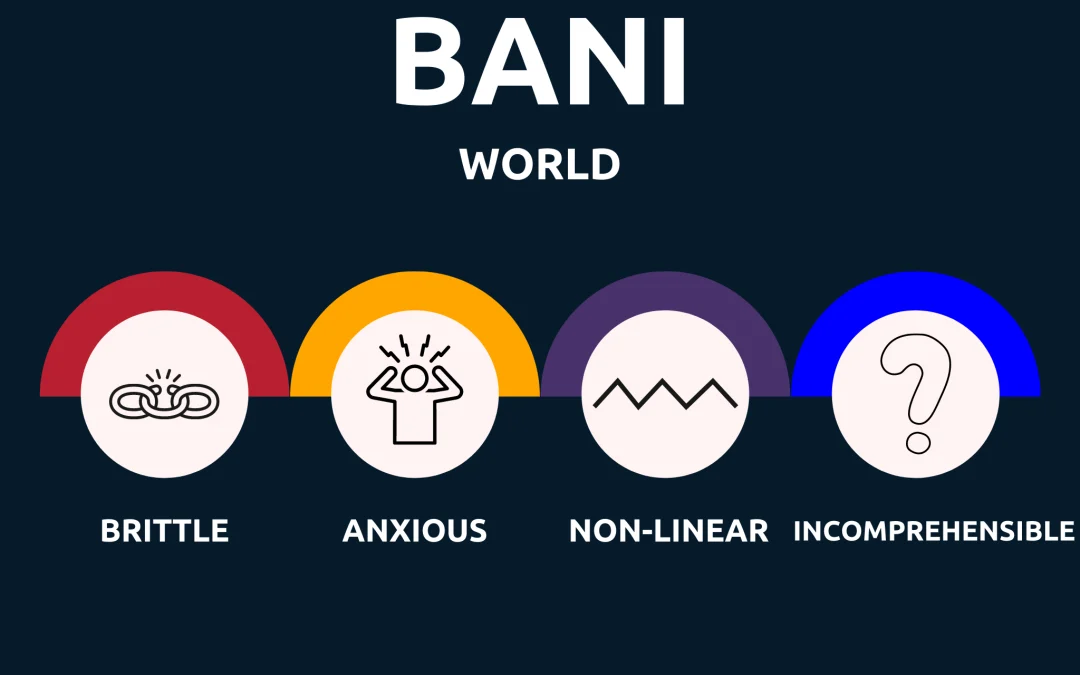
In response, a new model has emerged: BANI. Coined by futurist Jamais Cascio in 2018, BANI captures the realities of today’s world, where systems and organizations are increasingly:
Brittle – Fragile structures that appear strong but break under pressure.
Anxious – Persistent uncertainty that fuels fear and indecision.
Nonlinear – Disruptions that unfold unpredictably, making outcomes hard to anticipate.
Incomprehensible – Complexity that defies understanding, even with vast amounts of data.
This shift in perspective forces leaders to rethink their approach. The strategies that worked in a VUCA world are now inadequate. To thrive in a BANI environment, leaders must cultivate new skills, foster resilience, and embrace adaptability. Let’s explore what each component of BANI means and how to lead effectively in this new reality.
Brittle: The Hidden Fragility in Our Systems
Brittle things often appear strong—until they suddenly shatter. Many business structures, supply chains, and economies operate under this illusion of strength. However, minor disruptions can have disproportionate consequences, revealing their fragility.
Consider these examples:
A small earthquake in Japan disrupted the production of a single microchip, bringing automobile manufacturing in Detroit to a standstill.
A CrowdStrike software update caused millions of Windows computers to crash, grounding flights and disrupting businesses worldwide.
The Ever Given cargo ship blocked the Suez Canal, halting global trade and escalating costs for businesses worldwide.
How Leaders Can Respond
To counter brittleness, leaders must focus on resilience and redundancy rather than pure efficiency. Instead of optimizing for short-term gains, organizations should:
Develop backup systems to ensure continuity when disruptions occur.
Diversify supply chains to avoid over-reliance on a single provider.
Foster adaptability in teams to encourage quick responses to unexpected challenges.
In a BANI world, resilience is a necessity, not a luxury. Organizations must prepare for disruptions before they happen.
Anxious: Leading Through Fear and Uncertainty
Anxiety in today’s world is not just occasional stress—it is constant. Unlike the uncertainty of VUCA, which allowed time for strategic planning, BANI’s anxiety is relentless. It affects individuals, teams, and entire organisations.
People worry about:
Job security—Will AI replace my role?
Economic stability—Can the business survive market shifts?
Political changes—How will global conflicts impact our industry?
The Problem with Anxiety
When people feel overwhelmed, they often freeze. This leads to:
Reduced innovation and risk-taking.
Slower decision-making.
Increased resistance to change.
How Leaders Can Respond
Leaders cannot eliminate uncertainty, but they can reduce its impact by:
Empowering teams—Giving people control over decisions, even small ones, restores confidence.
Creating psychological safety—Encouraging dialogue and experimentation without fear fosters resilience.
Above all, leaders must provide a steady presence. Empathy and optimism are essential tools in countering the paralysing effects of anxiety.
Nonlinear: The End of Predictability
In a traditional business environment, effort and outcomes followed a logical path—work harder, achieve better results. That assumption no longer holds.
Small events can now trigger massive, unpredictable consequences.
For example:
The launch of DeepSeek AI in China erased trillions of dollars in market value almost overnight.
A single tweet from a CEO can alter stock prices more than a company’s official earnings report.
How Leaders Can Respond
Since predictability is no longer an option, leaders must:
Embrace agility—Rigid plans will fail in a nonlinear world. Flexibility is key.
Experiment rapidly—Small, iterative changes reveal what works before major investments.
Look for emerging patterns—Instead of predicting exact outcomes, focus on identifying trends and responding accordingly.
Success now depends on how quickly leaders can adapt to unexpected shifts. The ability to pivot is more valuable than a detailed long-term plan.
Incomprehensible: Making Decisions Without All the Answers
We are drowning in data, yet understanding it all is impossible. With AI advancements happening at an overwhelming pace, even experts struggle to keep up.
Every week brings a new breakthrough, making last month’s knowledge obsolete.
This presents a challenge: if leaders wait for complete clarity before making a decision, they will already be behind.
How Leaders Can Respond
To lead effectively in an incomprehensible world:
Trust intuition and experience—Analysis paralysis is a real threat. Sometimes, gut instincts matter more than excessive data.
Simplify where possible—Focus on the essentials rather than getting lost in complexity.
Accept uncertainty—The goal is not perfect knowledge but the ability to act decisively despite ambiguity.
What Leadership Looks Like in a BANI World
To navigate this environment, leaders must develop five key competencies:
1. Visionary Thinking
In a rapidly changing world, leaders must craft compelling narratives about the future. A clear vision transforms uncertainty into direction and anxiety into hope.
2. Agility and Adaptability
Since the future is nonlinear, leaders must expect change and pivot when needed. Encouraging teams to experiment fosters resilience.
3. Innovation and Reinvention
Rather than waiting for disruption, leaders should challenge assumptions and drive reinvention before it becomes a necessity. Creativity is no longer optional—it is a survival skill.
4. Relationship Building
Strong networks, trust, and collaboration are more important than ever. Seeking diverse perspectives enhances problem-solving and fosters innovation.
5. Resilience and Perseverance
Setbacks are inevitable. Effective leaders view failures as learning opportunities and keep their teams focused on long-term goals.
Final Thoughts: The Unbridled Leader’s Role in a BANI World
The old leadership models no longer work. When systems are brittle, leaders must build resilience. When anxiety pervades, they must offer clarity. When change is nonlinear, adaptability becomes essential. And when reality feels incomprehensible, leaders must act with confidence despite uncertainty.
This is why I advocate for learning from nature, particularly from horses. Horses have thrived for 65 million years by mastering adaptability, sensing danger before it arrives, and leading through trust rather than control.
If you want your team to develop the leadership skills needed for a BANI world, let’s have a conversation.
📩 Reach out for a complimentary discussion on how to future-proof your leadership team.
As a leader, what will you do differently this week to prepare for the challenges ahead?
Show Notes:
Here are the highlights from this episode:
00:00Introduction to Impactful Teamwork
01:28Understanding VUCA and Introducing BANI
03:52Breaking Down BANI: Brittle
07:06Breaking Down BANI: Anxious
08:45Breaking Down BANI: Nonlinear
10:47Breaking Down BANI: Incomprehensible
12:23Addressing Anxiety in Teams
18:28Core Competencies for Leaders in a BANI World