by Julia Felton | Apr 18, 2018
We’ve all heard the announcements on the Underground (or subway if you live abroad) to “Step Away From The Edge”. In effect they are reminding us that we need to step away and put space between us and our businesses and and yet the reality is that few business leaders really do this, especially in the SME sector. Business leaders struggle to “Stop working in the business and start working on the business” The result is that many businesses get stuck at a certain revenue ceiling because they simply can’t grow. The business leader/owner has become a bottle neck in the business causing operational flows to slow down and in the worst case stop all together.
Some recent research conducted by Haines Watts, a UK accountancy firm, of 500 UK SME’s revealed that “(42%) of UK SME owners believe that their business couldn’t survive more than a single week without them at the helm”. I can’t imagine what pressure that puts on the business leader just simply to keep things going. Having time to take any vacation, well that simply doesn’t figure into the equation. And yet when business leaders step away, even for just a few days, from the daily business operations, they come back renewed, re-energised and with a new perspective on business issues.
Here are five reasons for this very serious business challenge:
- Lack of Shared Vision
Business leaders are very poor at articulating clearly their vision for the business. As such their teams are not on the same page when it comes to the strategic growth plan. These divergent views cause silos to emerge, and create team disengagement as the team members, who could massively drive the business forward, are not engaged and don’t feel they know how to contribute to the success of the business.
- Poor Planning
The research revealed that only 84% of business owners are only able to spend between 1-10% of their working week planning for the future. In contrast, business leaders who are able to step back and focus predominantly on planning are more than twice as likely to run fast growth businesses (annual growth greater than 15%).This is the typical chicken and egg situation. The business leader doesn’t feel that they has time to plan, and yet without creating a robust, well thought out plan, no-one else can navigate the business, as they don’t know where they are heading.
- Lack of TrustOnly 60% of business leaders believe that they have the full support of their management team and as a result many business leaders simply don’t trust their team to deliver. Whether this is a perception built on ego – No-one can do this as well as me – or a genuine concern, the reality is the same. The business leader doesn’t share vital information with team members, and so they feel disempowered to do their role.Concerningly, despite nearly 50% half of business leaders lacking trust in their management teams, the teams themselves don’t realise that trust isn’t there. 83% of senior managers believe they fully understand the business owner’s goals and 87% hold the, often false, belief they would be trusted to run the business even in the owner’s absence. So, there is a massive gulf in team members perceptions and that of the business leader.
- Lack of Communication
The problem of a lack of trust is compounded by poor communication. 52% of business owners find themselves hiding their concerns from their teams because they are worried about showing vulnerability. And yet we know that being able to display vulnerability is a key skill of a leader. And if the business leader cannot articulate their concerns to their management teams then there is no transparency and courageous conversations fail to occur.
- Lack of a Growth Mindset
For an SME business there is a very real need to focus on sales if the business is to grow, and yet many management teams lack the skillset to help the business leader grow the business. The research revealed that over half (53%) of management teams have never helped grow a business prior to the one they now work in today. This is because in larger organisations there are specific functions dedicated to sales, and yet in a smaller business every single team member needs to be a brand ambassador actively promoting and selling the business at every opportunity
Given that SME sector is the powerhouse of economic growth across the world it is imperative that we help these business leaders elevate themselves out of the day to day operations so that they can become more strategic about their growth. Only by doing so will they be able to fully leverage the power of their teams which will create a more engaged workforce that help deliver more productivity and profitability to fuel business growth.
by Julia Felton | Feb 7, 2018
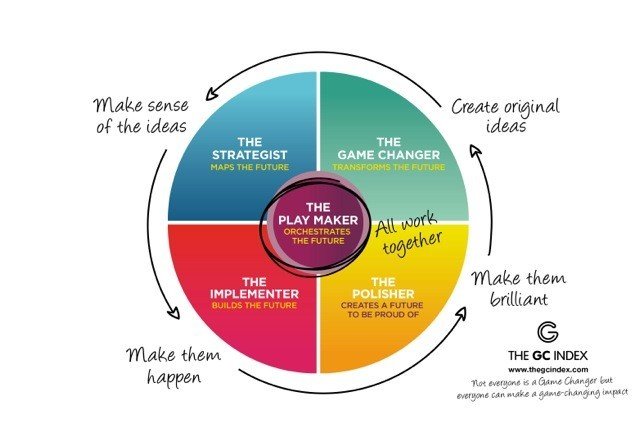
Many traditional corporate organisations are struggling to adapt to the demands of a new world that is rapidly changing around them. They are clinging on to the same ideas, talent management models, and ways of working with leaders who are either oblivious to the current mindset or too frightened to instigate change. Research by the GC Index suggests that Game Changers, the very people with the potential to initiate and drive transformational change, are rarely able to make their mark in corporate settings.
Game-changing is different to innovation. Innovators build on what has been done before: the pursuit of excellence through continuous improvement and incremental change. It’s Game Changers who can help trigger and drive transformational change.
The reality is that many organisations are driving their vision through the need for innovation. They often deliver this in quite a controlled way, by investing in innovation hubs, labs, processes and programmes.
So here are six ways that organisations that create game changing teams and cultures
1) FOCUS ON CONTRIBUTION
We need to do more than focusing solely on past experience and who is ‘available’ to work on a project. Instead, we should focus on the real contribution that individuals can make – focus on who is ‘best’.
By understanding what each person can contribute to their team, project and to the wider organisation, leaders are far more likely to create a game-changing culture.
2) IDENTIFY YOUR GAME CHANGING TALENT
In a world where today’s employee can be tomorrow’s competitor, identifying and embracing Game Changers is critical to long-term business performance. The GC Index is a new organometric, which enables organisations to identify their Game Changers.
Companies are using The GC Index to better understand the profile of their organisation and teams. It helps them maximise the contribution individuals can make at all levels and to ensure they create game-changing teams.
3) HELP GAME CHANGERS TO DEVELOP CORPORATE SKILLS
Most Game Changers find it difficult to navigate their way around a traditional corporate organisation. As a result they are often seen as dysfunctional or slightly awkward.
It’s important to help Game Changers understand the contribution other people make, and how others can help realise their game-changing idea.
By helping them recognise that some people will find their game-changing nature unsettling at times, and by giving them the tools to influence other people, they are far more likely to be able to make a positive game-changing contribution.
4) CREATE A GAME CHANGER COHORT
The CG Index research suggests Game Changers appear to naturally group together – by doing so they are able to express themselves freely and often more likely to realise their potential. There are lots of examples of this, whether it is in Silicon Valley, artists in Paris, or Fintech hubs in global financial districts.
Giving Game Changers a space to work together can promote both knowledge transfer and retention, in addition to increasing commitment and engagement through valued interpersonal connections.
5) FOCUS ON CULTURE CHANGE – EDUCATE MANAGERS
A fifth priority for organisations is to acknowledge that without changing the attitudes of managers and leaders, the engrained culture will continue to undermine progress towards achieving a game-changing culture.
We need to educate managers so that they understand the importance of game-changing talent and how to manage Game Changers. We also need to get them to start shifting their mindsets and put contribution and impact at the heart of their talent decisions. This focus on contribution will break down any inherent ‘unconscious bias’ and move managers out of the ‘fail safe zone’ to one where firstly they themselves feel ‘safe to fail’.
6) FIND A GAME CHANGER CHAMPION
Creating a game-changing culture requires an element of risk and therefore it’s important to have a Game Changer champion at the top.
It really needs someone on the Board who understands Game Changers and what is required to ensure they deliver value. Ground breaking creativity and innovation may lie with one individual. But it’s only a game-changing team that can achieve step change innovation and transformation that has longevity.
If you want to discover more about what type of Game Changer you are then why no join us for the launch of The ChangeMaker Profile powered by the GC Index on Tuesday 27th February in London. You can secure your place here.
The ChangeMaker Profile powered by the GC Index is a focused solution for those in the world of change and change management, which was developed in response to world-wide client demand. It leverages its framework of impact and contribution to support individuals, teams and organisations, throughout the transformational change process and is often used by organisations and individuals alongside other change management tools to give them the foundation to kick-start their change journey.
The profile allows people to understand how they can play to their natural strengths and maximise their contribution to change as an individual and as part of a team.
Can’t make the event but want to learn more, simply drop me a line at Ju***@****************er.com and we can have a conversation to explore how this solution could benefit your organisation.
by Julia Felton | Jul 26, 2017
How come some teams are successful and others aren’t? I’m sure we’ve all been in teams that work well and other teams that don’t, and if you’re like me being in a dysfunctional team is super frustrating. So what are the traits of high performance teams and how do we ensure that any team we are part of adopts these traits.
Google was inspired to conduct some research to codify the secrets of team effectiveness and to examine why some teams excelled whilst others fell behind, and what they discovered surprised them. .
Before this study, like many other organisations, Google Execs believed that building the best teams meant compiling the best people. It makes sense. The best engineer plus an MBA, throw in a PhD, and there you have it. The perfect team, right? However, in the words of Julia Rozovsky, Google’s people analytics manager, “We were dead wrong.”
Eager to find the perfect mixture of skills, backgrounds, and traits to engineer super-teams, Google put together a team of statisticians, organisational psychologists, sociologists, engineers, and researchers to help solve the puzzle. Over a two year period they studied 180 Google teams, conduct 200-plus interviews, and analysed over 250 different team attributes. However, at the end they still had no clear pattern of characteristics that could be plugged into a dream-team generating algorithm.
This is because they initially failed to consider the behaviours of the group and how that impacted the collective intelligence of the team. It seems that the dynamic of how the team moves through the cycle of form – storm – norm – perform is pivotal to the ultimate success of the team.
I’m sure you’ve heard the quote by Aristotle, “The whole can be greater than the sum of its parts” and intuitively we all know that two heads are better than one but it is how these two heads collaborate and inter-act together that determines the success of the group. Great teamwork is not based on individual brilliance but rather on the dynamic and relationships that exist between the team members.
So here are the five traits of a high performing team that Google eventually identified:
- Dependability – Team members get things done on time and meet expectations.
- Structure and clarity – High-performing teams have clear goals, and have well-defined roles within the group.
- Meaning – The work has personal significance to each member.
- Impact – The group believes their work is purposeful and positively impacts the greater good.
- Psychological Safety – An environment where opinions are listened to and team members feel heard
I’m sure we’ve all been in meetings and, due to the fear of seeming incompetent, have held back questions or ideas. I know I have. It’s unnerving to feel like you’re in an environment where everything you do or say is under a microscope. But imagine a different setting, a situation in which every team member feels safe to take risks, voice their opinions, and ask judgment-free questions. A culture where managers provide air cover and create safe zones so team members can let down their guard. That’s psychological safety.
Reviewing these five traits we can see that team success is as much to do with the team dynamics and the business culture as with individual skill sets. In an age where teamwork is becoming increasingly important to respond to the uncertain world in which we live, the need to hire team members that are a good cultural and values fit is essential. Just imagine the impact of having someone in your team who is not aligned with the other team members. Not only do they feel uncomfortable but they also impact the harmony of the group, and in the worst situation can negatively impact the entire team. John Maxwell refers to this as the “law of the bad apple” and if not dealt with swiftly can cause silo mentality to develop within the team.
It is also interesting to note that the research highlighted that high performance teams feel like they are making an impact. In other words the team is purpose-driven. They exist to create an impact that this bigger then themselves and have some broader influence on the world. Increasingly, I am coming across more and more people who are more consciously aware of their impact and want to be part of something that is making a difference in the world. After all, in many ways we all want to make a contribution and be in service to others, as that just fulfils one of our basic human needs.
What contribution do you want to make and how does that impact how you show up in a team? If you’d like to explore what your purpose is and how you can make a real difference in the world, then let’s have a powerful conversation, as I know when I unlocked my purpose it made a massive difference to my own self-worth and business success.

by Julia Felton | Jun 25, 2016
Having led and worked in teams for more than 30 years, I thought I’d share a few key ideas that I have learnt that will you get a team of people to work more cohesively and effectively together. It is particularly effective to do some of these with a new team or group that about to embark on a project together. It can really pay dividends in the smooth running of the project.
1. Enable Them To Build trust
In my book The Alchemy of Change I reveal how trust is the glue that holds a business together. It is that unseen factor in business that makes all the difference. In his book on the five dysfunctions of a team Patrick Lencioni explains i it is really important for a team to develop ‘vulnerability-based’ trust. This means that they need to share things and understand more about each other. Personally I love using Talent Dynamics which is an assessment tool which helps team members learn more about themselves and their other team members in a non-threatening way. And of course when you understand the drivers of your other team members communication can be enhanced. Also by every team member focusing on their strengths the group collective is enable to achieve greater productivity and profitability than the sum of the individuals. This is the power of collective teamwork.
Another way to help team members build trust is by allowing them to share stories with each other about when they were younger. Here is a format that I got from Larry Reynolds, which I have used many times to great effect.
- Think of a time when you faced some kind of challenge. It can be a challenge big or small, and it can be something that happened recently or many years ago. Challenges you faced as a child or young adult can make especially powerful stories. The only proviso is that things worked out alright in the end, and that you are happy to share this experience with others.
- How did you feel when you encountered this challenge? It’s probably something on the spectrum between concerned and terrified.
- What unexpected help came your way? Maybe you drew on some inner resources, or maybe someone else helped you.
- How did things work out in the end?
- What did you learn from this experience?
- What does that say about your values and beliefs as a person now
2. Help Them Get Comfortable With Disagreeing
It’s really important, if a team are to make great decisions that they are comfortable with a level of conflict and disagreement in the team. Give them some tasks to do that involve disagreement and negotiation. Set a task where a decision needs to make and carefully facilitate a discussion where when a person states a point of view or puts forward an idea, at least two people must say specifically what they like or agree with and then at least two people must point out potential issues, flaws or reasons that they disagree. When a team can get comfortable separating the ideas and concepts from the person, they will be able to make better decisions. Also if issues are discussed properly, teams are able to commit to decisions that they don’t necessarily fully agree with if they can understand the rationale behind the decision and they feel that they have been fully heard.
3. Help Them Get Comfortable Giving And Receiving Feedback
Giving and receiving feedback effectively will enable the team to grow and develop faster and will also enable them to hold each other accountable for behaviours and results. Enable them to practise giving real face-to-face feedback by doing an activity such as ‘warm seat’:
A ‘warm seat’ is a little bit like a hot seat but cooler! Group members prepare questions to ask the rest of the group about themselves. These questions can be positive e.g. what is great about working with me? Neutral e.g. what is it like working with me? Or negative e.g. in what ways do I sometimes annoy you? Group members take it in turns to sit in the warm seat for a pre-arranged amount of time e.g. five minutes and ask their questions. Group members answer the questions (which can be general or specific) as specifically as possible with examples. They can only answer questions posed and at any time the person is free to vacate the warm seat if they’ve had enough.
4. Set Up A Team Charter
Another practical thing that a team can do is to set up a team charter, which includes agreements about ways of working. Get clarity first on the team’s vision, purpose and values. Then get clear about people’s different roles within the team by defining individual responsibilities and goals through referencing their strengths using Talent Dynamics. They can then get into identifying appropriate behaviours for team members, communication and decision-making processes and agreements about the use of resources. Encourage the team to put forward ‘rules’ that they can all sign up to, for example, ‘we get back to e-mails from each other within 24 hours’ or ‘when we disagree, we express this calmly and openly’ etc. Once this charter is established, team members can be encouraged to hold each other accountable for both behaving in line with what has been agreed and for their responsibility areas. This should happen as part of every team meeting.
5. Practice Being A Real Team By Giving Them A Challenge To Complete
Overcoming obstacles to achieve a goal is something that we typically get all teams engage in during my leadership with horses workshop. In this exercise the team members set the goal they wish to achieve and then build obstacles that could represent things that could prevent them from meet the goal. They then get introduced to a new team member (a horse) and have to all work together to get over the obstacles and achieve the goals. The team get all kinds of insights into how to communicate effectively, the different positions of leadership and how to co-operate and collaborate together to achieve success. The celebrations that occur when the team is successful are incredible and every team has always gone back to the workplace with more confidence and certainty about their capabilities.
Since the team has had an embodied experience of how to work successfully together this physical or ‘muscle’ memory stays with them and also make them want to achieve that feeling of working in harmony and being jointly accountable again!. Once people feel what it’s like to truly work as a team and achieve positive results, they usually want to do it again!
To learn about how to develop your high performance team please connect with me for a complimentary conversation and lets explore what’s possible.
by Julia Felton | Jan 16, 2016
When I’m often speaking with my clients I hear the words “FAILURE IS NOT AN OPTION” and whilst I can concur with this principle what often gets overlooked is the fact that it is failure that leads to success. Whilst an overall intention would be for the business not to fail, the reality is that along the way there will be lots of failures – or as I prefer to call them opportunities to learn. There is nothing wrong with failure so long as the learning is taken and applied and the same error is not repeated again. Thomas Edison could have had 1,000 failures before he created the light bulb whereas he choose to re-frame that as 1,000 opportunities to learn what doesn’t work so that he could improve on this next time.
“Failure provides the opportunity to begin again, more intelligently.” ~ Henry Ford
One of the challenges in business is many business cultures do not activity support the concept of failure, aka opportunities to learn, and when team members mistakenly think they they cannot fail it stifles creativity and innovation and this can lead to the business becoming stagnant and unresponsive to changes in the competitive landscape.
Recently I have been working with a group of elite leaders, who coming from the world of sport, more than others, really believe that failure is not an option and that winning is the only imperative. The challenge is that this attitude has been affecting the culture of the business and so has been hampering the innovation and creativity in their business.
The harsh fact is that businesses often fail because they don’t have a high enough degree of innovation, co-operation and collaboration. Inevitably, a competitor comes along with a superior teamwork, co-operation, collaboration and inter-dependency and eventually the less effective business is unable to compete. Take Southwest Airlines as an example. They used to be a small, inconsequential airline operator and yet today, through taking an innovative approach to their business, they have now become one of the most profitable and valuable airlines in the United States.
For business to be successful in the 21st century it is imperative that it fosters an entrepreneurial spirit amongst team members. Long term, sustainable competitive advantage is achieved through out-innovating the competition in ways that enhance efficiency and create greater value for customers. To achieve this, team members need to be unleashed and allowed to tap into their own genius. Imagine the impact if every single person working for a company were able to create and innovate. Imagine how much more intellectual capital would be available to the business, as each person would be accessing their full potential, making a real contribution and be in Flow. It would be a win-win situation for everyone.
Contrast this with the traditional control and command structures where the message to team members is typically something like, “We don’t pay you to think: we just pay you to do your job”. As a result, great opportunities to be creative and innovative are lost because the team members interfacing with the customers do not feel empowered to make decisions and challenge the status quo. Ironically, the one thing that the command and control structure seeks to achieve in fact hampers business growth as resources are not optimised and business opportunities are wasted.
Whole Foods is a great example of a company that has managed to empower their team members by creating a workplace based on love and care and that is also fun, where team members aren’t afraid and collaboration reigns. It is this release of creativity and innovation that has enabled the company to improve and evolve rapidly.
Without a collaborative culture, this innovation and creativity would have been of limited value. It is no good for one business unit to come up with a great idea and then not share it with the rest of their colleagues. A culture of collaboration enables successful ideas and innovations to be shared and spread rapidly throughout the business. The great thing is that technology can help rapidly disseminate information so new ideas can be almost instantly put into action. With even more Big Data metrics than ever before, businesses can effectively monitor and track how these new initiatives are impacting business performance.
This continual review process creates the opportunity for continual learning and improvement within the business. In this set up, business truly becomes a living system that learns, grows, evolves, self-organises – and even self-actualises – on its own. The right degree of decentralisation, empowerment, love and care in the workplace enables business to adapt, innovate and evolve faster enabling them to enjoy strong, sustainable competitive advantage.
So how are you creating a culture of innovation and creativity within your business? What systems and processes do you have in place to finely manage the balance of innovation with the need for some structure? Are you business leaders demonstrating and role modelling what innovation looks like? What are the consequences of not failing to encourage failure?
If you’d like to learn more about how to create a create a culture of innovation and collaboration then you might enjoy reading The Alchemy of Change: Ancient Wisdom Reinvented to Unleash The Hidden Potential of Leaders and Teams
by Julia Felton | Jan 9, 2016
Success is a team sport and it is imperative that you have the right team members alongside you to create a winning team. Now I know when you are starting out in business having a team might seem like a luxury, but trust me it is the best investment you can make.
Having a team helps you feel supported and no longer alone. The curse of the business owner is feeling like they have to do it all themselves, whilst the opposite is in fact true. Surround yourself with team members who excel at the activities you don’t. It will make your life so much easier and allow you to spend time doing the things that you love and that add real value to the business.
And if you’ve ever like to add me to your team then let me know and we can schedule a complimentary strategy session to see if we would be a good fit for each other.
Just like any successful sports team, your team members must gel together if you are to really leverage the full benefits of teamwork.

by Julia Felton | Nov 27, 2015
Just because you have the title of leader doesn’t make you are a leader. And just because you don’t have the title of leader doesn’t mean you aren’t a leader. To my mind everyone in the organisation is a leader which is why in my new book The Alchemy Of Change: The Key To the Future Lies In The Past I explore the concept of Shared Leadership.
So what is Shared Leadership?
Shared Leadership is the concept that, given the rapidity of change, there is no way one person can know about everything in the business. For a business to be successful, leadership and decision making needs to be shared.
The old paradigm of command and control leadership simply won’t serve us in this The Big data era, where collaboration is a necessity. There is simply too much going on for one leader to be able to manage it all. This in itself creates blind spots for businesses, which is why a more flatter, more collaborative style of leadership, which is more responsive is required.
When Shared Leadership is adopted within the organisation then everyone looks out for the needs of the businesses, not in a self-serving ego way, but from a place of contribution to the community. Everyone is focused on the goal and works as a team to achieve this. It always surprises me that business has not taken a leaf from the world of sport. In a sports team there is no place for individual performance. Success only comes from the collective performance of the team.
The famous basketball player Michael Jordan knew this when he said: “Talent wins games but teamwork and intelligence wins championships”. Michael understood the power of collaboration and how only by all team members working together could the team win the game.
Interestingly, herds of wild horses also understand the power of Shared Leadership. The herd is structured with two leaders – the lead mare and the stallion – and they work in collaboration to keep the herd safe. They seek out food, water and shelter for the herd but the herd members do not solely rely on the leaders to keep them safe. Every herd member has a responsibility to maintain the safety of the herd and so contribute to its survival.
The herd has a shared purpose and focus, which quite simply is to stay alive. As a prey animal the horses main challenge is how to avoid being someone else’s dinner! It is this shared purpose and vision which enables the herd to become self regulating. There is no space in the herd for self-serving members and in fact they are driven out of the herd. This is the worst punishment ever because being evicted from the herd means that you are all alone, and this is not a safe place to be because its challenging to protect yourself when you are isolated from others.
So when is business going to wake up to the need for Shared Leadership? I wonder how much more productive and profitable an organisation could be if everyone was working from the same page towards the same goals and where the result of the team was more important than that of the individual.
The 2010 Burston-Marsteller?IMD Corporate Purpose Study revealed that organisations that focused on having a strong well communicated corporate purpose that everyone in the business got behind delivered a 17% improvement in financial performance compared to those organisations that didn’t. Wow, what a load of resources are being wasted in business simply because of the self serving stance that many people are taking.
Imagine the possibilities if everyone in business worked more effectively together as a high performing team. I wonder what we all could achieve.
If you’d like to learn more about the principles of creating a high performance business with Shared Leadership then please connect with me for a complimentary consultation.

by Julia Felton | Oct 1, 2015
When you type the phrase ‘inspiring leaders’ into Google, the results are most likely what you’d expect — images of Steve Jobs, Martin Luther King, Mahatma Gandhi and Nelson Mandela. But have you ever stopped to consider why these usual suspects show up time and time again in conversations about inspiring leadership, and what they might have in common, in terms of the way they think, act and communicate?
One of the most popular TED talks of all time, given by leadership expert Simon Sinek, considers this very question. With almost 20 million views, there are clearly many people who want to understand what it takes to lead in a way that inspires others, and why it is that some organisations and some leaders are able to inspire where others aren’t?
In his talk, Sinek claims to have discovered a pattern between these leaders, which he has codified into an idea called the ‘golden circle’.
“Every single person, every single organisation on the planet knows what they do, 100%. Some know how they do it, whether you call it your differentiated value proposition or your proprietary process or your USP. But very, very few people or organisations know why they do what they do…By “why,” I mean: What’s your purpose? What’s your cause? What’s your belief? Why does your organisation exist? Why do you get out of bed in the morning? And why should anyone care?”
Core to Sinek’s ‘golden circle’ principle is the idea that “people don’t buy what you do; they buy why you do it.”
Apple
Citing Apple as a shining example, Sinek attributes the brand’s success to its ability to get people to believe in what it does by communicating why they do things the way they do. So rather than saying “we make great computers — want to buy one?”, Apple has always placed emphasis on communicating from the inside out, clarifying why it builds the products it does.
According to Sinek, Apple says: “Everything we do, we believe in challenging the status quo. We believe in thinking differently. The way we challenge the status quo is by making our products beautifully designed, simple to use and user friendly. We just happen to make great computers. Want to buy one?”
The science
Sinek bases his theory upon scientific fact, and specifically, the biological make-up of the brain, which he says corresponds directly to his ‘golden circle’ rule.
A cross-section of the brain has three major components. The neocortex (on the outside) is responsible for all of our rational and analytical thought and language. Our limbic brains (the middle two sections) are responsible for all of our feelings, like trust and loyalty. They are also responsible for all human behaviour, all decision-making, and have no capacity for language.
So, according to Sinek, “when we can communicate from the inside out, we’re talking directly to the part of the brain that controls behaviour, and then we allow people to rationalise it with the tangible things we say and do. This is where gut decisions come from.”
For a business having a clear purpose, a clear Why, is essential to give the business direction. The business Why acts like a true north compass steering the business towards success, Without knowing where you are going the business can end up stalling and at best going round in a circle. Being busy but achieving little.
A clear business Why is also of paramount importance as it helps engage the mind and soul of team members who want to innately contribute to a bigger purpose. When everyone is on the same page then as the organisation is able to start unlocking some of its hidden potential. Why? because team members give more of themselves when they acknowledge they are committed to a vision bigger than themselves. In the words of Sinek, “Whether they’re individuals or organisations, we follow those who lead, not because we have to, but because we want to. We follow those who lead, not for them, but for ourselves.”
So if you haven’t already, ask yourself why you do what you do every day. Once you can answer that with conviction, you’ll be more likely to hire team members who share your beliefs and win the trust and loyalty of those whom you lead, whilst sprinkling a bit of inspiration along the way.
Creating a solid Business Promise (Why) is a key facet of one of the three cornerstones of creating a Joined Up Business and that is explained in my book the Alchemy Of Change: Ancient Wisdom Re-invented to Unleash the Potential Of Leaders and Team. You can get a copy here.
by Julia Felton | Sep 22, 2015
Your flow comes from following your natural path. Your team momentum comes from each team member following their natural path. Each frequency and each profile has a different role within the team where they can be most effective. Often the best team selection is not the person who can be most effective, but the person who enables the existing team to become more effective.
Here are the 8 profiles, and the role within the team that allows them to be in their greatest flow:
Creator: The initiator
Creators are the best initiators, and although they can be quick to create chaos, they can also be surprisingly innovative at finding ways out of chaos. Always put them in charge of new projects, but move them on to the next creation once their job is done.
Star: The promoter
Stars are the best promoters, but need to lead from the front. Give them the chance to shine, and give them the space to deliver results without tying them down. Give them the systems and support to enable them to focus on building new business.
Supporter: The leader
Supporters are the best leaders, but don’t expect them to come up with the plan. Build a plan and set the goals with a Supporter, and then let them lead the team towards the plan. Let them set their own management style, and their own agenda.
Deal Maker: The peace maker
Deal Makers are the best peacemakers, and will leave everyone feeling good. Don’t expect them to go out cold calling, as they thrive on building the relationships they have. Work with Deal Makers to nurture the customer and relationships you have.
Trader: The negotiator
Traders are your best negotiators. They will always get you the best price, in both what you buy and what you sell. They want to be given the parameters in which to work. Traders will have their ear to the ground in your market and your team.
Accumulator: The ambassador
Accumulators are your best ambassadors. They are reliable, get things done on time, and are not prone to making rash decisions. Accumulators make the best project managers, when a specific task needs to be delivered reliably.
Lord: The analyst
Lords are your best analysts. Give them the space to study the detail, and to deliver the data. Don’t ask them to go out and network, as they are strongest when focused behind the scenes.
Mechanic: The completer
Mechanics are your best completers. They will wrap up the process and find smart ways to do it better next time. Don’t ask a mechanic to start from scratch, but do give them an existing process or product to improve on.
by Julia Felton | Apr 7, 2015
Trust is not an abstract, theoretical, idealistic goal forever beyond our reach. Trust—or a lack of it—is inherent in every action that we take and affects everything that we do. Trust is the cement that binds relationships, keeping spouses together, business deals intact and political systems stable. Without trust, marriages fail, voters become apathetic and organizations flounder. Without trust, no person or company can ever hope for excellence.
The truth is, trust must be carefully constructed, vigorously nurtured and constantly reinforced. Although it takes a long time to develop, it can be destroyed by a single action. And once lost, it is exceptionally difficult to re-establish.
Over the years horses have taught me much about how to build trust. The best lessons probably came from Bunny and Red, two rescue horses that were terrified of people. In order to build their trust I had to demonstrate consistent, credible behaviour. I had to do what I told them I would do, continually following through and also rewarding and acknowledging them for every action they took that enhanced our relationship. The truth is that it took a long time to build trust with these horses, but once formed we had an amazing relationship that still exists today. However, I am all too aware of how fragile that trust is and how easily it could be lost.The same principles for building trust with the horses can be applied to building more trustful relationships in business. Here are 14 things to remember when building trust, adapted from
Follow Your Conscience by Frank Sonnenberg:
1. Be straight with people. Tell it like it is.
2. Don’t be afraid to present bad news. It’s worse to sweep it under the rug.
3. Remain calm, cool and collected during difficult times.
4. Present both sides of an issue. (Let them judge for themselves.)
5. Be a good listener.
6. Disclose potential conflicts of interest.
7. Even a tiny exaggeration can destroy your credibility.
8. Always tell the truth or the truth will tell on you.
9. Your actions “off-stage” (like at an office party or on Facebook) impact your trust and credibility.
10. “Everybody does it” is a poor excuse for doing it yourself.
11. Learn how to disagree without being disagreeable.
12. Repeating a rumor is as vicious as starting one.
13. People will test you in small ways before trusting you outright.
14. The only thing worse than talking about others is talking about yourself.
If you’d like to learn how to build trust in your organisation then I’d be happy to talk with you because it has been shown that the higher the levels of trust in business the more profitable and successful the business can be.
Want to find out where you are most trusted in business, then take the free assessment here.