
by Julia Felton | Dec 9, 2025
Most leaders don’t realise how much influence they lose the second they switch on a webcam.
In the boardroom, they’re confident, intentional, switched on.
Online?
They look like they’ve joined witness protection.
Giant forehead. Echoey audio. Distracting background clutter. Eyes staring at the screen instead of the people.
Trust slips. Engagement dies. Authority evaporates.
And because remote meetings now are the boardroom, this problem is no longer cosmetic. It’s existential.
So I brought in someone who lives and breathes this work.
This week on Impactful Teamwork, I was joined by Alfred Poor – keynote speaker, technology expert, and virtual-presentation specialist. His mission? Helping founders and leaders show up online with influence, clarity, and credibility.
This conversation was one of the most practical we’ve ever had.
Below is a full breakdown plus action steps you can implement today.
The 75% Reality Check
Gartner predicts that 75% of all business meetings in the US will be online. For many of us, it’s already higher.
Video calls are no longer the convenient option.
They are the core arena where leadership happens.
Hiring, firing, pitching, influencing, decision-making, problem-solving, performance reviews, investor conversations…
All increasingly happening through a lens.
As Alfred says:
“Video meetings are the new telephone… and also the new boardroom.”
If you are not intentional about how you show up, you’re choosing to undermine your own impact.
The Pandemic Broke Our Standards
Before COVID, only a handful of leaders used video regularly. After COVID, everyone was suddenly on screen with no training, no intention, no thought.
People slapped open laptops on kitchen counters.
Harsh lighting. Terrible angles. Distracting backgrounds.
Everything rushed. Nothing considered.
That “make do” mentality never reset.
But influence doesn’t happen by accident. It happens by design.
Alfred’s work boils virtual leadership down to three non-negotiables:
1. Be seen
2. Be heard
3. Minimise distractions
That’s it.
Simple. Powerful. Game-changing.
Let’s break them down.
1. Be Seen – Your Presence Matters
Online presence isn’t vanity. It’s leadership.
If people can’t clearly see your face, your eyes, your gestures, or your emotional cues, you lose authority. You lose connection. You lose trust.
Here’s what Alfred hammered home.
Fix your lighting
Most leaders have awful lighting because they rely on whatever room they happen to be in.
The fix is simple:
- Use two lamps with plain white shades
- Choose daylight bulbs (slightly blue, more flattering)
- Avoid yellowish light
- Move ring lights off-centre so you don’t flatten your face
- If you wear glasses, beware of those bright white donuts of reflection
Lighting doesn’t need to be expensive. It needs to be considerate.
Fix your framing
No more giant head. No more “up the nose” horror angle.
- Raise your camera to eye level
- Move it further back so your torso is visible
- Aim for the framing you’d see on BBC or Sky News
- Keep your gestures in your natural “power zone” (centre of your chest)
This instantly makes you appear more grounded, engaging, and trustworthy.
Fix your eye contact
Looking at people’s faces on screen feels like eye contact.
It isn’t.
Eye contact online = looking at the camera.
Alfred’s 50p hack:
Stick a pair of googly eyes next to the lens and talk to them.
Ridiculous. Effective. Transformative.
2. Be Heard – Your Voice Carries Your Leadership
Audio is the most underestimated part of virtual presence.
If your sound is muffled, echoey, or inconsistent, people stop listening. They drift. Their brain has to work harder, and that means they switch off.
Avoid your laptop mic
It picks up:
- Room echo
- Background noise
- Harshness
- Every tap on your keyboard
Better options
- USB mic (like the Blue Yeti in cardioid mode)
- Lavalier mic clipped to your clothing
- Headset if needed, especially in noisy environments
Tame the room
Hard surfaces create echo.
You don’t need a studio. You need softening:
- Curtains
- Cushions
- Rugs
- Even a blanket thrown over a table
If you wouldn’t hold a leadership meeting in a tiled bathroom, don’t sound like you’re sitting in one.
3. Minimise Distractions – Your Background Is Part of Your Brand
This is where leaders lose trust without realising it.
Stop using virtual backgrounds
Yes, I’m saying it.
Yes, Alfred said it too.
Your hair disappears.
Your hands glitch.
Your chair vanishes.
You look like a hologram.
It’s distracting, disorienting, and quietly damaging to your credibility.
If you haven’t thought about your background, people will wonder what else you haven’t thought about.
Better options
- Tidy real background
- Plain wall
- Photographic backdrop hung on a clothes rail
- A simple brand element like your logo or a company colour
And for the love of trust-building, remove anything:
- Messy
- Personal
- Political
- Strange
- Half-drunk
Your background speaks before you do.
A Big Mistake: Hiding Behind Slides
For years, screen sharing has meant:
Slide covers the screen.
Your face becomes a tiny postage stamp.
On a real stage, leaders never hide behind the screen.
They stand in front of it.
Alfred showed a brilliant alternative:
Use tools that allow your face and slide together.
You remain present.
Your authority stays intact.
Your message lands.
Even without fancy tools, you can:
- Speak to camera first
- Share the slide briefly
- Return to camera to anchor the message
Your presence is the presentation.
The Leadership Truth Underneath It All
This episode wasn’t really about cameras, lights, or microphones.
It was about leadership.
How you show up online reveals your:
- Intentionality
- Credibility
- Attention to detail
- Professionalism
- Authority
- Trustworthiness
If your team sees chaos behind you, they unconsciously question how you lead.
If your audio is unclear, they question your clarity.
If your lighting is off, they question your presence.
If you stare down at the screen, they question your confidence.
Your virtual environment is a leadership signal.
Make it a powerful one.
Action Steps You Can Implement Today
1. Record yourself on Zoom or Teams
Watch yourself back with brutal honesty.
Notice your lighting, framing, sound, background, and eye contact.
2. Improve one thing this week
- Raise your camera
- Add better lighting
- Clean your background
- Fix your audio
Leadership is built in micro-shifts.
3. Create a team virtual-presence standard
Your organisation needs shared agreements on:
- What “professional” looks like
- How backgrounds should appear
- Audio expectations
- How slides are presented
This enhances trust, clarity, and collective influence.
Final Word
Virtual leadership is not about turning yourself into a YouTuber.
It’s about bringing your real, grounded authority into the medium where leadership now lives.
After this episode with Alfred Poor, one thing is clear:
Remote influence is no longer optional. It’s a core leadership skill.
And when you master how you show up online, your team listens more deeply, your clients trust you more quickly, and your message travels further with less effort.
Listen to the full episode for the deeper insights.
Your virtual presence is part of your leadership legacy.
Start refining it today.
Show Notes
00:00 Introduction and Guest Welcome
01:23 The Importance of Virtual Meetings
04:30 The 75% Solution Explained
08:51 Lighting Tips for Virtual Meetings
14:55 Framing and Camera Setup
20:14 Lighting and Camera Quality
20:39 The Importance of Eye Contact
22:09 Virtual Backgrounds: Pros and Cons
23:22 Trust and Authenticity in Virtual Meetings
28:27 Effective Use of Microphones
33:38 Engaging Presentations with OBS Studio
36:38 Practical Tips for Leaders
36:55 Conclusion and Resources
You can connect with Alfred at: www.alfredpoor.com
Video Meeting Blueprint: https://alfredpoor.com/video-meeting-blueprint
Booking link for a free call: https://BookAChatWithAlfred.com
by Julia Felton | Apr 29, 2025
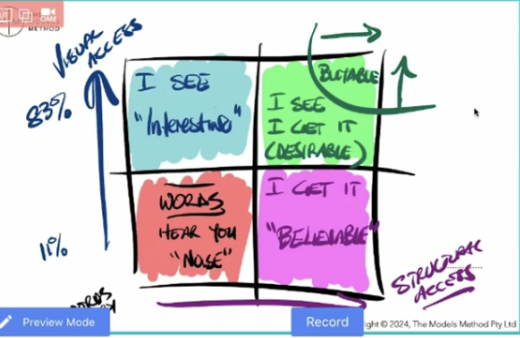
In this week’s edition of Impactful Teamwork, my guest Simon Bowen, founder of the Models Method shared a brilliant insight: Words alone often fail. Relying purely on language is risky because:
- It depends on each person’s vocabulary and interpretation.
- People “hear” but don’t always “understand.”
Action Point: Whenever you communicate complex ideas with your team, pair your words with a simple visual or structure. This could be a basic two-by-two matrix, a diagram, or even a simple flowchart.
Remember:
- Visuals = “I see.”
- Structure = “I get it.”
- When people both “see” and “get it,” they feel engaged and aligned.
The “Green Zone” of Communication
Simon introduced the concept of a two-by-two matrix where effective communication sits in the “green zone” — the top right quadrant where information is both visually engaging and structurally clear.
- Visual access makes communication interesting.
- Structural access makes communication believable.
- When you combine both, your ideas become desirable and even viable.
Action Point: Next time you’re preparing for a meeting or presentation, think about:
- What can I show visually?
- How can I organize it structurally?
Even a rough sketch can make a huge difference!
Simon emphasized that every leadership communication is a performance. It’s not about being extroverted — it’s about choreographing your communication for maximum impact.
Drawing on lessons from stage magic and comedy, he explained:
- Great leaders set up clear “pathways”.
- They deliver “punchlines” that reveal new perspectives.
- They trigger curiosity — keeping their teams engaged and wanting more.
Action Point: Think about the “story arc” of your next team conversation.
- What “setup” are you creating?
- What “aha moment” or “reveal” can you deliver?
Curiosity is one of the most powerful levers you can pull as a leader.
The Four “C’s” of Leadership
Simon beautifully framed leadership around four key elements:
- Character — Your character enters the room before you do.
- Communication — Clear communication builds believability.
- Commitment — Your commitment inspires accountability.
- Courage — Your courage fuels your team’s confidence.
Action Point: Reflect on these four areas.
- Where are you strongest?
- Where could you improve?
Leadership isn’t about having all the answers — it’s about how you show up every day.
Purpose and Values: The Foundation for Shared Leadership
In today’s complex and chaotic world, leadership can (and should) be shared within teams. But for shared leadership to work, the organization must:
- Have a clear, compelling, self-evident purpose.
- Define values that truly matter — not just baseline values like “trust” or “respect,” but the ones that make your team uniquely you.
Action Point:
- Ask yourself (and your team): If our company disappeared for six months, who would suffer and why?
- Clarify not just “what” you do, but why it matters to the world.
And when defining values, go beyond generic statements. Identify values that demand real behavior and actions every day.
The Superpower of Pause and Deep Thinking
One of the most profound reminders from Simon was that we’ve engineered pause out of the modern world.
To be great leaders, we must create intentional space for deep thinking, reflection, and model-building.
Action Point:
- Block regular “thinking time” into your calendar.
- If you catch yourself staring into space, grab a notepad and start sketching your thoughts — create a model!
Bonus Tip: When someone asks what you’re doing, say “I’m building a model to unpack a concept.” It instantly shifts perceptions: you’re seen as a deep, strategic thinker.
Final Reflections
Leadership isn’t a right — it’s a responsibility. It demands character, communication, commitment, and courage. It’s about guiding your team through chaos safely, anchoring them to purpose, values, and a shared vision.
As Simon so beautifully put it: “Business should be a noble enterprise.”
Let’s step up to create the kind of leadership that the world so desperately needs.
S
Show Notes
00:00 Introduction and Guest Welcome
02:01 The Importance of Models in Communication
04:13 Visual and Structural Access in Communication
12:16 The Role of Leadership in Effective Communication
14:34 Character and Communication in Leadership
20:19 Shared Leadership and Organizational Purpose
24:03 Balancing Commercial and Cause in Organizations
25:23 The Importance of Purpose and Impact
27:20 Defining and Living Organizational Values
29:17 The Role of Kindness in Company Culture
32:43 Analog Humans in a Digital World
34:51 The Power of Pause and Deep Thinking
37:56 Leadership and Teamwork Insights
38:20 Conclusion and Resources
Next Steps:
- Visit www.modelsmethod.com to access Simon’s incredible free resources.
- Sign up for his “20 Minute Teaching” sessions — now available for UK and Europe time zones too!
- Reflect on your own communication: Are you operating in the “green zone”?
- Start sketching simple models to communicate key ideas with your team.
Thank you, Simon, for sharing your genius with us — and thank YOU for tuning in to Impactful Teamwork. See you next week!

by Julia Felton | Apr 26, 2020
The COVID-19 pandemic has turned many businesses on their heads overnight, as people have had to adjust to remote working. Many industries that had been resisting allowing team members to work at home have, in a matter of a few days, had to pivot and adapt to this new norm.
For both team members and employers, there have been challenges to navigate along the way. Not least of all is that employers have had to trust that team members will do the work. For some companies that had resisted remote working up to this point, I know they had an inherent distrust in their team members and didn’t believe that the employees would do a full day’s work. Ironically, I often hear of exactly the opposite happening. Stuck at home with their families, some people are gravitating to work as a means of escape and so are working way more than the standard working week hours. I know my brother is one such person. It’s so easy to go back into this office after his kids have gone to bed and just check email again or finalise that report he was writing.
So, how do we find a happy medium—and how do all parties communicate effectively at this time? I’d like to propose the 5 E Framework as a model for helping navigate this change:
Embed The Purpose
Now, hopefully your organisation has a clear purpose that every team member understands. Purpose provides the raison d’etre for the business and, combined with company values, helps everyone have clarity on where the business is going. It provides the true north of what is expected and therefore can guide team members in how to prioritise their work and decision making, when there are no colleagues directly around.
Clear Expectations
When working remotely, it is essential that everyone is clear on what is expected of them. Know what the protocol is for answering emails and responding to messages, what the work hours are, etc. Many people I know feel that they have to respond immediately to every notification that pings on their computer, or else their boss won’t think they are working. This is foolhardy, as all these notifications distract us and, in fact, hamper our productivity. Remember the technology should be there to support you, not negatively disturb you.
Empower Team Members
When working remotely, it is even more important than ever to stop micro-managing your team members and empower them to get the job done. Give them a clear briefing; make sure they have understood the briefing, the deliverables, and the timeline; and then, let them get on with it. Continually checking in to see how they are getting on with the project will just demotivate and frustrate them.
Engage and Connect
In the absence of “water-cooler” chat and seeing colleagues face-to-face, it is important to check in with them and make sure they are okay. Everyone is reacting differently to these challenging situations—so, as a leader, spending time to really connect and find out what is going on for your team members, outside of work, is essential. It helps builds trust and connection, and demonstrates empathy.
Efficient Communication
Ensure that you communicate regularly with your team members when they are working remotely. In this time of rapid change, that might mean a daily check-in call for the team to make sure everyone is on the same page and has all the information they need. It’s amazing how much information you glean when working in an office, and how often people forget to communicate really important things when they don’t see the other person face-to-face. I was recently coaching a client, and her boss had forgotten to tell her the deadline had changed. It wasn’t malicious—it was just an oversight. So, regularly ensuring everyone is on the same page can mitigate this.
Effective virtual communication also means that you need to use the appropriate level of energy. As a leader, it is your job to inspire the team, and your energy and enthusiasm needs to be contagious at this time, in order to keep your virtual team motivated.
I’d love to hear about the lessons you’ve learnt about effective virtual communication at this time!

by Julia Felton | Apr 18, 2018
We’ve all heard the announcements on the Underground (or subway if you live abroad) to “Step Away From The Edge”. In effect they are reminding us that we need to step away and put space between us and our businesses and and yet the reality is that few business leaders really do this, especially in the SME sector. Business leaders struggle to “Stop working in the business and start working on the business” The result is that many businesses get stuck at a certain revenue ceiling because they simply can’t grow. The business leader/owner has become a bottle neck in the business causing operational flows to slow down and in the worst case stop all together.
Some recent research conducted by Haines Watts, a UK accountancy firm, of 500 UK SME’s revealed that “(42%) of UK SME owners believe that their business couldn’t survive more than a single week without them at the helm”. I can’t imagine what pressure that puts on the business leader just simply to keep things going. Having time to take any vacation, well that simply doesn’t figure into the equation. And yet when business leaders step away, even for just a few days, from the daily business operations, they come back renewed, re-energised and with a new perspective on business issues.
Here are five reasons for this very serious business challenge:
- Lack of Shared Vision
Business leaders are very poor at articulating clearly their vision for the business. As such their teams are not on the same page when it comes to the strategic growth plan. These divergent views cause silos to emerge, and create team disengagement as the team members, who could massively drive the business forward, are not engaged and don’t feel they know how to contribute to the success of the business.
- Poor Planning
The research revealed that only 84% of business owners are only able to spend between 1-10% of their working week planning for the future. In contrast, business leaders who are able to step back and focus predominantly on planning are more than twice as likely to run fast growth businesses (annual growth greater than 15%).This is the typical chicken and egg situation. The business leader doesn’t feel that they has time to plan, and yet without creating a robust, well thought out plan, no-one else can navigate the business, as they don’t know where they are heading.
- Lack of TrustOnly 60% of business leaders believe that they have the full support of their management team and as a result many business leaders simply don’t trust their team to deliver. Whether this is a perception built on ego – No-one can do this as well as me – or a genuine concern, the reality is the same. The business leader doesn’t share vital information with team members, and so they feel disempowered to do their role.Concerningly, despite nearly 50% half of business leaders lacking trust in their management teams, the teams themselves don’t realise that trust isn’t there. 83% of senior managers believe they fully understand the business owner’s goals and 87% hold the, often false, belief they would be trusted to run the business even in the owner’s absence. So, there is a massive gulf in team members perceptions and that of the business leader.
- Lack of Communication
The problem of a lack of trust is compounded by poor communication. 52% of business owners find themselves hiding their concerns from their teams because they are worried about showing vulnerability. And yet we know that being able to display vulnerability is a key skill of a leader. And if the business leader cannot articulate their concerns to their management teams then there is no transparency and courageous conversations fail to occur.
- Lack of a Growth Mindset
For an SME business there is a very real need to focus on sales if the business is to grow, and yet many management teams lack the skillset to help the business leader grow the business. The research revealed that over half (53%) of management teams have never helped grow a business prior to the one they now work in today. This is because in larger organisations there are specific functions dedicated to sales, and yet in a smaller business every single team member needs to be a brand ambassador actively promoting and selling the business at every opportunity
Given that SME sector is the powerhouse of economic growth across the world it is imperative that we help these business leaders elevate themselves out of the day to day operations so that they can become more strategic about their growth. Only by doing so will they be able to fully leverage the power of their teams which will create a more engaged workforce that help deliver more productivity and profitability to fuel business growth.

by Julia Felton | Jan 16, 2018
“What can horses teach me about authentic communication” and the answer is lots. When partnering with the horses:
- you get the opportunity to drop into the space of “horse time”. Away from the stresses and strains of daily life you are able to slow down, reflect and experience the power of real connection
- you have to communicate with your heart and not your head. All authentic communication starts with a heart felt connection and the horses are masters at letting us know how true we are being to ourselves
- you have to be present, grounded and paying attention. If you don’t the horse will simply ignore you
- you get to experience the power of non-verbal communication and how it can influence others
- you experience how emotions can disrupt the communication channel
The great thing about learning from horses, who are master communicators, is that you will learn how to synchronise your intention – mentally, emotionally and physically. You will get unbiased, immediate feedback on your communication style. And importantly if what you are doing isn’t working you get the opportunity to recalibrate and try a different approach. Interacting without verbal communication allows participants to discover a whole new world in the process!
Working with horses demands that you be very clear in your communication both verbal and non-verbal. Horses do not understand words and therefore rely on reading body language and energy. You will experience how to align your energy in such a way that your communication becomes clear and concise.
What type of world or work environment do you create for yourself through your communication? Is it supportive, inspiring and powerful or could it be improved? When you start using this new knowledge with others they will feel motivated, excited and willing to work with you, which will lead to new levels of performance.
To discover more how horses and help you develop your authentic communication skills (and leadership and team working skills too) lets have a chat. You can book into my diary here or better still join us on the next Art of Authentic Communication workshop.

by Julia Felton | Jan 3, 2018
Communication skills are vital to our success in business and life, and yet how many of us appreciate the unless we communicate authentically we may well be sabotaging our own success. When we fail to communicate effectively team members, colleagues, clients, suppliers and family members can get frustrated leading to stress and anxiety. And just like poor communication can have a negative ripple effect within the business, authentic communication can actually help businesses become more collaborative, innovative and creative leading to greater productivity and profitability. And its the same with your family and friends too.
So Why Is Authentic Communication Important?
Authentic Communication is a heart-centred way of communicating in which you allow your Authentic Self to do the talking and listening instead of your fear-based Ego. When we engage in authentic communication we move from just being in a transactional relationships to forming real human connection. One where the other person feels acknowledged and heard. Authentic communication is a pre-requisite for success in organisations, businesses and in any project as it allows for transparency and speed in communications.
When you communicate authentically you are able to express yourself productively and become curious in the other person’s perspective and how they are feeling about the situation. You are clear about your values and your core truth and from this place you are able to achieve different results. When leaders communicate authentically this has a profound effect on the business because the culture of the organisation is created by what people do and who they are. When leaders and team members operate from a place of authenticity then:
- trust increases
- team members feel more valued and engaged in their work
- connection and rapport improves
- it breaks down the silo mentatlity in business
- there is more collaberation and sharing of resources
- the workplace is happier as the air is “clearer”
- the business culture starts to focus on ‘we’ rather than ‘me’ as barriers are broken down
- the inside of the business matches the outside
Business relationships prosper when people trust each other, information is freely and generously exchanged and relationships are vibrant. However communication whilst simple is not easy. It is multi faceted and complex especially when one considers that so much is communicated by our body language. So unless our body language and our words are aligned and congruent the message simply will not be heard.
Surprisingly, happiness is an added benefit of authentic communication. Psychologist Sidney Jourard, found that 85 percent of a person’s happiness in life comes from happy interactions with other people. The reverse holds true as well: 85 percent of a person’s unhappiness or problems in life comes from difficulties in getting along with others
So if you are interested in honing your authentic communication skills I encourage you to join me and Tessa Gray later this month for our unique Art of Communication workshop. This is no ordinary workshop as your teachers will be Julia’s herd of horses, who are master communicators. They will test and challenge the clarity, congruence and connection of your communication, and rest assured you will leave the day more fully aware of the non-verbal impact you have on you communication success. After all, like everything else in life, communication begins with you.
by Julia Felton | Nov 22, 2017
According to the 2015 Employee Trends Report by Quantum Workplace, one of the biggest areas of concern for team members is that there is often not open and honest communication with managers. So why is this? Why does miscommunication pervade at least 50% of business conversations? Is technology to blame or are there some other dynamics at work.
In my experience, yes technology does have a part to play. Emails and text can be taken out of context and without any supporting body language to back up the conversation they can fuel anxiety and in some cases, escalate beyond repair, this is why face to face conversations are so much more effective.
And yet face to face conversations too can lead to miscommunication especially when the manager fails to lead the conversation or is fearful about discussing the subject. Take for example if a manager needs to have a difficult conversation with team members, say about their performance. If the manager is not feeling confident in having the conversation they might not articulate clearly the problem and so the team member leaves confused about what they have done wrong. This then causes the situation to escalate and before long both parties become frustrated. I call these conversations Courageous Conversations as they require the manager to be ruthlessly honest and transparent, often saying things that no-one has said in the past.
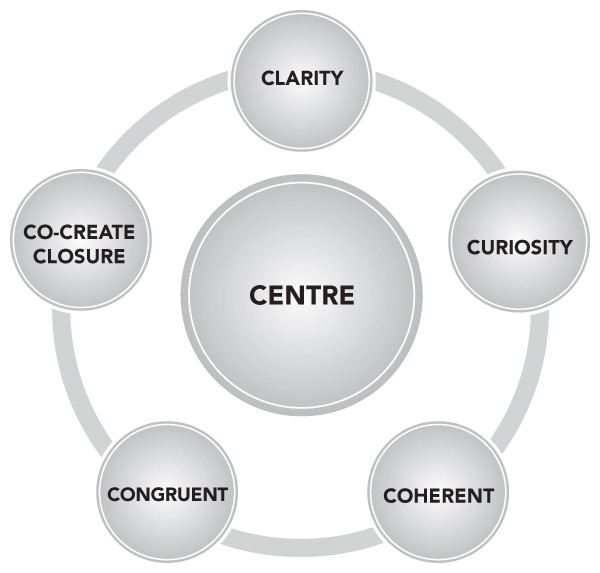
Having a clear framework for navigating these Courageous Conversations is essential to help managers approach the situation with confidence and certainty. This is why I developed the 6 C’s to Successful Courageous Conversations Framework.
Throughout any Courageous Conversation, it is imperative that you manage your emotional energy. If as the leader of the conversation you are grounded and in the moment it will help the person you are talking to remain in this state too. Make sure you breathe deeply, stay calm and stay centered in your energy. Notice if you go off track and re-calibrate if necessary.
Step One: Clarity
Be clear on the reason for the conversation and the desired outcome. Most courageous conversations falter because there is a lack of clarity about the real issue. Get to the root cause of the problem and address this rather than focusing on the symptoms
Step Two: Curiosity
Cultivate an attitude of discovery and curiosity. Pretend you don’t know anything and learn as much as you can about the other person’s point of view. Watch their body language and listen to what they are not saying as well as what they are saying. Don’t interrupt, unless to clarify, and let the person talk until they are finished.
Step Three: Coherent
Make sure that you have heard and understood everything that has been said by repeating back to them what they said. This will ensure the team member feels that they have been listened to
Step Four: Congruent
When the team member has said everything, then share with them how you see things from your perspective. Help them see your position without undermining their own. Seek clarity on how the team member came to that conclusion and how it differs from your own stance.
Step Five: Co-Create Closure
Now you both understand each other’s point of view it’s time to co-create a solution. Brainstorm and come up with ideas that you both think might work. Find something the team member says that resonates with the solution you desire and build on this. If the conversation at any time becomes adversarial go back to inquiry and further clarification on their point of view. The more the team member feels listened to the more they will engage in co-creating a solution with you.
Remember, that for any situation you encounter there are always multiple perspectives, so be empathetic of the other person. Always be curious about how they see the situation and be aware of how your own judgments and prejudice may be impacting what you are observing. When you appreciate, that others have a different perspective from you and you can start to see things through their eyes, you are able to make more informed decisions, and in doing so increase team member engagement.

by Julia Felton | Jul 19, 2017
How to have powerful conversations is a real challenge in business. And this cartoon that I came across on LinkedIn recently shows you exactly why. Both people are right and cannot understand why the other can’t see it. Can you relate to that?. Being certain that something is correct when your colleague is adamant that it isn’t.
I know I have been in this situation on more than one occasion. When this happens it is easy for the situation to escalate out of control with both parties believing that they are right, because after all they are. The only solution in these situations is to step into the other person’s shoes and to see things how they see them. Only then you will realise that they are also right and the confusion is coming from the fact that you are both seeing different things.
Now of course as readers and observers to this situation we can easily see the problem that these two people have, as we are in the position to see the challenge through yet another lens. Yes, that’s right there are always three positions of perspective to any situation. These are:
In this situation the man on the left hand side of the page is seeing the world through his lens and that means that the number is 6. If the man stepped across the page and stepped into the shoes of the man on the right hand side of the page, he would see that the number is 9. And finally if the man stepped away from the situation and looked back, he would clearly see, as we do, that both men are right but it is just how they are viewing the situation that is causing the confusion.
Armed with this information, the two men can now have a powerful conversation, in a calmer manner, as they can appreciate the different perspectives on what is happening. The man on the left is able to appreciate the folly of his insight and so make a much better decision.
These three positions of perspective can be used anytime you have to have a difficult conversation with someone, or if you have to make a difficult decision. What I love to do is to put three peices of paper on the floor. Then one by one I stand on each peice of paper and reflect on how I am feeling in that space. How does the situation change when I view it from a different perspective. It is amazing what insight you can get into other people’s intentions and feelings when you do this.
I remember the first time I used this model was when I was deciding what to do about my racehorse Charlie. My three month loan period was fast approaching and I had to make a decision about whether I wanted to buy him. Although I wanted to, I knew he also had some underlying lameness problems which we hadn’t got to the bottom of, and given I already had one lame horse I didn’t want another one. So from my perspective the only option was give him back. However, when I stepped into the position of Other I realised that the owner was happy not to have the responsibility and upkeep for Charlie, so they didn’t really want him back. Finally, when I looked at the situation through the lens of the observer I realised another solution existed and that the owner might just consider extending the loan for another 3-6 months. Armed with all these different insights I was now able to make a much more informed decision about how to proceed.
And as many of you know, Charlie stayed with me and eventually, some six months later I brought him for £1. That was something I could have never imagined would be possible initially.
So what opportunities are available to you right now, if you could just look at them from another perspective? There are probably a lot more than you ever imagined.
The Art of Authentic Communication
If you enjoyed this post then I know you will enjoy the Art of Authentic Communication workshop I am running this Friday 21st July, along with the horses. There are still a few places left if you want to come along. During this experiential workshop will learn how to:
- Use the three diferent dimensions of communication
- Engage in listening and communicating more effectively
- Mediate discussions amongst team members
- Gain an insight into different personality types and their preferred method of communication
- Become more assertive
- Use your body language as a tool for communication
- The importance of non-verbal communication
- Influence team members and inspire them to follow you.
To book in simply click here. I can’t wait to share all this great information with you, as I know that mastering the art of authentic communication can seriously improve your life and business.

by Julia Felton | Jun 21, 2017
If you want to get the best from your team you need to learn to connect, engage and communicate with them. Even if this isn’t your natural bent, you can learn to do this. In fact, the reason I’m writing this post today is because one of my clients said to me this week “Julia, one of the things I appreciate about you is that you’re so good at asking questions. I’m not. That’s just not how I’m wired.”
To which I responded, “Thanks for the compliment, but I’m not wired that way either.” Learning to use questions to lead isn’t a natural ability for most of us, it’s an acquired skill. And it’s not that hard to do on a skill level, it’s only hard on an implementation level. So, here are a few ideas to help you get started on unleashing your inner questioner.
1. Learn to see yourself as a developer of talent, not the boss. At the end of the day, most of us like to be tellers because we see ourselves as “the boss.” When we own the boss hat, most of us like to be in the teller role (I hired you. I pay you. Do what I tell you to do). And as long as we own that mindset, we’ll struggle with asking questions. However, if you can make the mental shift from boss to talent developer, you’ll begin to see your role completely differently (which is key because talent developers create leverage, whereas bosses don’t).
2. Make questioning your first response. I know this may feel pedantic, but when someone asks you a question, ask them a question back. Refuse to just give the answer (something that most of us who are male will always struggle with :-). Instead, when someone asks, “So, what do you think I should do?” throw it back to them, “First, tell me what you think you should do?” If they say, “I asked you first.” Just respond, “Well, how do you think I’d respond?” Return question for question. As hard as this is, don’t give the first answer. This was something I was challenged with when working in my corporate role, but asking questions helps team members become more resourceful and ultimately take more responsibility for their actions. In today’s world of mobile communication it is just too easy for team members to abdicate any responsibility and just ask their boss. But this does not help us develop leaders of the future.
3. Open your team conversations with questions. Instead of saying, “Pete, we have a problem here. And here’s what I want you to do.” Open the conversation with a wide open question. “Pete, as you know, we have a problem here. What do you think is creating it?” Or, “What’s your best thinking about how to solve this?” Or, “Do you have any ideas about how we can eliminate this in the next 30 days?”
Yes, there is an art to asking good questions (for example, wide open questions are better for creating independent thinkers), but what’s more important is that you embrace the principle that being a questioner is a better leadership choice than being a teller. Once you do that, you’ll acquire the skill set over time through trial and error. But you’ll never get there if you don’t embrace this concept as a core leadership practice.
So do you? Do you really believe that being a leader who leads through questioning is better than being a leader who leads by telling? I hope so because the choice you make will have profound consequences for you and your company for years to come. So, choose wisely! Remember,
“If you want to get the most from your people, then you need to draw the best that is in them—out of them.”
By the way, if you’re thinking, “But asking questions sure takes a lot more time than telling,” then you probably don’t own the idea that a leader isn’t a boss, a leader is a talent developer who leverages the time, talent, treasures, resources, intellectual property and connections of their people to produce a result.
Oh, and one last thought. This principle and practice holds true whether you are leading a two person team or a two thousand person team.
Go forth and ask better questions so that you can connect, engage and communicate.
by Julia Felton | Jul 31, 2016
When challenged with having a difficult conversation many people simply do not know how to approach the situation. This is why I have developed a framework that I call the 6 C’s To Successful Courageous Conversations to provide you with a road map for navigating the conversation. Being able to have courageous conversations is a key skill of being a Joined Up Leader and I share more on this in my book The Alchemy Of Change.
Centre
It is key that you stay in charge of yourself, your purpose and your emotional energy throughout any courageous conversation. Breathe, centre and notice when you become off centre and choose to return to centre again.
This is where your power lies. By choosing the calm, centred state, you’ll help the person you are speaking with to be more centred, too. Centring is not a step centring is how you are as you take the steps. Grounded and in the moment.
Step #1: Clarity
Be clear on the reason for the conversation and the outcome that you desire. Most courageous conversations falter because there is a lack of clarity about the real issue. Get to the root cause and focus on this matter rather than the symptoms that might be showing.
Consider how the behaviour you are addressing is impacting the team and the business. Remember this is not about you, so ensure that you control your emotions and approach the conversation in such a way that you do not contaminate it with unconscious feelings or mixed body language. (For most people this means doing some preparation work in anticipation of the courageous conversation).
Step #2: Curiosity
Cultivate an attitude of discovery and curiosity. Pretend you don’t know anything (you really don’t) and learn as much as possible about the other person and their point of view. Pretend you’re entertaining a visitor from another country, and find out how things are for them in that place; how certain events affect the other person, and what their values and priorities are.
Watch for their body language and listen for unspoken energy as well. What do they really want? What are they not saying? Let the person talk until they are finished. Don’t interrupt except to acknowledge. Whatever you hear, don’t take it personally. It’s not really about you. Learn as much as you can in this phase of the conversation. You’ll get your turn, but don’t rush things.
Step #3: Coherent
Coherent means showing that you’ve heard and understood. Try to understand the other person so well you can make their argument for them. Then do it. Repeat back to them what you heard so you can ensure you fully understood what they said. They will not change unless they see that you see where they stand. Acknowledge whatever you can, including your own defensiveness if it comes up. Acknowledgment can be difficult if we associate it with agreement., however keep them separate. Saying, “this sounds really important to you,” doesn’t mean that you’re going to go along with their decision but it does make the other person feel listened to.
Step #4: Congruent
When you sense the other person has said all they want to then, it’s your turn. What can you see from your perspective that they’ve missed? Help clarify your position without minimizing theirs. Seek clarity from the other person on how they came to the conclusion they did. And why that was not what you intended.
Step #5: Co-create Closure
Now you’re ready to begin building a new solution. Brainstorming and continued curiosity and inquiry are really useful here. Ask the other person what they think might work. Whatever they say, find something you like and build on it. If the conversation becomes adversarial, go back to inquiry. Asking for the other’s point of view usually creates a sense of safety and encourages them to engage. If the other person feels they are being listened to and can shape the outcome they are more likely to feel inspired to offer so solutions
I urge you to use this framework for any difficult conversations that you need to have rather than sticking your head in the sand and avoiding the issue and hoping it will go away.
Communication is essential in business and the latest 2015 Employee Engagement Trends Report by Quantum WorkPlace reveals that one of the biggest areas of uncertainty for employees remains the fact that there is not often honest and open communication with managers. So simply by addressing this issue head on, you should start to see trust and employee engagement levels increase.