


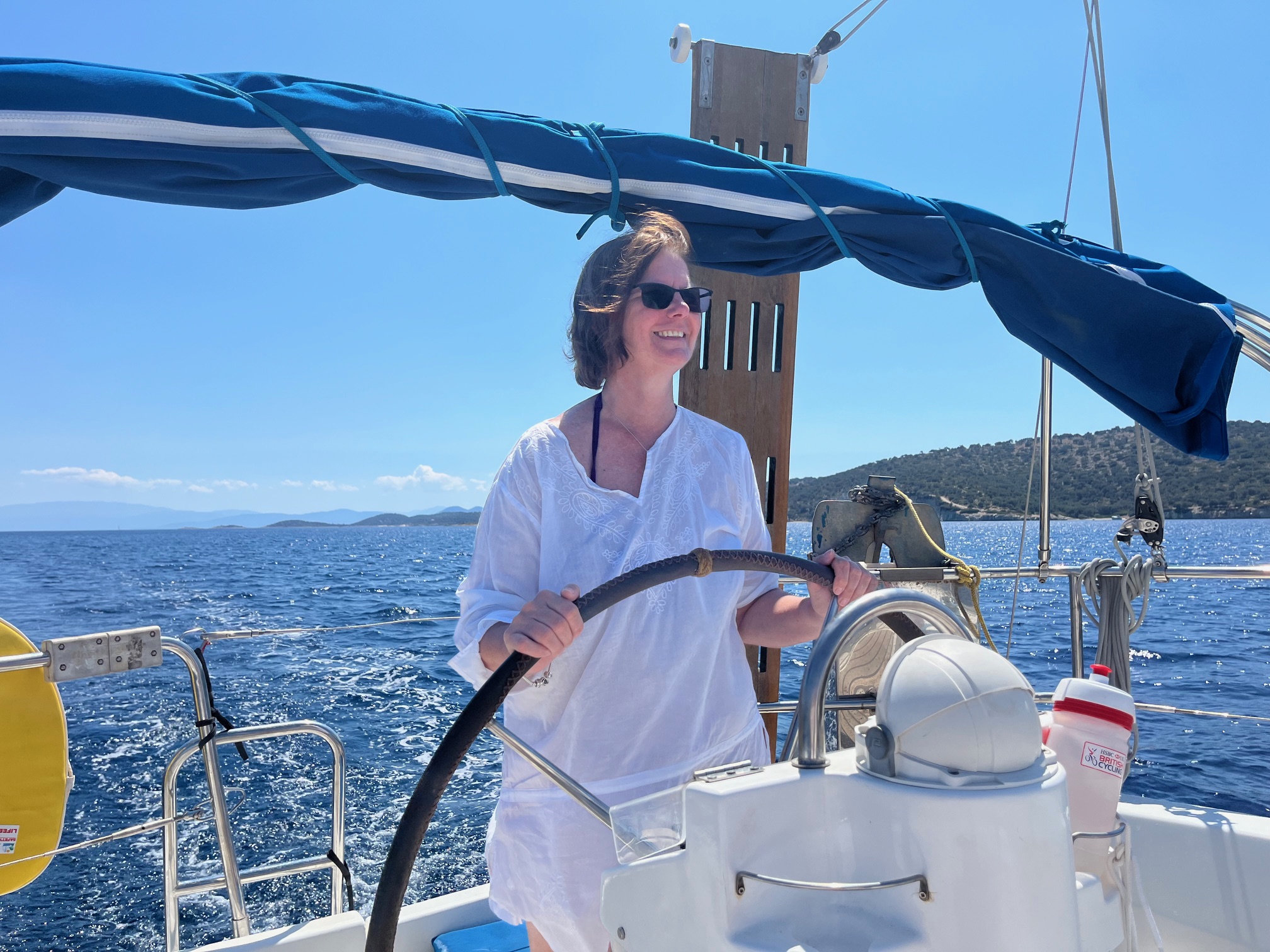
It turns out you don’t need to be in the boardroom to sharpen your leadership skills. Sometimes, the best leadership lessons emerge when you least expect them—like on a sailing holiday in Greece. After a week under the Mediterranean sun, navigating the open waters with my partner and nine other boats in a flotilla, I came back feeling more connected, more grounded—and full of reflections about leadership, teamwork and business.
Here are some of the leadership lessons I brought back with me, straight from the deck of a Beneteau 323.
1. The Power of Shared Leadership
This trip marked our third sailing holiday, but when I rewind the clock to our first adventure, I’m reminded how essential shared leadership really is. I hadn’t planned to do any training—I thought I’d spend the week relaxing by the pool while my partner completed his Day Skipper practical. What actually happened was quite different: I joined the crew, learned the ropes (literally!), and earned my Competent Crew certificate.
And thank goodness I did.
Because when we set sail on that first flotilla trip six months later, having a shared understanding of how the boat operated—and my partner not having to shoulder all the responsibility—meant we worked together as a team. I brought a different perspective, focusing more on safety and systems, while he focused on navigation. Together, we made a more effective, resilient crew.
Action: Ask yourself—how are you enabling shared leadership in your team? Who else can hold the reins with you?
Reflection: True leadership isn’t about knowing everything—it’s about knowing how to empower others to lead with you.
2. The Power of Beliefs: Old Experiences Shape New Realities
Before these flotilla adventures, my only sailing experience was in dinghies—and let’s just say that included three capsizes and a few dunkings, thanks to my partner’s enthusiastic steering! That experience left a deep impression. I developed a belief that sailing with him meant getting wet—and potentially being in danger.
So when we first took out a larger keelboat, even though it was far more stable, my nervous system was on high alert. I was terrified we’d capsize.
It wasn’t until I learned more about the stability of these boats, spoke to others, and built new experiences that I was able to let go of that limiting belief. And that’s when I started to actually enjoy sailing.
Action: What limiting beliefs are you carrying into your leadership or team interactions? What outdated ‘truths’ need to be re-evaluated?
Reflection: Beliefs formed in one context don’t always serve us in another. It’s time to let go of the stories that are no longer true.
3. Roles, Responsibilities, and Accountability Create Flow
Sailing taught me—yet again—the importance of clearly defined roles. When it was time to depart a port, there were multiple tasks that had to be done efficiently and safely. Naturally, we divided them: I was in charge below deck, securing items and closing hatches, while my partner handled the sails and navigation.
Each of us knew what to do. No confusion. No duplication. Just flow.
And the reason it worked? Systems. During my training, I’d been given a checklist to ensure the boat was ready to sail. That simple structure gave me confidence. It also freed up mental space because I didn’t have to remember everything—I just had to follow the process.
Action: Have you clarified who is doing what in your business? Do your people have clear systems and checklists to follow?
Reflection: When everyone knows their role and what’s expected of them, it creates empowerment, efficiency and trust.
4. The Value of Supportive Teams
One of the main reasons we continue to sail as part of a flotilla is the incredible support structure it provides. There’s a lead boat with a captain, an engineer and a social host—all of whom are available to assist if anything goes wrong.
And trust me, things do go wrong.
Like the time our anchor jammed mid-drop and we had 50 feet of chain dangling from the front of our boat. We couldn’t dock, we couldn’t move, and we definitely couldn’t fix it alone. But thanks to the flotilla team, help arrived—and after two hours and some serious manpower, the problem was solved.
Action: Who are your “flotilla captains”? Do your team members have people they can call on when something goes wrong?
Reflection: Psychological safety at work is just like sailing safety on the water. People perform better when they know help is at hand.
5. Proper Planning Prevents Poor Performance
There’s a reason that phrase is a cliché—it’s true. When we didn’t plan our manoeuvres properly, everything got a bit chaotic. My partner would suddenly say, “Let’s tack now!” and I’d freeze—unsure of what to do, feeling flustered.
But when we planned together—”Step one: bring in the mainsail; step two: adjust the jib”—the manoeuvre was seamless.
And this is so true in business too. When things are moving fast, it can feel like you don’t have time to plan. But pausing to clarify the steps means fewer mistakes, less chaos, and better outcomes.
Action: Where can you slow down to plan more effectively this week?
Reflection: Clarity breeds confidence. A calm, prepared team is a high-performing team.
6. Emotional Energy Sets the Tone
During one of our more rushed manoeuvres, my partner became visibly anxious. His energy shifted—he became erratic, issuing conflicting commands—and I froze. It reminded me how much a leader’s energy sets the tone for everyone else.
I had a fascinating conversation with a Navy captain on the trip who echoed this. He said that in high-pressure situations, the leader’s calmness anchors the entire crew. Whether you’re navigating a yacht or leading a team through a business storm, the principle is the same.
Action: How are you managing your emotional energy in moments of stress?
Reflection: Your energy is contagious. Staying grounded helps your team stay steady in uncertain times.
7. Don’t Lose Sight of the Bigger Picture
While helming the boat, I often picked a point on the horizon to steer towards. It gave me focus—but it also narrowed my field of vision. One day, I was so fixated on that point that I failed to notice a massive ferry bearing down on us from the side!
In business, this happens all too often. We’re so focused on the goal that we miss what’s happening around us—market shifts, team fatigue, or emerging risks.
Action: Take a moment to look up from your to-do list. What are you not seeing?
Reflection: Peripheral awareness is just as important as focus. Great leaders take in the full horizon.
Final Thought: From Busy to Brilliant
One of the biggest lessons from this trip was about attention—where we place it, how we manage it, and the impact it has on our performance.
That’s why I’m running a 20-minute webinar on August 12th called “From Busy to Brilliant: How Strategic Attention Fuels High-Performance Teams.” If you want to learn how to leverage attention to drive business results, I’d love for you to join me. Simply register at here
Whether you’re on a sailboat in Greece or in the thick of your next big project, the lessons are there—if you’re willing to pause, observe, and learn. I came back from holiday not just refreshed, but re-inspired.
Here’s to navigating your own leadership journey with more clarity, calm, and connection.
Show Notes
00:00 Introduction: Lessons from a Greek Holiday
02:19 The Power of Shared Leadership
09:18 Roles, Responsibilities, and Accountability
11:17 Team Dynamics and Support Systems
17:27 The Importance of Planning
21:41 Maintaining Strategic Attention
23:46 Conclusion and Upcoming Webinar