by Julia Felton | Oct 1, 2015
When you type the phrase ‘inspiring leaders’ into Google, the results are most likely what you’d expect — images of Steve Jobs, Martin Luther King, Mahatma Gandhi and Nelson Mandela. But have you ever stopped to consider why these usual suspects show up time and time again in conversations about inspiring leadership, and what they might have in common, in terms of the way they think, act and communicate?
One of the most popular TED talks of all time, given by leadership expert Simon Sinek, considers this very question. With almost 20 million views, there are clearly many people who want to understand what it takes to lead in a way that inspires others, and why it is that some organisations and some leaders are able to inspire where others aren’t?
In his talk, Sinek claims to have discovered a pattern between these leaders, which he has codified into an idea called the ‘golden circle’.
“Every single person, every single organisation on the planet knows what they do, 100%. Some know how they do it, whether you call it your differentiated value proposition or your proprietary process or your USP. But very, very few people or organisations know why they do what they do…By “why,” I mean: What’s your purpose? What’s your cause? What’s your belief? Why does your organisation exist? Why do you get out of bed in the morning? And why should anyone care?”
Core to Sinek’s ‘golden circle’ principle is the idea that “people don’t buy what you do; they buy why you do it.”
Apple
Citing Apple as a shining example, Sinek attributes the brand’s success to its ability to get people to believe in what it does by communicating why they do things the way they do. So rather than saying “we make great computers — want to buy one?”, Apple has always placed emphasis on communicating from the inside out, clarifying why it builds the products it does.
According to Sinek, Apple says: “Everything we do, we believe in challenging the status quo. We believe in thinking differently. The way we challenge the status quo is by making our products beautifully designed, simple to use and user friendly. We just happen to make great computers. Want to buy one?”
The science
Sinek bases his theory upon scientific fact, and specifically, the biological make-up of the brain, which he says corresponds directly to his ‘golden circle’ rule.
A cross-section of the brain has three major components. The neocortex (on the outside) is responsible for all of our rational and analytical thought and language. Our limbic brains (the middle two sections) are responsible for all of our feelings, like trust and loyalty. They are also responsible for all human behaviour, all decision-making, and have no capacity for language.
So, according to Sinek, “when we can communicate from the inside out, we’re talking directly to the part of the brain that controls behaviour, and then we allow people to rationalise it with the tangible things we say and do. This is where gut decisions come from.”
For a business having a clear purpose, a clear Why, is essential to give the business direction. The business Why acts like a true north compass steering the business towards success, Without knowing where you are going the business can end up stalling and at best going round in a circle. Being busy but achieving little.
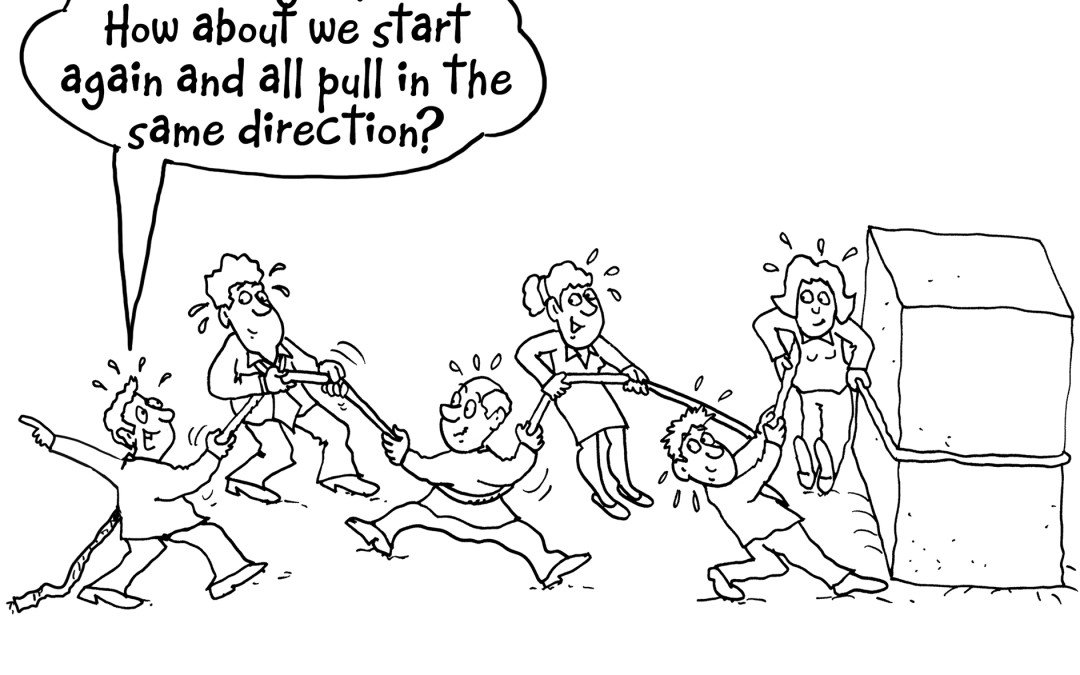
A clear business Why is also of paramount importance as it helps engage the mind and soul of team members who want to innately contribute to a bigger purpose. When everyone is on the same page then as the organisation is able to start unlocking some of its hidden potential. Why? because team members give more of themselves when they acknowledge they are committed to a vision bigger than themselves. In the words of Sinek, “Whether they’re individuals or organisations, we follow those who lead, not because we have to, but because we want to. We follow those who lead, not for them, but for ourselves.”
So if you haven’t already, ask yourself why you do what you do every day. Once you can answer that with conviction, you’ll be more likely to hire team members who share your beliefs and win the trust and loyalty of those whom you lead, whilst sprinkling a bit of inspiration along the way.
Creating a solid Business Promise (Why) is a key facet of one of the three cornerstones of creating a Joined Up Business and that is explained in my book the Alchemy Of Change: Ancient Wisdom Re-invented to Unleash the Potential Of Leaders and Team. You can get a copy here.
by Julia Felton | Sep 22, 2015
Your flow comes from following your natural path. Your team momentum comes from each team member following their natural path. Each frequency and each profile has a different role within the team where they can be most effective. Often the best team selection is not the person who can be most effective, but the person who enables the existing team to become more effective.
Here are the 8 profiles, and the role within the team that allows them to be in their greatest flow:
Creator: The initiator
Creators are the best initiators, and although they can be quick to create chaos, they can also be surprisingly innovative at finding ways out of chaos. Always put them in charge of new projects, but move them on to the next creation once their job is done.
Star: The promoter
Stars are the best promoters, but need to lead from the front. Give them the chance to shine, and give them the space to deliver results without tying them down. Give them the systems and support to enable them to focus on building new business.
Supporter: The leader
Supporters are the best leaders, but don’t expect them to come up with the plan. Build a plan and set the goals with a Supporter, and then let them lead the team towards the plan. Let them set their own management style, and their own agenda.
Deal Maker: The peace maker
Deal Makers are the best peacemakers, and will leave everyone feeling good. Don’t expect them to go out cold calling, as they thrive on building the relationships they have. Work with Deal Makers to nurture the customer and relationships you have.
Trader: The negotiator
Traders are your best negotiators. They will always get you the best price, in both what you buy and what you sell. They want to be given the parameters in which to work. Traders will have their ear to the ground in your market and your team.
Accumulator: The ambassador
Accumulators are your best ambassadors. They are reliable, get things done on time, and are not prone to making rash decisions. Accumulators make the best project managers, when a specific task needs to be delivered reliably.
Lord: The analyst
Lords are your best analysts. Give them the space to study the detail, and to deliver the data. Don’t ask them to go out and network, as they are strongest when focused behind the scenes.
Mechanic: The completer
Mechanics are your best completers. They will wrap up the process and find smart ways to do it better next time. Don’t ask a mechanic to start from scratch, but do give them an existing process or product to improve on.
by Julia Felton | Mar 24, 2015
Trust “is both a mindset and a toolbox for 21st-century leadership”. Robert A. McDonald, Chairman, President and CEO, The Procter & Gamble Company
In today’s networked world, Trust has become the new currency – the critical competency for individuals, teams, organisations and even countries. Trust impacts every situation and relationship whether personal or professional.
Trust acts like a lubricant. It reduces friction and creates conditions for evolving high performance teams. How well the team works together is the true indicator of future success or the ability to manage through the struggle of relentless change. Without trust there would be no harmony in the team and business and dis-ease would prevail.
When we work in a high trust team things get done quicker and more easily. There is less conflict, less back-stabbing, less politics and more time spent on value added activities like innovative and customer service.
However, trust within teams does not happen overnight. As Joachim Low, the winning German Football Team World Cup coach noted “We’ve been together now for 55 days. We started this project 10 years ago, so this is the result of many years’ work, beginning with Jurgen Klinsmann. We’ve continued that work and our strength has been our constant progress. We’d not made this ultimate step before, but champions do what they will do. We believed we’d win it. We’re looking back over ten years of preparation and hard work. This team has developed a spirit which is unbelievable. We’re proud to be the first European team to win a title in Latin America, in Rio, in Brazil, in a footballing country par excellence… and this makes us proud.”
So what are the four key actions that team members must cultivate if they are to build and maintain trust with their fellow team members:
Commitment
Commitment is an important part of building trust. Every team member must acknowledge they play an important role in creating the success of the team and helping it achieve its goals. When one team member fails to deliver it has a knock on effect on everyone else in the team. This is why no matter if personal or professional obstacles present them team members must seek ways to keep their commitment to the team. Just as they need to rely on others, others must be able to rely on them.
Competence
Team members must trust that their teammates are competent and can successfully complete the tasks relevant to the team’s success. For example, each team member should be able to focus on an assigned task without worrying about teammates following through with their assigned tasks. Individual team members must realize when they need help and ask for it, instead of concealing weaknesses from the group. When team members show vulnerability to their teammates and the teammates respond in an efficient and helpful manner, trust will grow between them.
Communication
Consistent and meaningful communication is necessary for building a trusting relationship within a team. For instance, if a team member finishes a task early, they should communicate to their teammates that they are finished and ask if they can help another team member with their part of the work. If one team member discovers vital information that is relevant to the team’s success, such as a deadline change or a lack of resources, they should communicate it to the other members as soon as possible.
Collaboration
True collaboration won’t happen without a sense of trust between team members. When team members collaborate, they share creative ideas without fear that another team member will take credit for their ideas. Through collaboration innovative ideas are born. It is definitely a case of 1+1=3. When team members trust each other they are more likely to show their vulnerability, which in turn will build more trust within the team.
In summary trust anchors every successful team. When team members demonstrate commitment, competency, communication and collaboration then others will trust them and superior performance will result both in terms of productivity and profitability. However, when a team is forming who do you trust? In the words of Ernest Hemingway “The best way to find out if you can trust somebody is to trust them.”. Building trust is a two way street as you need to give trust in order to get it.
by Julia Felton | Feb 24, 2015
In a recent article the Harvard Business Review cited the following as traits of innovative leaders. I’m curious what you think about these traits and are there any you would add.
Many organisations would like their leaders to create more innovative teams. But how exactly should they do this? Most highly innovative leaders can often find it difficult to pinpoint what accounts for their skill. Research carried out by US –based leadership development consultants Jack Zenger and Joseph Folkman identified 10 distinctive behaviours that set innovative leaders apart.
These leaders:
- Display excellent strategic vision. The most effective innovation leaders could vividly describe their vision of the future
- Have a strong customer focus. They networked with clients and asked incessant questions about their needs and wants.
- Create a climate of reciprocal trust. They initiated warm, collaborative relationships with the innovators who worked for them.
- Display fearless loyalty to doing what’s right for the organisation and customer. Pleasing the boss took a back seat to doing the right thing for the project.
- Put their faith in a culture that magnifies upward communication. These leaders were often described as projecting optimism, full of energy, and always receptive to new ideas.
- Are persuasive. They presented ideas with enthusiasm and conviction, and the team willingly followed.
- Excel at setting stretch goals. They set goals that required people to go far beyond just working harder but required that they find new ways to achieve a high goal.
- Emphasize speed. These leaders believed that experiments and rapid prototypes were preferred to lengthy studies by large committees.
- Are candid in their communication. These leaders were described as providing honest, and at times blunt, feedback.
- Inspire and motivate through action. This comes from a clear sense of purpose and meaning in the work.
So do you have the skills and mindset as a leader to create innovative teams? I’d love to hear if you’d focus on anything different.
by Julia Felton | Jan 27, 2015
Whether you are a business owner or an employee it is essential that you find the right person or job role that is a match for you. I know given the tough economic conditions we’ve been through recently that it is tempting for a candidate to apply for any job for and for recruiters who needs to find resource to accept a less and ideal candidate.
Stop. This is such a flawed strategy for both parties and ultimately ends up costing everyone valuable time, energy and money as:
- The candidate ultimately won’t enjoy the job. Sure they might be able to do the role, but are they giving 110% to it. If the role is not aligned to their own passion and purpose they simply won’t be as productive or creative in the role as they could be.
- For the business owner they are not utilizing the team members best strengths and so ultimately the productivity and engagement of the team member declines and the net result is less profitability for the business.
What both parties crave for is a situation where the team member is working to their strengths, and delivering massive value to the business . This occurs when the team member is in a state we call flow. Put simply, flow is the path of least resistance. When team members are in flow, productivity rises, results increase, occurrences line up, everyone has more fun and feels more connected to the organisation and it’s goals.
When a team member is in flow they feel energised, focused and fully engaged in the task at hand. Often there can be a distortion of time as their internal clock does not seem to match the external clock – perhaps you have experienced this when you have been doing something you love and time just literally seems to fly by. That’s a time that you were in flow.
So how do you know if you are in flow:
- If you are feeling stressed, overwhelmed or anxious, then it’s a fairly good indicator you are out of Flow.
- The opposite is true when you are in Flow, you feel joy and even rapture whilst performing the task. In the work place, this results in a harmonious environment.
The challenge I come across time and time again are team members that are in the wrong roles. They are not playing to their strengths and as a result the are sabotaging the success of the business. This is not usually intentional it is just that unless you are in flow you are unlikely to be able to access the hidden 90% of your potential that exists.
Imagine the benefits if all your team members were operating at or above their peak performance level. Imagine what an impact that would have both on the motivation of the employee but also on the organizational results. Customers would feel more cared for, projects would get delivered on time and the harmony in the workplace would be infectious. This is the type of workplace where trust pervades as everyone is doing their role to their very best.
One tool that I use to help my clients and their business get into flow is something called Talent Dynamics. Based on an ancient Chinese philosophy, the I Ching, it allows each person in a team or organisation to understand the quickest and easiest way for them to get into and stay in Flow by working with their strengths. It also helps them understand where they are most able to add value to the organisation. Simply, by understanding the value you contribute to a team, then you can immediately help identify potential Business Development opportunities.
If you manage a team then by profiling your whole team you can create mutual understanding and get the whole team into flow. Understanding the strengths of team mates and how they contribute and add value to the business allows you to better communicate and it is easier to gain trust and respect with each other and so deliver results in performance and profitability.
So whether you’re a business owner or a candidate make sure that you find the perfect role for you – one that speaks to your strengths and where you can add real value.
The first step to finding out your strengths is to identify where you are most trusted in business. You can take the quick 30 second assessment at http://bit.ly/trusttest.
by Julia Felton | Sep 26, 2013
Step 6 in creating a Joined Up Business is resource effectively and to do this you need a Joined Up team. So many entrepreneurs I see are struggling to harness more clients and cash because they are the centre of the business as a result the business cannot grow. I have always said that success is a team sport as so if you want to up level your business you need to bring valuable team members. Yet time and time again I see people making poor decisions regarding the resources they need. So why is this? The reason is that often we like to hire (engage the services) of people like us but that is the death knell for a small business. People like us like the same tasks that we like so the result is that the other tasks (the ones we hate and procrastinate about) never get completed.
I m sure many of you are familiar with the wheel of life. You map all the areas of your life and aim to get everything in balance because only if the wheel is in balance can it turn effectively. On the way to the airport this morning I had a stark reminder of what happens when things get out of balance because I got a flat tyre. Being out of balance – with only three tyres – meant I could not go forward and so had to pull over onto the hard shoulder of the motorway. And the only way to efficiently and effectively get me moving again was to summon in support in the form of the Green Flag man. He came and changed my tyre for me so I could get going again. It was a really great analogy for me of how often the same thing happens in business. We forget to focus on an area until it goes wrong and then we either have to try and fix it ourselves or find support and team members to get this challenge resolved.
So how do we find the right people to work with us in our Joined Up Team ? How do we identify individuals that we can work with who can add real value to our business. Well the trick is not to hire people like us but rather the opposite because these people will love doing the tasks we hate. The tool I use to help me determine the right person to hire is Talent Dynamics. This short assessment helps people identify their natural strengths and so reveals the areas of business where they can add the most value because they are in flow. So what is flow? Flow is the state we are in when time flies by and we love what we are doing. Everything seems easy, yet time and time again I see business owners stepping out of flow because they seem to think that business should be hard. They fail to realise that they are delivering the most value when they are doing what they love and things are easy.
Within Talent Dynamics there are 8 different archetypes and you can read all about them here. Each archetype has different strengths and activities that they are best suited to work on in a business. Maybe you have high dynamo energy like the creators – they have their head in the clouds and are great at strategy and creating new ideas but lousy at follow up and detail. Contrast this with the traders (tempo energy people) who love detail and have their ear to the ground. They love to know what is going on and are great at detail. Give them customer facing roles where they can nurture the clients and they will flourish.
Then there are blaze energy people who just love connecting with others. It’s all about the people for them so they are great at networking, deal making and raising the visibility of your business. In contrast steel energy people are all about the task and analytical detail. The process is more important for them than the people so these people relish roles like accountancy and finance that are meticulously detailed. It’s important to note that we all have our unique energy blueprint and can all “do” all the energies but you will be more efficient, productive and therefore happy if you focus on the activities that you have the greatest affinity and propensity to excel at.
Once you understand where your strength and talents lie it is easy then to hire people with complementary skills. In doing so you create a Joined Up Team that is balanced and gets all the tasks of he business accomplished. You can take your talent dynamics test here and if you need any help in creating your Joined Up Team just let me know and we can schedule a Joined Up Business Strategy Session to jump start your business to the next level.