In today’s fast-paced, unpredictable business world, reinvention is no longer a luxury — it’s a leadership imperative. At the recent Reinvention Summit in Dublin, I was struck by the urgency and magnitude of change leaders are facing. The statistics were mind-blowing: 85% of business models will be obsolete within five years. This isn’t a distant future scenario. It’s happening now.
In this blog, I’ll explore why reinvention must become the core of modern leadership, and how you can evolve your leadership approach to stay relevant, responsive, and resilient in today’s volatile environment.
Why Reinvention Can’t Wait
We’re not just living in an era of change — we’re living in an era of continuous transformation. Here’s why:
Innovation timelines are shrinking: 63% of leaders say their organizations can’t innovate fast enough to keep up with customer demands and technological advancements.
AI is redefining value: Over 50% of professional services tasks will be automated by 2027 (McKinsey).
Old strategy models don’t work: 70% of leaders are stuck in outdated planning cycles that can’t anticipate or respond to change.
In short, disruption is no longer a threat — it’s your daily operating system.
Reinvention Isn’t Starting Over — It’s Evolving Forward
Many leaders resist reinvention because they assume it means throwing everything out and starting again. That’s not true. Effective reinvention honors the best of the past while letting go of what no longer serves. It’s about building adaptive systems that evolve without burning out your people or losing your edge.
So how do we reinvent leadership for this new world? Let’s explore five key strategies.
This rhythm keeps your leadership agile and aligned with the natural cycles of growth.
2. Lead Continuous Change — Don’t Just Manage Stability
The traditional leadership model was designed for a stable world. Today’s reality demands a shift from control and predictability to experimentation and flexibility.
Old Leadership
Reinvented Leadership
One-time change projects
Ongoing change systems
Top-down decisions
Empowered teams
Fixed long-term plans
Adaptive strategies
Risk avoidance
Calculated experimentation
Control and efficiency
Innovation and agility
💡 Action: Reframe your role from managing stability to leading reinvention. Develop a culture where change is expected, welcomed, and integrated into everyday work.
3. Become Your Organization’s Chief Reinvention Officer
Reinvention isn’t just a business strategy — it’s a leadership identity. The Academy of Reinventors (of which I’m a member) outlines six pillars of reinvention every leader should embrace:
Anticipation – Scan the horizon for trends before they become disruptions.
Experimentation – Test ideas quickly. Fail fast, learn faster.
Collaboration – Break down silos and learn across teams and industries.
Sustainability – Design with long-term adaptability in mind, not short-term wins.
Resilience – Build a culture that embraces uncertainty as opportunity.
People Empowerment – Equip teams with skills, autonomy, and a growth mindset.
💡 Action: Use these six pillars as a checklist. Where are you strong? Where do you need to focus?
4. Reinvent Team Structures: From Hierarchies to Networks
Traditional teams operated in silos with rigid roles. Reinvented teams are fluid, networked, and purpose-driven.
Traditional Teams
Reinvented Teams
Rigid hierarchy
Flat, cross-functional collaboration
Fixed roles
Roles based on strengths and projects
Top-down decisions
Empowered, self-directed teams
Departmental silos
Cross-functional, agile networks
💡 Action: Set up a “Reinvention Lab” — a small team that pilots new ways of working and leadership styles. Treat business as an experiment, and test before scaling.
5. Bake Reinvention Into Your Daily Operations
If you want reinvention to stick, it must become part of your organization’s DNA — not just a one-off initiative. Here’s how to do that:
Allocate a reinvention budget for testing and innovation.
Measure what matters: Go beyond financial KPIs. Track adaptability, agility, and engagement.
Celebrate learning from failure — not just results.
Make learning non-negotiable: Invest in ongoing development and create space for curiosity.
💡 Action: Implement a Reinvention Scorecard. Track how often your team is experimenting, learning, and adapting. Use it in team check-ins or leadership reviews.
Avoiding Titanic Syndrome: Don’t Cling to Past Success
One of the biggest risks facing leaders today is Titanic Syndrome — the refusal to let go of past success in the face of a changing future. Kodak invented digital photography but didn’t embrace it. Nokia ignored smartphones. Blockbuster laughed at Netflix.
💡 Action: Use a Titanic Syndrome Diagnostic:
What past successes are we clinging to?
What emerging trends are we ignoring?
Where are we assuming “what worked before will work again”?
Final Thoughts: The Future Belongs to Reinventors
Reinvention is not a trend — it’s the defining leadership skill of the 21st century. The leaders who thrive will be those who:
✅ Anticipate rather than react ✅ Empower teams rather than control them ✅ Design for adaptability rather than stability ✅ Embrace curiosity rather than certainty
So the question isn’t “Do I need to reinvent?” — it’s “How fast can I start?”
Let this be your invitation to lead boldly into the future, to try, test, evolve, and adapt — just like nature does. Reinvention isn’t risky. Clinging to the past is.
Your Reinvention Starter Checklist:
☐ Schedule quarterly leadership “season” reviews
☐ Establish a Reinvention Lab
☐ Track progress with a Reinvention Scorecard
☐ Empower teams with autonomy and upskilling
☐ Celebrate experimentation and learning
Let’s not wait for disruption to force our hand. Reinvent now — and lead the change
of leadership that the world so desperately needs.
In this week’s edition of Impactful Teamwork, my guest Simon Bowen, founder of the Models Method shared a brilliant insight: Words alone often fail. Relying purely on language is risky because:
It depends on each person’s vocabulary and interpretation.
People “hear” but don’t always “understand.”
Action Point: Whenever you communicate complex ideas with your team, pair your words with a simple visual or structure. This could be a basic two-by-two matrix, a diagram, or even a simple flowchart.
Remember:
Visuals = “I see.”
Structure = “I get it.”
When people both “see” and “get it,” they feel engaged and aligned.
The “Green Zone” of Communication
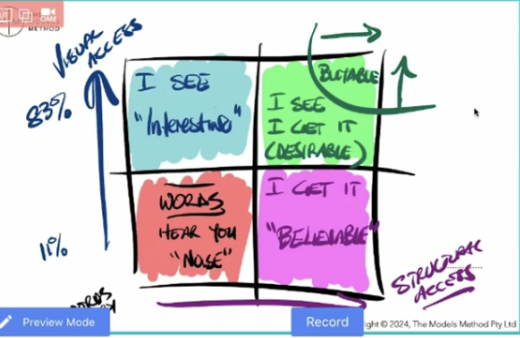
Simon introduced the concept of a two-by-two matrix where effective communication sits in the “green zone” — the top right quadrant where information is both visually engaging and structurally clear.
Visual access makes communication interesting.
Structural access makes communication believable.
When you combine both, your ideas become desirable and even viable.
Action Point: Next time you’re preparing for a meeting or presentation, think about:
What can I show visually?
How can I organize it structurally?
Even a rough sketch can make a huge difference!
Leadership Is a Performance Art: The Power of Choreography
Simon emphasized that every leadership communication is a performance. It’s not about being extroverted — it’s about choreographing your communication for maximum impact.
Drawing on lessons from stage magic and comedy, he explained:
Great leaders set up clear “pathways”.
They deliver “punchlines” that reveal new perspectives.
They trigger curiosity — keeping their teams engaged and wanting more.
Action Point: Think about the “story arc” of your next team conversation.
What “setup” are you creating?
What “aha moment” or “reveal” can you deliver?
Curiosity is one of the most powerful levers you can pull as a leader.
The Four “C’s” of Leadership
Simon beautifully framed leadership around four key elements:
Character — Your character enters the room before you do.
Communication — Clear communication builds believability.
Commitment — Your commitment inspires accountability.
Courage — Your courage fuels your team’s confidence.
Action Point: Reflect on these four areas.
Where are you strongest?
Where could you improve?
Leadership isn’t about having all the answers — it’s about how you show up every day.
Purpose and Values: The Foundation for Shared Leadership
In today’s complex and chaotic world, leadership can (and should) be shared within teams. But for shared leadership to work, the organization must:
Have a clear, compelling, self-evident purpose.
Define values that truly matter — not just baseline values like “trust” or “respect,” but the ones that make your team uniquely you.
Action Point:
Ask yourself (and your team): If our company disappeared for six months, who would suffer and why?
Clarify not just “what” you do, but why it matters to the world.
And when defining values, go beyond generic statements. Identify values that demand real behavior and actions every day.
The Superpower of Pause and Deep Thinking
One of the most profound reminders from Simon was that we’ve engineered pause out of the modern world.
To be great leaders, we must create intentional space for deep thinking, reflection, and model-building.
Action Point:
Block regular “thinking time” into your calendar.
If you catch yourself staring into space, grab a notepad and start sketching your thoughts — create a model!
Bonus Tip: When someone asks what you’re doing, say “I’m building a model to unpack a concept.” It instantly shifts perceptions: you’re seen as a deep, strategic thinker.
Final Reflections
Leadership isn’t a right — it’s a responsibility. It demands character, communication, commitment, and courage. It’s about guiding your team through chaos safely, anchoring them to purpose, values, and a shared vision.
As Simon so beautifully put it: “Business should be a noble enterprise.”
Let’s step up to create the kind of leadership that the world so desperately needs.
S
Show Notes
00:00 Introduction and Guest Welcome
02:01 The Importance of Models in Communication
04:13 Visual and Structural Access in Communication
12:16 The Role of Leadership in Effective Communication
14:34 Character and Communication in Leadership
20:19 Shared Leadership and Organizational Purpose
24:03 Balancing Commercial and Cause in Organizations
In today’s fast-changing, unpredictable world, the leaders who thrive are not those who rely on past successes, rigid structures, or outdated management playbooks. Instead, the 21st century demands adaptive, forward-thinking, and continuously evolving leadership—a model built on reinvention.
Why Leadership Must Be Reinvented Now
The traditional models of leadership were built for a more stable and predictable world. Hierarchical structures, top-down decision-making, and long-term strategic plans worked in an era of slow-moving change. However, today’s world operates at an accelerated pace, driven by technology, globalization, economic uncertainty, environmental shifts, and societal expectations.
The Data Speaks: Change Is No Longer an Event—It’s Continuous
60% of businesses report that they need to reinvent themselves every three years or less just to survive
One out of three public companies will cease to exist in their current form over the next five years—a failure rate six times higher than forty years ago
The average lifespan of an S&P 500 company has dropped from 33 years in 1964 to just 12 years projected by 2027
A Harvard Business Review study found that 75% of business transformations fail, largely because they approach change as a one-time initiative instead of an ongoing process.
Titanic Syndrome: The Danger of Holding on to the Past
One of the biggest threats to leadership today is what’s called Titanic Syndrome—when leaders and organisations, faced with disruption, create their own downfall by clinging to past successes, refusing to adapt, or ignoring emerging realities
Nokia ignored the shift to smartphones.
Kodak invented digital photography but failed to capitalize on it.
Blockbuster laughed at Netflix’s online streaming model.
Each of these companies had the opportunity to reinvent, yet they chose stability over evolution—and paid the price.
The same applies to leadership. If leaders today fail to adapt, evolve, and reinvent their leadership approach, they risk becoming obsolete—just like the organizations they lead.
How To Reinvent Leadership for the 21st Century
Reinvention isn’t just a business strategy—it’s a leadership mindset and a system. And with 45% of CEO’s believing their business will not be viable in 10 years if it stays on the same path, it is now a leadership imperative.
Here’s a practical, action-oriented framework for leaders who want to future-proof their leadership and create organisations that thrive in disruption.
1. Build a Reinvention Mindset: Adopt Nature’s Approach To Leadership
Nature is the greatest teacher of reinvention. The seasons change, ecosystems adapt, and animals evolve to new environments. Leaders should take inspiration from nature’s cycles of reinvention:
Winter (Reflection & Renewal) → Step back, assess, and let go of outdated methods.
Spring (Growth & Experimentation) → Test new strategies, encourage creativity, and allow fresh ideas to emerge.
Summer (Execution & Scaling) → Double down on what’s working and build momentum.
Autumn (Harvest & Preparation) → Celebrate wins, document lessons, and prepare for the next reinvention cycle.
👉 ACTION: Schedule quarterly “Seasons of Leadership” reviews where you assess what needs to be let go, nurtured, tested, scaled, and celebrated.
2. Shift From Managing Stability To Leading Continuous Improvement
Leaders can no longer afford to react to change; they must anticipate, design, and implement it continuously.
Key Shifts in Leadership Thinking
Old Leadership Model
New Reinvention Model
Change is a one-time project
Change is a continuous system
Top-down decision-making
Decentralised, empowered teams
Rigid long-term plans
Agile, adaptable strategies
Risk avoidance
Experimentation & calculated risks
Control and efficiency
Innovation and flexibility
👉 ACTION: Use the Titanic Syndrome Diagnostic to evaluate where your leadership style may be clinging to outdated success patterns.
3. Reimagine Your Leadership Role: Become a Chief Reinvention Officer
To succeed in the 21st century, leaders must go beyond traditional leadership models. You need to become a Chief Reinvention Officer—someone who anticipates change, designs new strategies, and implements transformation continuously.
The Reinvention Leadership Model
A reinvention-ready leader must master these six pillars:
Anticipation → Actively scan for emerging trends before they become disruptions.
Experimentation → Test new ideas rapidly with a “fail fast, learn fast” mindset.
Collaboration → Break silos and encourage cross-functional, cross-industry learning.
Sustainability → Lead with long-term adaptability, not just short-term gains.
Resilience → Create a culture that embraces uncertainty and sees change as an opportunity.
People Empowerment → Equip teams with the skills, autonomy, and mindset to adapt.
👉 ACTION: Shift your leadership approach from command and control to inspire and empower—let your team lead reinvention at all levels.
4. Reinvent Team Collaboration: From Hierarchies To Networks
Traditional hierarchical leadership no longer works. Teams today thrive in decentralized, agile, and purpose-driven environments.
How to Reinvent Your Team Structure
Traditional Teams
Reinvented, Agile Teams
Rigid hierarchy
Flat, cross-functional collaboration
Fixed job roles
Fluid roles based on strengths & projects
Top-down decision-making
Empowered, self-directed teams
Siloed departments
Cross-functional networks
👉 ACTION: Introduce “Reinvention Labs”—teams dedicated to testing new ideas, processes, and leadership styles in small, controlled experiments.
5. Build a Reinvention System: Make Change Part of Daily Operations
The best leaders don’t just talk about reinvention—they bake it into their organisation’s DNA.
How to Build a Reinvention System
Create a “Reinvention Budget”—allocate resources specifically for innovation and experimentation.
Measure What Matters—track metrics beyond financials, such as agility, adaptability, and team engagement.
Celebrate Failure—reward learning and risk-taking, not just results.
Make Learning a Non-Negotiable—continuous learning should be embedded in daily work, not just in annual training sessions.
👉 ACTION: Implement a “Reinvention Scorecard” to track how often your team is experimenting, adapting, and learning from failure.
The Future of Leadership Belongs To Reinventors
The leaders of the future will not be the ones who hold on to outdated structures, methods, or mindsets. They will be the ones who embrace change, continuously reinvent, and lead with adaptability.
Use the Titanic Syndrome Diagnostic to identify outdated leadership habits.
Empower Teams Through Reinvention Labs—let teams lead innovation.
Shift From Stability to Agility—lead reinvention, not just change.
Build a Reinvention System—make continuous learning and innovation part of daily operations.
💡 Final Thought: Reinvention is not a one-time project—it’s a way of life for 21st-century leaders. The question is not whether you need to reinvent, but how fast you can start.
Are you ready to become a Chief Reinvention Officer?
Are you a business leader feeling more overwhelmed now than ever—even after hiring a team? Do you find yourself becoming the bottleneck in your own business operations? If so, you’re not alone. Many fast-growing business leaders fall into this trap. But the good news is there’s a simple and effective model to help you escape it.
In this post, I want to introduce you to a game-changing productivity tool: the TOADD Model—an acronym for Train, Outsource, Automate, Delegate, and Discipline. This model will help you step out of the daily weeds of your business and lead more strategically. It’s time to unshackle yourself from the busy trap and unlock your team’s true potential.
Why Models Matter for Leaders
Before we dive into TOADD, let’s talk about the power of models. Models allow us to codify our genius—our intellectual property—in ways that are clear, repeatable, and easy for others to understand. That’s why I use models like the Unbridled Teamship Roadmap and my IMPACTFUL Leadership Traits framework. When you frame your leadership strategy using memorable acronyms or visual diagrams, your team is more likely to remember and apply what you teach them.
Now, let’s unpack the TOADD model and see how it can revolutionise your productivity.
T – Train: Short-Term Effort for Long-Term Freedom
Training team members may seem like a time drain, but it’s actually a smart long-term investment. One of the most common objections I hear is, “I don’t have time to train anyone.” But here’s the truth: every hour you invest in training could save you dozens of hours down the road.
💡 Action Step:
Choose one repetitive task you do weekly (e.g., social media posting, inbox management).
Use a screen recording tool like Loom or Zoom to document how you do it.
Share this with a team member and give them a chance to take it on.
If that task takes you an hour a week, you’re freeing up 52 hours a year just by training someone else to handle it.
O – Outsource: Tap into the Global Talent Pool
If you don’t have a team yet—or you need specialized support—consider outsourcing. The modern gig economy makes it easier than ever to find high-quality freelancers who can tackle just about any task.
From virtual assistants to graphic designers to funnel builders, the world is your oyster. You can even find affordable, highly skilled talent from countries like the Philippines, South Africa, and Nigeria.
💡 Action Step:
Write down 3 tasks you don’t enjoy or aren’t great at.
Test one freelancer with a small project and assess the results.
Outsourcing doesn’t have to be permanent—you can start small and scale as your needs grow.
A – Automate: Let Tech Do the Heavy Lifting
Technology is your silent teammate. You can now automate everything from lead generation to email marketing to appointment reminders. The time you save can be reinvested into high-impact strategy and innovation.
In my business, for example, I’ve automated my quiz funnel using tools like SCORE App, Zapier, and my CRM. Once someone completes the quiz, they automatically receive follow-up emails and resources—without me lifting a finger.
💡 Action Step:
Identify one manual task you repeat often (e.g., sending meeting reminders, client onboarding).
Explore automation tools like Zapier, Make.com (formerly Integromat), or CRMs with built-in workflows.
Set up a simple automation and monitor the impact.
Small automations can have massive ripple effects in freeing up your schedule.
D – Delegate: Empower Your Team to Lead
Delegation isn’t just a leadership skill—it’s a mindset shift. Many leaders hesitate to delegate because they believe “no one can do it like me.” But this mindset keeps you stuck and slows down your team.
Worse, you may be holding on to tasks you hate, mistakenly thinking no one else wants them either. In reality, those same tasks may be someone else’s zone of genius.
💡 Action Step:
Audit your daily tasks for a week in 15-minute increments.
Highlight tasks that could be handed off to someone else.
Ask your team members what they love doing—you might be surprised!
Then delegate accordingly and be available to coach and support them through the learning curve.
D – Discipline: The Glue That Holds It All Together
The final D stands for Discipline—both personal and team-wide. Discipline means following through on commitments, setting boundaries around your time, and holding team members accountable. Without discipline, all the training, outsourcing, automation, and delegation in the world won’t stick.
It also means staying consistent with feedback loops. When something doesn’t go as planned, don’t take the task back—coach your team through it.
💡 Action Step:
Review weekly: Are your systems and team operating as expected?
Reflect: Are you following through on your own priorities?
Reinforce: Are you holding space for feedback and continuous improvement?
Great businesses are built on consistent behaviours, not random bursts of energy.
Bonus Tip: Start by Tracking Your Time
If you’re not sure where to start, begin by tracking how you spend your time each day. Use a time tracker or simply jot down your tasks in 15-minute chunks. You’ll quickly see where your time is leaking—and where TOADD can help.
Final Thoughts: Productivity Is a Team Sport
The TOADD model isn’t just about getting more done—it’s about leading smarter. It’s about reclaiming your role as a visionary and empowering your team to step into theirs.
Here’s your TOADD recap:
T – Train others to take on repeatable tasks.
O – Outsource work you don’t need to do yourself.
A – Automate processes to save time and energy.
D – Delegate to unlock your team’s superpowers.
D – Discipline yourself and your team to follow through.
When you implement TOADD, you stop being the bottleneck and start becoming the catalyst for exponential growth. So, which letter are you going to start with this week?
Let’s Talk:
I’d love to hear from you—what’s one thing you’re going to Train, Outsource, Automate, Delegate, or Discipline this week? Drop me a message or tag me on LinkedIn!
What the latest research reveals—and what it means for your team
As a business leader, you’re probably feeling the strain of managing change while trying to keep your team steady and focused. The pace of transformation—technological, economic, and geopolitical—is accelerating. And as the world around us becomes increasingly unpredictable, your team is likely craving one thing above all else: stability.
In the latest episode of my Impactful Teamwork podcast, I explore one of the most pressing challenges facing organisations today—the tension between stability and agility—and why getting the balance right is now critical for attracting, engaging, and retaining top talent.
The episode draws on insights from Deloitte’s 2025 Human Capital Trends Report, which offers some sobering data for business leaders. The good news? With intention and smart leadership, you can turn this challenge into a competitive advantage.
Why This Conversation Matters Now
Recent weeks have been a whirlwind—from political decisions that reshape global markets overnight to rapid advancements in AI and technology. In the midst of all this, your team members are trying to stay grounded while navigating uncertainty at work and at home.
Redundancies, restructuring, and leadership changes have become the norm. I shared the story of a client who had six different bosses in just two years. She returned from a holiday to find her desk moved—and instantly feared the worst. That one small change triggered a wave of anxiety because, in her experience, change has almost always meant loss.
It’s a reminder of just how fragile the sense of security can be at work. And yet, organisations are also under immense pressure to be nimble and responsive. So how do you meet both needs?
The Data: A Wake-Up Call for Leaders
The Human Capital report reveals some striking stats:
66% of workers feel overwhelmed by the pace of change.
49% worry that rapid transformation will leave them behind.
75% of workers say they crave greater stability.
And yet, only 39% of leaders are taking meaningful action to address this tension.
There’s a clear disconnect between what employees want and what businesses are providing.
The workplace has shifted from a stable, hierarchical environment with clearly defined roles to a fluid ecosystem where people are expected to operate across functions, often outside their job descriptions.
Traditional structures just aren’t cutting it anymore. But simply dismantling them in favour of agile, fast-moving teams can leave your people feeling untethered. As a leader, your challenge is to design new kinds of “anchors”—stability points that don’t compromise adaptability.
Anchoring Agility: Rethinking How Work Gets Done
What does stability look like in a modern, agile organisation? According to Deloitte, it comes from reimagining three key areas:
1. How Teams Learn
In the old paradigm, people learned within stable teams and under long-term leaders. Today, high attrition rates and shifting structures make that hard. New anchors can include peer learning networks, mentorship communities, and skills-based development platforms—including those powered by AI.
2. How Work Is Organised
Gone are the days of strict job descriptions and siloed teams. People now contribute across departments, projects, and platforms. Success is no longer measured by tasks completed, but by value created. Stability, therefore, comes from clarity of outcomes, not rigidity of roles.
3. Where Work Happens
The office is no longer the anchor. Hybrid, remote, and asynchronous working models are the new norm. Your role as a leader is to create consistency in expectations and freedom in execution. That’s the sweet spot where autonomy meets accountability.
Embracing Potential Over Pedigree
One of the most powerful findings in the report is this: employees are hungry for growth—but not in the traditional sense. Ladders have become lattices. Team members want career paths based on their skills and potential, not just past experience or academic qualifications.
And yet, 59% of organisations still value experience over potential. That’s a missed opportunity.
As leaders, we must challenge ourselves to look beyond the CV. Who in your team hasn’t yet had the chance to shine? What hidden skills might emerge if you simply gave someone the opportunity?
I shared the story of a woman I recently met who, just two years ago, was terrified of public speaking. Now, she’s one of the most inspiring trainers I’ve worked with—all because someone believed in her before she believed in herself.
What’s at Stake If We Get This Wrong?
If we fail to address the balance between agility and stability, we risk more than inefficiency. We risk:
Eroding trust between leaders and teams
Losing innovation because people don’t feel safe to contribute
Damaging retention, as team members search for more grounded environments
Missing growth opportunities, by overlooking team potential
Workplace culture is no longer a “nice-to-have”—it’s a strategic differentiator. When people feel valued, clear, and safe, they do their best work. When they don’t, they leave—or worse, they disengage.
So, What Can You Do This Week?
The question I left listeners with—and the one I invite you to explore—is this:
How are you managing the tension between stability and agility within your team or organisation?
If it feels like a “crazy-eight” cycle—where one moment you’re seeking structure and the next, flexibility—you’re not alone. But your job as a leader is to hold both poles and guide your people through the uncertainty with confidence and clarity.
Here are three actions you could take:
Check in with your team: What do they need to feel safe and focused right now?
Clarify your outcomes: Are you measuring what really matters—value creation over task completion?
Spot hidden potential: Who on your team could do more, if only they were asked?
Final Thoughts: It’s Not Either/Or
The future of work isn’t about choosing between agility or stability. It’s about learning to strengthen both at the same time.
Welcome to this week’s edition of Impactful Teamwork, where we’re reimagining the future of business leadership. Today I want to share a transformative concept that I believe will shape the next era of high-performance business: Teamship.
As businesses scale, the traditional top-down leadership model is rapidly becoming outdated. We need something more collaborative, more resilient, and radically more human. That’s where Teamship comes in—a new approach to leadership that puts the collective power of the team front and center.
What Is Teamship?
Teamship is a progressive, shared leadership model that emphasises collective ownership, mutual trust, and dynamic collaboration. Unlike the command-and-control structures that most businesses have inherited from military-style hierarchies, Teamship invites every team member to step up, lead from where they stand, and co-create outcomes.
Rather than relying on one heroic leader to make all the decisions, Teamship recognises that the best solutions arise when diverse voices contribute and when leadership is situational, shared, and earned.
Why Teamship Now?
The need for Teamship has never been more urgent. Business leaders today are facing:
Geopolitical uncertainty
Disruption from AI and automation
Climate instability
Rising expectations from younger, purpose-driven employees
These dynamics demand agility, adaptability, and alignment—qualities that Teamship fosters by design. The lone leader model simply can’t keep pace with the speed and complexity of today’s environment.
Action Step: Reflect on a recent business challenge. Could the outcome have been improved by broader input or shared responsibility? That’s the Teamship lens in action.
The Shift from Leadership to Teamship
For decades, leadership has been viewed as a role or title—something held by the few at the top. But in the world of scaling businesses that’s no longer effective. Leaders can’t possibly hold all the answers, especially when rapid growth creates new layers of complexity every day.
Teamship flips the script. It moves from:
Hierarchy to shared ownership
Control to trust
Individual brilliance to collective intelligence
“Everyone leads from where they stand.” — That’s the heart of Teamship.
Real-World Benefits of Teamship
When businesses embrace Teamship, the results speak for themselves:
1. Increased Engagement and Retention
Gallup reports that only 23% of employees globally are actively engaged at work. The root cause? A lack of trust, inclusion, and autonomy. Teamship reverses this trend by empowering everyone to lead and contribute meaningfully.
2. Faster Innovation and Problem-Solving
In high-trust environments where psychological safety is prioritised, teams feel free to explore, challenge, and innovate. With Teamship, you get faster decision-making because you’re tapping into the full range of your team’s collective creativity.
3. Greater Resilience and Agility
Shared leadership fosters more resilient teams. They recover quicker from setbacks and adapt more effectively because they’re not waiting for top-down direction—they’re already in motion.
4. Aligned Momentum and Reduced Burnout
When energy, trust, and curiosity flow freely across the team, performance is amplified and burnout is minimised. You create momentum without sacrificing wellbeing.
Challenges to Adopting Teamship
Let’s be real—this shift isn’t always easy. Here are a few obstacles I see business leaders face when transitioning to Teamship:
1. Letting Go of Control
This is often the hardest step. Many leaders fear that stepping back means losing influence, but in reality, the opposite is true. As I often say, horses don’t follow force—they follow presence, clarity, and trust. And human teams are no different.
Action Step: Identify one area where you can delegate more ownership this week. Observe what shifts in engagement and initiative as a result.
2. Lack of a Clear Framework
Many teams know they want more collaboration, but they don’t know how to achieve it. That’s why I created the Unbridled Teamship Roadmap—a step-by-step model rooted in natural herd dynamics and modern leadership science.
3. Cultural Resistance
Teamship challenges the status quo. It calls for a disruption of traditional power dynamics and ego-driven behavior. That kind of transformation needs courageous role-modeling from senior leaders.
4. New Skills Are Required
Teamship requires emotional intelligence, communication, and self-awareness—not just from the leader, but from every team member. My experiential coaching sessions with horses are designed to accelerate the development of these crucial skills by making the invisible visible.
Action Step: Prioritise team training that develops emotional intelligence and self-awareness alongside technical skills.
The Three Pillars of Teamship
To embed Teamship in your organization, focus on activating these three powerful levers:
1. Trust
Trust is the foundation of high-performing teams. It’s built through authenticity, consistency, and empathy. Without psychological safety, collaboration stalls.
Action Step: Introduce regular “trust check-ins” during team meetings to surface hidden concerns and strengthen connection.
2. Energy
Teamship honors energy as a strategic asset. That means recognizing the importance of rest, renewal, and sustainable performance—just like horses who expend energy when needed and then return to grazing to recover.
Action Step: Build intentional recovery time into your team’s workflow—whether it’s a no-meeting day, mindfulness moments, or short walking meetings.
3. Curiosity
Curiosity fuels reinvention and learning. In Teamship cultures, questions are valued more than assumptions, and experimentation is encouraged.
Action Step: Start your next team meeting by asking, “What are we curious about this week?” Then explore the answers together.
From Control to Connection: The Call to Action
Teamship isn’t a buzzword—it’s a paradigm shift. It’s about moving from control to connection, from independence to interdependence, and from silos to synergy.
If you’re scaling a firm, embedding Teamship can unlock the momentum you need to grow sustainably, while keeping your people engaged and your purpose intact.
So what’s one action you will take this week to start applying Teamship in your business?
Take the First Step: Discover Your Teamship Score
If you’re ready to explore how Teamship could transform your business, start by taking my free diagnostic: Turbocharge Your Team Quiz. It’s based on the Unbridled Teamship Roadmap and will give you personalised insights into where your team stands across the nine accelerators and three levers of Teamship.
Once you’ve completed the quiz, you’ll be invited to book a Turbocharge Your Team Audit, where we’ll explore how to bring these principles to life in your organisation.
This week marks a major milestone for me—Impactful Teamwork has officially turned one! That’s 52 weeks of consistent podcasting, sharing insights, stories, and strategies to help business leaders build high-performing teams. As I paused to reflect and celebrate this achievement, two powerful themes emerged: Consistency and Celebration—the often-overlooked cornerstones of sustainable team performance.
Why Consistency is a Leadership Superpower
Consistency isn’t flashy, but it’s foundational. In a world that’s constantly shifting, your ability to show up reliably for your team becomes a stabilising force. It builds trust, enhances accountability, and creates psychological safety—the fertile ground in which collaboration, innovation, and performance thrive.
Insight 1: Show Up Predictably
Your team needs to know how you’ll respond in various situations. When your behaviour aligns with your values day in and day out, you build a culture where people feel safe, seen, and empowered to contribute their best. Predictability doesn’t mean being robotic—it means being anchored.
✨ Try This: Start your meetings with a consistent structure or ritual—like a quick round of wins or a shared intention. This simple act fosters rhythm and reliability.
Insight 2: Use Consistency to Compound Impact
Drawing from the principle of Kaizen—small, consistent improvements—think of consistency as “compound interest” in leadership. One percent better each day may seem minor, but over time, the results are transformational.
Consider this: just as one daily chocolate bar can quietly add 10kg over two years (as I’ve personally experienced!), one small act of leadership—each day—can reshape your team culture.
✨ Try This: Choose one leadership behaviour to consistently apply this month—perhaps regular 1:1 check-ins or timely feedback—and track its impact.
Insight 3: Be the Calm Amid the Storm
Especially during change or crisis, your steadiness gives your team certainty. When you model grounded leadership, your team feels safer to navigate ambiguity and contribute with confidence.
✨ Try This: Take 2–3 minutes daily to ground yourself before team interactions. Breathe deeply, reconnect with your purpose, and then engage from a place of calm clarity.
Celebration: The Secret Sauce of Sustainable Success
While consistency builds the structure, celebration is the fuel. Yet so many leaders skip this crucial step. We hit a goal and move on to the next, leaving effort unacknowledged and engagement untapped.
Insight 4: Make the Invisible Visible
Celebration turns effort into visibility. When you pause to recognise wins—big or small—you reinforce the behaviours you want to see more of, from collaboration to creativity.
✨ Try This: Implement a “Friday Wins” moment, where each team member shares something they’re proud of from the week.
Insight 5: Celebrate Effort, Not Just Outcomes
In a volatile world, outcomes often shift. What matters is the effort, learning, and collaboration that got you there. Recognising this builds resilience and a growth mindset.
✨ Try This: After a project concludes, hold a “Retrospective Celebration” focused not just on results, but lessons learned and contributions made.
Insight 6: Understand the Science Behind It
Celebration is more than a feel-good activity—it rewires the brain. It releases:
Dopamine, the motivation chemical that says, “That felt good, do it again.”
Oxytocin, the connection hormone that deepens trust and belonging.
Leaders who celebrate frequently build more motivated, engaged, and collaborative teams.
✨ Try This: Tie recognition to your core values. “You showed great initiative in aligning with our value of innovation when you created that new process.”
Don’t Let Celebration Backfire: Make It Personal
A story I shared in the podcast perfectly illustrates this. A top-performing salesperson received a case of champagne as a reward—except he didn’t drink. The gift didn’t just fall flat—it caused him to resign.
Moral of the story? Know your people.
✨ Try This: Ask each team member how they like to be recognised—publicly or privately, through words, experiences, or gifts.
Ways to Celebrate Without Breaking the Bank
Celebration doesn’t need to be elaborate. Small, genuine gestures matter most.
A handwritten thank-you note
A shout-out in a team meeting
A peer-nominated recognition system
A surprise coffee from their favorite café
A “Wall of Wins” in the office
These moments create emotional anchors that increase team loyalty, energy, and satisfaction.
Make Celebration a Strategic Habit
Celebration isn’t fluff—it’s a strategic lever. Teams that feel recognised and appreciated are more likely to stay engaged, go the extra mile, and remain loyal. Especially after completing tough projects, the pause to celebrate becomes a moment of collective pride and restoration.
✨ Try This: At the end of a project, don’t just do a debrief—host a mini celebration. Gather the team, express gratitude, and share what went well. Anchor the win emotionally and culturally.
Consistency + Celebration = Team Momentum
If consistency creates structure and reliability, and celebration fuels joy and motivation, then together they create unstoppable momentum.
This isn’t just leadership theory—it’s neuroscience, psychology, and human nature. My horses teach this lesson every day on our Unbridled Leadership retreats. They instinctively follow consistent, calm energy—and respond beautifully to positive reinforcement. Just like our teams do.
Final Reflection: Where Can You Be More Consistent and Celebratory?
Where are you already being consistent as a leader? Where could you improve?
What recent team win—large or small—deserves recognition?
How can you celebrate in a way that feels authentic, meaningful, and inclusive?
As Tom Peters says, “Celebrate what you want to see more of.” And I couldn’t agree more. Because what gets celebrated, gets repeated.
Here’s to another year of impactful Teamwork. I’m off to celebrate with the horses—how will you celebrate today?
Show Notes:
Here are the highlights from this episode:
00:00 Welcome to Our Anniversary Episode!
02:18 The Power of Consistency in Leadership
05:40 Personal Reflections on Consistency
09:58 Celebrating Milestones and Achievements
13:25 The Neuroscience Behind Celebration
16:26 Effective Ways to Celebrate in the Workplace
22:12 Final Thoughts on Celebration and Consistency
Welcome back to another edition of Impactful Teamwork – the podcast for business leaders who are committed to creating high-performing teams that are both purpose-driven and performance-focused. I’m Julia Felton, your host and guide, and in this week’s episode, I’m diving into a topic that keeps surfacing with clients, colleagues and even the horses I partner with in my leadership work – connection.
In today’s fast-paced, digital-first world – particularly in the midst of the AI revolution – true human connection is becoming a rare and precious commodity. And yet, it’s the very thing that’s needed most.
Whether you lead a multi-million-pound business or a fast-growing scale-up, your ability to connect authentically – with yourself, your team, and your stakeholders – could well be the difference between momentum and stagnation. So in this blog, I want to unpack the insights from this week’s podcast episode and explore how you can deepen connection to drive team performance and sustainable business success.
We’re Drowning in Noise – and Craving Connection
We live in a world saturated with information, marketing messages and AI-generated content. It’s getting harder to discern what’s real and what’s not. I was reminded of this during a recent workshop where we looked at an image of two people relaxing by a pool – a seemingly idyllic holiday scene. But when we looked closer, we realised the man had three arms. The image was AI-generated, and we’d almost missed the giveaway.
That moment reinforced something I’ve been noticing across boardrooms and workshops alike: people are craving authenticity more than ever before. They want to feel seen, heard, and valued – not manipulated, marketed to or managed at arm’s length.
Why Connection is a Leadership Imperative
In my book Unbridled Success, I talk about the importance of TLC – not in the sense of tea and sympathy, but Trust, Leadership, and Connection. These are the three essential pillars of effective teamwork.
Connection, in particular, underpins everything. It’s the invisible thread that ties your strategy to execution, your purpose to performance, and your people to each other.
As leadership expert John Maxwell puts it:
“Connection is the ability to identify with people and relate to them in a way that increases your influence with them.”
That influence, built on empathy and trust, is what drives buy-in, engagement, and ultimately results.
Four Levels of Connection That Drive Impact
So how do we connect more powerfully? In this week’s podcast, I share the four key dimensions of connection that I use in my work with clients (and horses!). These are:
1. Visual Connection – What People See
We remember 50% of what we see, but only 20% of what we hear. That’s why visual communication is such a powerful lever for leadership.
In our hybrid working world, tools like Zoom have become vital. They allow us to read body language, spot signs of fatigue or disengagement, and build rapport even from a distance. But it’s not just about being on camera – it’s about how you show up. Are you energised? Present? Authentic?
As a leader, your visual presence sends a message before you even speak.
2. Intellectual Connection – What People Understand
Your team needs to understand what your business stands for, where it’s headed, and why it matters. That starts with you being clear on your message and speaking about it with passion.
I remember a moment in a horse-led coaching session where a client was struggling to articulate her “why”. As she shared a list of logical business goals, my horse, Charlie, stood disengaged. Then, suddenly, she said: “This business matters because it will help me save elephants in Africa.” In that moment, Charlie walked straight over and put his head on her chest. Because finally – she was speaking from the heart.
3. Emotional Connection – What People Feel
We buy with emotion and justify with logic – and your team is no different. They don’t just want to hear your strategy; they want to feel your belief in it. They want to know you care.
One of my clients, let’s call her Susan, connected deeply with a pony named Olive during a retreat exercise. As she stood beside Olive, breathing with her, years of unprocessed grief surfaced. Olive responded by gently wrapping her neck around her. In that moment of raw emotional connection, healing and clarity emerged.
This kind of emotional resonance is powerful – and it’s just as important in business as it is in life.
4. Verbal Connection – What People Hear
While words may only account for 7% of communication, the right words matter. As Mark Twain said,
“The difference between the right word and the almost right word is the difference between lightning and a lightning bug.”
Your language sets the tone. Are you inspiring or diminishing? Are you empowering people or instilling doubt? Choose words that energise, uplift and align with your vision.
Remember – your team is listening for more than just instructions. They’re listening for meaning.
Connection Starts With You
Here’s the thing – you can’t connect with others until you connect with yourself. That means getting honest about what you want, what you believe, and what you stand for.
When I work with the horses, they always reflect back your internal state. They don’t respond to titles or targets – only to who you are in the moment. It’s a humbling reminder that leadership isn’t just about competence. It’s about congruence.
Why Connection is Your Competitive Advantage
In a world where AI can mimic voices and images, your humanity is your edge. People don’t want perfect. They want real. And connection – authentic, vulnerable, human connection – is the key to building trust, loyalty and high-impact teams.
So as you head into your next team meeting, pitch, or strategy session, ask yourself:
Am I truly connecting with this person?
Am I seeing them, hearing them, feeling with them – or just talking at them?
And am I showing up as the most authentic version of myself?
Listen to the Full Episode
This blog only scratches the surface of what we explore in this week’s Impactful Teamwork episode. So I invite you to take 20 minutes to tune in – whether you’re on your commute, out walking the dog, or taking a well-earned break.
Ready to Deepen Your Team Connection?
If today’s episode resonated with you and you’re curious about how to bring deeper connection into your team, I’d love to invite you to explore The Team IMPACT Framework – my signature process for transforming teams through trust, leadership and connection.
Drop me a message or connect via ju***@****************er.com, and let’s chat.
Until next time, stay curious, stay connected – and keep creating impactful teamwork.
Show Notes:
Here are the highlights from this episode:
00:00Introduction to Impactful Teamwork
00:55The Importance of Human Connection
01:09Connection in the Age of AI
03:09The Triad of Trust, Leadership, and Connection
In a recent episode of my podcast, Impactful Teamwork, I explored a deeply personal yet profoundly important topic for leaders: the Law of Legacy. This theme resonated powerfully with me following the recent passing of my horse, Coach Toby, whose remarkable influence on hundreds of leaders and teams reinforced the importance of intentional legacy.
What is Legacy in Leadership?
As leaders, our lasting value is often measured not just by what we achieve personally, but by how successfully we enable others to carry forward our vision and values. Legacy, at its core, answers the reflective question:
“What do we want people to say at our funeral?”
Many leaders avoid considering this. Yet, it is crucial because it drives intentional living, proactive leadership, and strategic succession planning. Eleanor Roosevelt aptly captured this idea when she said:
“Life is like a parachute jump. You’ve got to get it right the first time.”
Coach Toby’s Inspiring Legacy
My own awareness of legacy deepened significantly through my horse Toby, who inspired the creation of Business HorsePower. Toby became not just a horse, but a mentor, challenging business leaders to develop trust, certainty, and authentic leadership. Surprisingly demanding, Toby taught countless teams about effective leadership, clear communication, and the power of connection. His legacy includes clients who, empowered by their experiences, boldly transitioned to entrepreneurship or secured dream career opportunities.
Toby exemplified intentional legacy, influencing hundreds with clarity and purpose—exactly what leaders should aim for.
Actionable Insights for Corporate Leaders
1. Define the Legacy You Want to Leave
Most people drift through life, accepting outcomes passively. Exceptional leaders, however, intentionally define their legacy. Consider what you truly value and how you want to impact future generations. For me, legacy involves creating workplaces where individuals thrive and recognising nature as a blueprint for sustainable leadership. Ask yourself:
What core impact do I want to leave?
How will my actions today align with this legacy?
2. Live Your Legacy Daily
To lead effectively, you must embody your legacy every day. This builds credibility and reinforces your vision clearly to those around you. If your legacy involves collaboration and empowerment, demonstrate this consistently. I personally believe that business can be a powerful force for good, driving meaningful global change beyond traditional avenues like government and media.
3. Choose Who Will Carry Your Legacy
Succession planning is frequently overlooked but is vital. Leaders must proactively identify and mentor successors who can continue their vision. In scaling businesses, especially, leaders often become bottlenecks, impeding growth because they haven’t developed successors. Reflecting on my corporate career, I recognised the importance of succession planning clearly during my sabbatical, when I successfully prepared a deputy to step into my role.
Coach Toby illustrated effective succession planning by naturally enabling another horse, Thistle, to step forward, though this also highlighted the importance of mentoring successors carefully, ensuring they’re ready to lead.
4. Pass On the Baton Effectively
Leadership expert John Maxwell outlines four levels of legacy creation:
Achievement: Doing significant things independently.
Empowerment: Equipping others to do big things for you.
Significance: Developing leaders who collaborate on great tasks.
True Legacy: Positioning leaders to succeed independently without you.
True leadership legacy is about removing yourself from daily operations, orchestrating success from a distance, and allowing others to flourish. Legacy is only realised when your organisation thrives independently of your direct involvement.
Real-Life Impact of a Thoughtful Legacy
Reflecting on my career, creating the first-ever global hotel benchmarks was an impactful legacy I inadvertently created. This data-driven initiative continues to guide industry standards today, illustrating how lasting legacies often begin with pioneering ideas.
My journey with Coach Toby further shaped my current mission—awakening leaders to new, nature-inspired leadership models. Toby’s legacy is not merely his memory but a lasting impact, empowering people to transform their careers and lives meaningfully.
Your Leadership Legacy: What’s Next?
To truly lead with impact, intentionally crafting your legacy is essential. Reflect deeply:
Are you clear on the legacy you want to create?
How are your actions today shaping this future?
Intentional legacy leads to fulfilment and significant, sustained impact. Embrace your leadership role with clarity, courage, and purpose—just like Coach Toby did.
Take Action: Spend some quiet reflection time to write down your intended legacy. Share it with someone who will help hold you accountable. Remember, your legacy starts with conscious choices today.
Let’s lead consciously and leave legacies that genuinely matter.
In today’s fast-changing, unpredictable world, the leaders who thrive are not those who rely on past successes, rigid structures, or outdated management playbooks. Instead, the 21st century demands adaptive, forward-thinking, and continuously evolving leadership—a model built on reinvention.
Why Leadership Must Be Reinvented Now
The traditional models of leadership were built for a more stable and predictable world. Hierarchical structures, top-down decision-making, and long-term strategic plans worked in an era of slow-moving change. However, today’s world operates at an accelerated pace, driven by technology, globalization, economic uncertainty, environmental shifts, and societal expectations.
The Data Speaks: Change Is No Longer an Event—It’s Continuous
60% of businesses report that they need to reinvent themselves every three years or less just to survive
One out of three public companies will cease to exist in their current form over the next five years—a failure rate six times higher than forty years ago
The average lifespan of an S&P 500 company has dropped from 33 years in 1964 to just 12 years projected by 2027
A Harvard Business Review study found that 75% of business transformations fail, largely because they approach change as a one-time initiative instead of an ongoing process.
Titanic Syndrome: The Danger of Holding on to the Past
One of the biggest threats to leadership today is what’s called Titanic Syndrome—when leaders and organisations, faced with disruption, create their own downfall by clinging to past successes, refusing to adapt, or ignoring emerging realities
Nokia ignored the shift to smartphones.
Kodak invented digital photography but failed to capitalize on it.
Blockbuster laughed at Netflix’s online streaming model.
Each of these companies had the opportunity to reinvent, yet they chose stability over evolution—and paid the price.
The same applies to leadership. If leaders today fail to adapt, evolve, and reinvent their leadership approach, they risk becoming obsolete—just like the organizations they lead.
How To Reinvent Leadership For 21st Century
Reinvention isn’t just a business strategy—it’s a leadership mindset and a system. And with 45% of CEO’s believing their business will not be viable in 10 years if it stays on the same path, it is now a leadership imperative.
Here’s a practical, action-oriented framework for leaders who want to future-proof their leadership and create organisations that thrive in disruption
1. Build a Reinvention Mindset: Adopt Nature’s Approach To Leadership
Nature is the greatest teacher of reinvention. The seasons change, ecosystems adapt, and animals evolve to new environments. Leaders should take inspiration from nature’s cycles of reinvention:
Winter (Reflection & Renewal) → Step back, assess, and let go of outdated methods.
Spring (Growth & Experimentation) → Test new strategies, encourage creativity, and allow fresh ideas to emerge.
Summer (Execution & Scaling) → Double down on what’s working and build momentum.
Autumn (Harvest & Preparation) → Celebrate wins, document lessons, and prepare for the next reinvention cycle.
👉 ACTION: Schedule quarterly “Seasons of Leadership” reviews where you assess what needs to be let go, nurtured, tested, scaled, and celebrated.
2. Shift From Managing Stability To Leading Continous Change
Leaders can no longer afford to react to change; they must anticipate, design, and implement it continuously.
Key Shifts in Leadership Thinking
Old Leadership Model
New Reinvention Model
Change is a one-time project
Change is a continuous system
Top-down decision-making
Decentralised, empowered teams
Rigid long-term plans
Agile, adaptable strategies
Risk avoidance
Experimentation & calculated risks
Control and efficiency
Innovation and flexibility
👉 ACTION: Use the Titanic Syndrome Diagnostic to evaluate where your leadership style may be clinging to outdated success patterns
3. Reimagine Your Leadership Role: Become a Chief Reinvention Officer
To succeed in the 21st century, leaders must go beyond traditional leadership models. You need to become a Chief Reinvention Officer—someone who anticipates change, designs new strategies, and implements transformation continuously.
The Reinvention Leadership Model
A reinvention-ready leader must master these six pillars:
Anticipation → Actively scan for emerging trends before they become disruptions.
Experimentation → Test new ideas rapidly with a “fail fast, learn fast” mindset.
Collaboration → Break silos and encourage cross-functional, cross-industry learning.
Sustainability → Lead with long-term adaptability, not just short-term gains.
Resilience → Create a culture that embraces uncertainty and sees change as an opportunity.
People Empowerment → Equip teams with the skills, autonomy, and mindset to adapt.
👉 ACTION: Shift your leadership approach from command and control to inspire and empower—let your team lead reinvention at all levels.
4. Reinvent Team Collaboration: From Hierarchies To Networks
Traditional hierarchical leadership no longer works. Teams today thrive in decentralized, agile, and purpose-driven environments.
How to Reinvent Your Team Structure
Traditional Teams
Reinvented, Agile Teams
Rigid hierarchy
Flat, cross-functional collaboration
Fixed job roles
Fluid roles based on strengths & projects
Top-down decision-making
Empowered, self-directed teams
Siloed departments
Cross-functional networks
👉 ACTION: Introduce “Reinvention Labs”—teams dedicated to testing new ideas, processes, and leadership styles in small, controlled experiments.
5. Build a Reinvention System: Make Change Part of Daily Operations
The best leaders don’t just talk about reinvention—they bake it into their organisation’s DNA.
How to Build a Reinvention System
Create a “Reinvention Budget”—allocate resources specifically for innovation and experimentation.
Measure What Matters—track metrics beyond financials, such as agility, adaptability, and team engagement.
Celebrate Failure—reward learning and risk-taking, not just results.
Make Learning a Non-Negotiable—continuous learning should be embedded in daily work, not just in annual training sessions.
👉 ACTION: Implement a “Reinvention Scorecard” to track how often your team is experimenting, adapting, and learning from failure.
The Future of Leadership Belongs To Reinventors
The leaders of the future will not be the ones who hold on to outdated structures, methods, or mindsets. They will be the ones who embrace change, continuously reinvent, and lead with adaptability.
Use the Titanic Syndrome Diagnostic to identify outdated leadership habits.
Empower Teams Through Reinvention Labs—let teams lead innovation.
Shift From Stability to Agility—lead reinvention, not just change.
Build a Reinvention System—make continuous learning and innovation part of daily operations.
💡 Final Thought: Reinvention is not a one-time project—it’s a way of life for 21st-century leaders. The question is not whether you need to reinvent, but how fast you can start.
Are you ready to become a Chief Reinvention Officer?