

Something unexpected lands in your business — a competitor moves, a client escalates, a transition you promised the board would be smooth begins to wobble — and you notice that your leadership team turns towards you and waits. They are capable people, and any one of them could take the moment. Yet they hold their position, because in your organisation leadership is something attached to a job title rather than something a person steps into when the situation calls for it.
The problem is not that you have too much hierarchy. It is that you have only one kind of leadership available in the room, and it is permanently occupied by you.
Roles Are Not Ranks
I have just come back from studying in America with June Gunter, founder of Teaching Horse and the author of Chaos to Clarity: The Teaching Horse Field Guide to Finding a Way Forward. We spent the week with the horses, talking about herd dynamics and the Diamond Model of Shared Leadership.
A herd does not organise itself around status. It organises itself around position, and those positions are taken according to what the moment requires. Leadership rotates. It is dynamic, it is shared, and every member of the herd carries part of it. These are roles, not ranks, and that distinction is the whole argument.
The Numbers Underneath Your Last Failed Change Programme
June opens the second chapter of her book with three figures that will be uncomfortably familiar. Between 60 and 70% of change initiatives fail. Only 23% of the workforce is truly engaged. Poor collaboration costs each worker three hours of productivity every week.
Those are not three separate problems requiring three separate interventions. They are symptoms of a leadership model that has run out of road.
The alternative is not softer. It is measurably more commercial. Organisations that embrace collaborative leadership see 21% higher productivity, and when people are genuinely invested in a change, it is 30% more likely to stick.
Three Positions, One Diamond
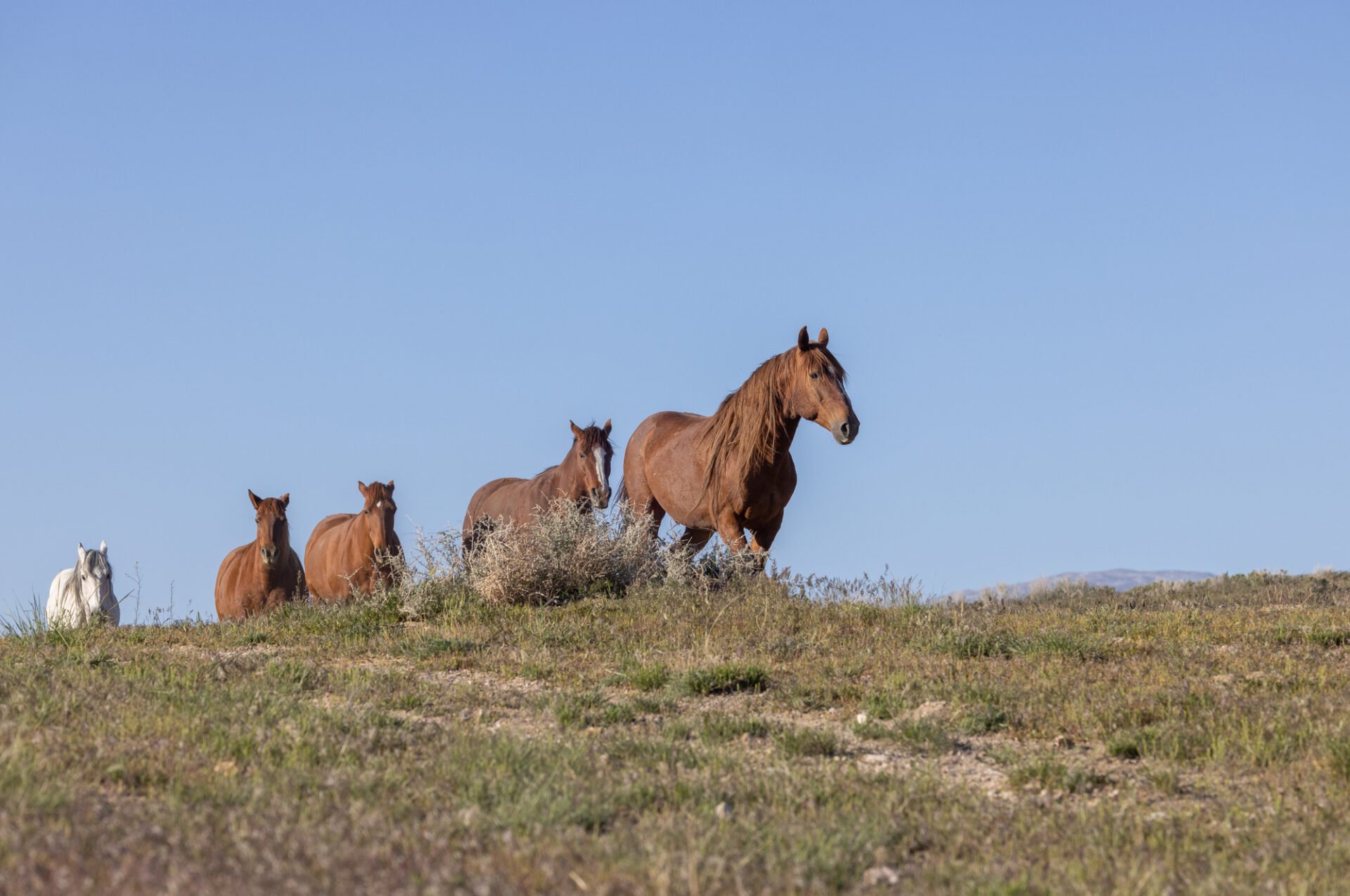
When a herd moves from where it is to where it has chosen to go, it naturally forms a diamond, and that shape holds three distinct roles.
- The lead mare leads from the front. Her role is direction and focus. She reads the environment and commits to a path, and the herd follows her not because she dominates them but because she has consistently demonstrated focused attention and an unwavering commitment to their welfare.
- The lead stallion leads from behind. His role is protection and unity. He holds the rear so that no member is left behind, watches for what is coming rather than what is already here, and keeps the group moving forward. He does not micromanage the herd. He makes it possible for the herd to move as a collective.
- The sentinels lead from the middle. They hold the horizontal points of the diamond, monitoring for threats and changes in the environment and relaying what they see to the front and the back. They also welcome new members and ensure they are properly integrated.
That third role is the one most organisations have no language for at all. Leading from the middle is not about holding your leaders accountable. It is about holding them capable, and demonstrating your intent to help them be successful. Horses never serve their leaders up as scapegoats; they guide and protect them, because that is what is in the best interest of the herd.
Horses Convene. Organisations Scatter.
June recently took a group of around thirty executives to Return to Freedom, a wild horse conservation area in California. Despite everything they had been asked to do, the group failed to pay attention, and the wild herd began moving towards them assertively. What June did next is the part of the episode I would rather you heard in full.
What happened afterwards is worth sitting with. Faced with uncertainty, the horses came together. They convened. They did not scatter. Now think about what happens in your organisation when something goes wrong. People retreat into their own function, protect their own numbers and wait for the noise to pass. Horses worked out a very long time ago that they are safer together than they are apart, and in a great many organisations the people inside them have not yet made that decision.
One line from that week has stayed with me since. In the horse world, followship is an act of leadership, because without following there is no completion. Watch a herd on the move and you will notice that the lead mare never turns round to check whether anybody is coming. The decision has already been made that they are going together.
Assign The Roles This Week
Working this way does not require you to restructure anything, and that is rather the point.
Take one challenge your organisation is genuinely facing, whether that is a difficult transition, a competitive threat, or a team struggling to collaborate. Gather the people involved and assign the diamond roles out loud. Somebody leads from the front. Somebody leads from behind. Somebody holds each side. Tell your team what you are doing and why you are doing it, and then give them explicit permission to lead from the position they are holding.
Do not wait for the perfect moment or the perfect team. Wild horses do not have the luxury of perfect conditions, and what they have instead are tested principles that hold up under pressure. Your people are already capable of leading this way. They are simply waiting for somebody to show them how.
So the question worth carrying into your week is this. When do you need to lead from the front, when do you need to lead from the side, and when do you need to lead from behind? And are you brave enough to let one of your team take the lead without first convening a discussion about whether they are permitted to?
Listen to the full episode of Impactful Teamwork for the four capabilities that sit underneath all three positions, and for what June actually did when a wild stallion walked towards her. Then take the Turbocharge Your Team assessment to find out which pillar of the Unbridled Teamship Roadmap is holding your leadership team back, so that you know exactly where to start.
Show Notes
01:19 The Diamond Model
01:47 Shared Leadership
03:40 Three Positions of Leadership
05:06 The Lead Mare
05:54 The Lead Stallion
07:13 The Sentinels
08:41 Return to Freedom
11:51 Followship
14:29 The Business Case
15:21 This Week’s Challenge